After the fairly modest event we had up north in Ibaraki, the Jungyo returns to Tokyo for one of its permanent events – the dedication sumo event at Yasukuni Shrine.
As John Gunning mentioned in his recent article about Jungyo, this event is free of charge, and allows about 6000 spectators to enjoy a day of sumo right at the heart of the big city.
The upshot of all this is that there were a lot of visuals on the ‘net, and you are in for one long post. Clear up a couple of hours of your time, folks. Prepare a bento box, visit the toilet, tuck in the kids.
Sports media outlets in Japan have been reporting that Hakuho has filed the documents to renounce his Mongolian citizenship with the Mongolian President’s office earlier this month.
This has been reported in the Mongolian press and from there it spread to the Japanese media. Hakuho was asked to comment on it today, but was very guarded. “I’m surprised it made the news at this early stage. This is a matter relating to both countries, so we’ll have to wait and see what happens. I can’t say anything one way or the other at the moment.”
That is the raw story, and here are my comments on it.
It is clear that Hakuho does not renounce his citizenship because he has something against Mongolia. Quite the contrary. This is simply a necessary step in order to obtain Japanese citizenship, as Japan generally does not allow dual citizenship.
Hakuho has permanent residence status in Japan, and does not need citizenship to live and work there. There are only two main differences between his current status and citizenship. One is the right to vote or be elected, and the other is the right to become a member of the NSK. And I think we can safely disregard the idea that he decided to enter Japanese politics.
Hakuho has been talking about becoming a toshiyori (oyakata) for a long time now. And not just talking – he has taken four uchi-deshi already. Uchi-deshi are recruits scouted by someone who aspires to create his own heya. While he is still attached to his original heya, those recruits also belong to that heya. Once he is eligible to form his own heya, however, his uchi-deshi are allowed to leave the original heya together with him. Hakuho’s Uchi-deshi include Yamaguchi, Ishiura, Enho and the most recent addition, Toma from Okinawa.
To become a toshiyori, one must have Japanese citizenship. And one must have it by the time one retires from active sumo. Get the citizenship a day after you have filed your retirement documents – and it’s too late.
However, due to the strong sense of patriotism most Mongolians share, and Hakuho especially so, due to being the son of a national hero, he has been putting it off. His father’s death last year removed one obstacle, at least as far as filial piety is concerned. However, he did not make the move in the months that followed.
All this inclines me to believe that he determined to start the process only when he feels his retirement is imminent or at least highly likely. That is, I believe the fact that he has taken this step now means that he is preparing to retire soon, or at least acknowledges a strong possibility that he will have to.
Of course, we are not talking about forced retirement due to any scandal. Even if any of the little things that he does that annoy the NSK so much drive them to force him to retire – he wouldn’t be needing that citizenship in such a case, as of course he wouldn’t be able to continue as a member if that happened.
So my own interpretation of the situation is that the injury he suffered at the end of Haru basho, snapping his coracobrachialis at the tendon it shares with the biceps, may be at the bottom of this move. He has opted not to have surgery for it. Although he says that this should not affect his ability to grab a mawashi, he knows full well that a Yokozuna can only avoid retirement by winning 10 bouts or more every basho, and there is a limit to the number of kyujo he can enjoy – especially if there is no prospect of improvement following them. I believe he hopes he can still win those 10 bouts for a while yet, but he is sensible enough not to bet his future career on it.
We have a short one today. The Jungyo temporarily leaves the vicinity of Tokyo and goes north to Ibaraki. Ibaraki is the former Kisenosato’s home turf, and indeed, the main attraction in this Jungyo event seems to be a visit from Araiso oyakata.
But let’s start with the beginning, as rikishi alight from the buses:
Akiseyama, that is – lovingly known among Japanese sumo fans as “Mountain of Bread”. Seriously, it’s amazing that he has such serious mobility issues and still manages to hold a pretty secure position in Juryo.
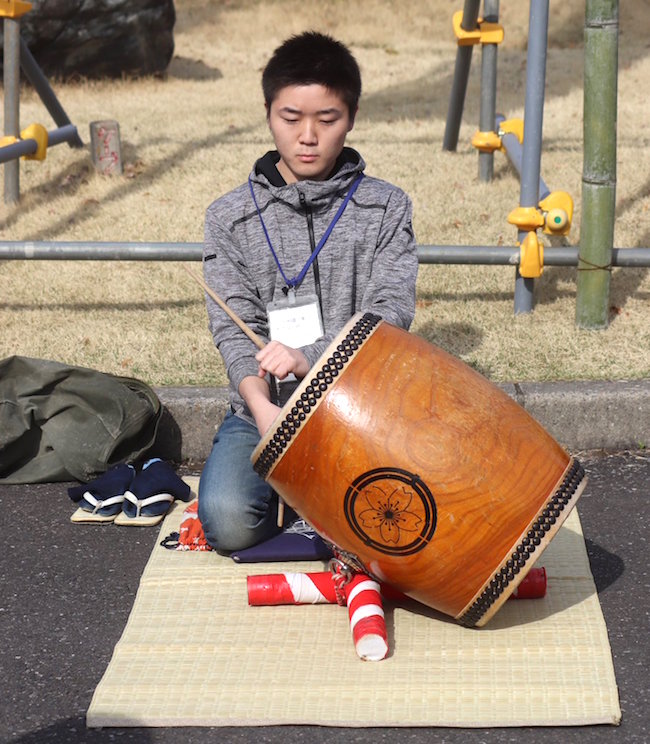
At the entrance, Yobidashi Hiromasa beckons us in with his drum roll:
This is, of course, the official photo, and in it Hiromasa is serious and dedicated. There is also an unofficial photo, though:
And in that, we see that he keeps his smartphone at hand, probably because drumming is awfully boring, and he also having relaxed chats with the incoming customers.
Since he persuaded us so nicely to come inside, let’s go and shake hands with a dreamy Arawashi:
Seriously, who came up with the idea that he is anything like Chiyoshoma?
And proceed into the venue to see some of the rikishi practicing along the walls. Takakeisho and Daieisho play drill sergeants to their tsukebito:
Oopsie-daisy. Funny little misfire there by Daieisho. But then he goes on to show some real leg exercise. Yes, Takakeisho, you are supposed to lift with your legs, not with your back. Daieisho has mighty strong legs.
In the hana-michi, Enho kind of practices with Onosho. Those two have been goofing together almost every day of this Jungyo.
But you can see that Enho is favoring his right shoulder. That’s still not in working order, apparently, though he did say to the press that he intends to go berserk in Makuuchi next basho. If he doesn’t get to do keiko, no berserking is going to cut it.
On the dohyo, we have Kaisei and Meisei. It’s not the same “sei”:
At this point, official practice is over, and the dohyo is vacated in favor of the usual shows. Some rikishi linger outside. This far north, the sakura is in full bloom, and what’s better than some keiko under the beautiful blossoms?
Indeed, Kotoeko and Kotorikisen look like they enjoy themselves thoroughly.
The Yokozuna put on their ropes to prepare for dohyo-iri and also to get a photo with the local sponsor:
In the past, I have heard some sumo fans who thought this formal kimono was something unique to sumo. It isn’t. This a mon-tsuki kimono set, which includes a kimono, a hakama (the gray semi-skirt thing worn over the kimono), and a haori (jacket, held together with a fine pom-pom). It’s Japanese traditional formal wear, and anybody in Japan may wear it on festive or formal occasions.
Anyway, the Yokozuna are back in the venue, and as Hakuho awaits his turn, he still signs autographs. Nobody is supposed to get near him when he wears the tsuna, and so his tsukebito keep a large buffer zone around him, but one of them brings the shikishi over to for him to sign:
The former Yokozuna comes inside to make a speech and thank his fellow Ibaraki people for their support throughout his career. As he ascends the dohyo, you can hear shouts like “Why did you quit?!”, “You look great in a suit!” etc.
He says that now without the pressure he can practice a lot more easily than he used to. “I never get tired”
The whole speech scene really entertains some of the sekitori waiting for their bouts. Especially the part you don’t see in the above video, in which he receives a large portion of the local delicacy… natto…
And… that’s it. I could find no hint of a bout nor even the list of matches of the day. So I have to leave off with the pin-up corner, today featuring:
How will these March rankings be reshuffled for May?
Do you want to know where your favorite rikishi is likely to be ranked for the Natsu basho without waiting for the official announcement on April 30? Never fear, the crystal ball is here. This time, I’ll give you my predicted banzuke right at the start, and then go through some of the biggest moves and uncertainties.
Haru winning records in green; losing records in red.
Biggest Rises
The biggest rise, 10 full ranks, belongs to Shimanoumi, who vaults all the way from Juryo 1 to Maegashira 8. After spending the better part of four years in upper Makushita and lower Juryo, Shimanoumi broke out with two consecutive 13-2 championships in the second division, and it will be interesting to see how he fares in his top-division debut. If my prediction is correct, he will be doing so at the highest rank in about a decade.
Other notable jumps belong to Ichinojo (M4 to Sekiwake), Aoiyama (M7 to Komusubi), Kotoshogiku (M8 to M1), Ryuden (M11 to M5), Yoshikaze (M12 to M6), and Chiyomaru (J1 to M12).
Biggest Falls
There are some doozies here. As you can see in my Juryo forecast, Chiyonokuni will fall from M12 into the bottom half of the second division, but this is due to injury, not performance. He’ll be joined there by M16 Yutakayama, whose drop is entirely due to performance. And Ikioi, who should have sat out the last tournament, will manage the rare feat of falling all the way from M9 to Juryo, becoming the highest-ranked rikishi to drop to the second division without sitting out since Toyohibiki three years ago.
Staying in Makuuchi but falling from the joi-jin into the bottom half of the division are Kaisei (M1 to M9), Nishikigi (M3 to M9), and Tochiozan (M4 to M12).
Best Banzuke Luck
Good banzuke luck refers to being either under-demoted or over-promoted given one’s rank and record as a consequence of other performances. In my forecast, such good luck is entirely concentrated at the bottom of the banzuke. Tokushoryu and Enho are very fortunate to be promoted from Juryo to Makuuchi at all, much less to be ranked M14, but the losing records by everyone ranked M14-M17 at Haru make it pretty much impossible to do anything else. And among that make-koshi crowd, Ishiura and Chiyoshoma are very lucky to cling to the bottom of the top division, and Terutsuyoshi would be ranked lower except for the fact that there’s no one to move ahead of him.
Worst Banzuke Luck
Actually, no ranking in my forecast is unreasonably harsh. The only rikishi with any right to complain are Onosho and Shohozan, and they only drop half a rank further than they “should.”
Biggest Question Marks
Let’s take it from the top of the banzuke.
Will Mitakeumi (7-8) get to stay at Komusubi with a half-rank demotion, or will that slot go to Kotoshogiku instead?
How far will Tamawashi (5-10) fall from West Sekiwake? Based on recent precedent for sanyaku rikishi, I’ve given him the mildest possible demotion, to M2e, but he could easily end up a rank lower.
How big will Shimanoumi’s promotion be? Ranking him at M8e seems pretty reasonable to me, but anywhere from M7e to M8w wouldn’t surprise me, and the banzuke committee could opt to go even lower.
How far will Kaisei and Nishikigi fall? I’ve given them relatively lenient demotions because of their places in the joi and the caliber of the opposition they faced, but one could easily argue for placing them a rank lower. The same can be said about Tochiozan, but it’s harder to see who could move ahead of him.
What will they do with the mess at the bottom of the banzuke? Having four exchanges between Makuuchi and Juryo makes the most sense to me, but anything from two (with Toyonoshima and Ikioi surviving) to five (with Takagenji trading places with Chiyoshoma) is possible. And when it comes to the precise rankings, any solution that avoids promoting someone with a losing record is a victory.
Tune in at the end of the month to find out how the crystal ball did!