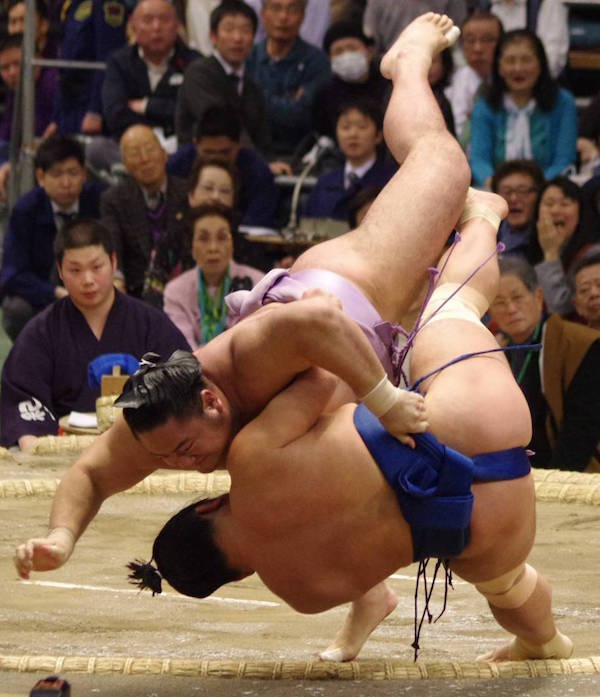
Act 2 is running on overdrive and rikishi are being shunted away from the yusho hunt, but our leaders – the undefeated Kaisei and Yokozuna Kakuryu – have yet to show any inclination to lose a single match. At this point, the main group of contenders are two wins behind, and we would need to see both men lose not just one, but two of their next six matches. Mathematically possible, but it could be a tall order.
The easier mark is, of course, Maegashira 6 Kaisei. But don’t be fooled, Kaisei is huge, powerful and seems to be quite determined to keep pushing forward. He is, in fact, a serious contender. Given that Kaisei has in the past served and even had a winning record in San’yaku, he is not a total stranger to the pinnacle of sumo competition.
But this entire yusho race pivots on Yokozuna Kakuryu. Once again we head into the second week with him as the lone Yokozuna, and undefeated. At Hatsu, he struggled in the second week because he sustained an injury to his ankle which robbed him of the ability to create any forward pressure. If we see him looking hesitant, or not moving strongly forward, let’s all do ourselves a favor and assume he’s hurt, rather than that he lacks the fiber, courage or endurance to be a Yokozuna. Frankly, in the back half of this year and into 2019, he may be the only Yokozuna that survives.
Day 9’s matches continue to act 2’s theme – the scheduling team are creating increasingly interesting pairings, working to create three distinct groups, the contenders, the defeated and the survivors.
(Abbreviated due to a shortage of time – apologies if I miss your favorite rikishi)
Aminishiki vs Hidenoumi – Uncle Sumo continues to suffer in Juryo. Now at 2-6, he is nursing a worsening of his injured knee. Likely a Hidenoumi pick-up.
Sokokurai vs Aoiyama – I am going to come out and say it. Aoiyama has only 2 losses. Had he not been robbed in the first week, he would be 7-1 and the second man in the chase group. No going back, but this would be the second time in 12 months that he would have been a contender. As it is, this match is strongly in favor of the Bulgarian.
Daiamami vs Asanoyama – The lone man with 7 wins steps off against Asanoyama. They are evenly matched at 3-3 over their career, but Daiamami is having a good basho, so I expect him to come in genki and strong.
Ikioi vs Kotoyuki – Mr 5×5 has been unable to produce any offense this tournament. I expect Ikioi to dispatch him with a wince and grimace of pain.
Abi vs Okinoumi – First meeting between these two, but it seems to have potential. Abi looked very good on day 8, but he will need to think fast as Okinoumi has a deep library of sumo knowledge and experience to draw upon.
Kaisei vs Ryuden – Odd fact that Kaisei has never beaten Ryuden, they have had two prior matches. But Kaisei is looking very genki, and this is almost a kind of cupcake for him, I would think.
Endo vs Tamawashi – This has the potential to be a great match. Endo’s ablative sumo on day 8 really caught my attention – he took a huge blast to land the grip he wanted, and he made his opponent pay. Tamawashi also likes to open big and open strong. They have had 12 prior matches, and they are split evenly 6-6.
Ichinojo vs Takakeisho – You can see the frustration on Takakeisho’s face now. His oshi attack will face a significant uphill struggle against the Boulder. Takakeisho has beaten him 3 times out of 4, so I think he has a plan, and it’s time to see which version of Ichinojo shows up day 9: The one that beat Takakeisho in January, or the one that lost in November.
Shohozan vs Tochinoshin – Power and speed are in ample supply when these two are fighting. Shohozan will stay mobile and try to keep the Hatsu Yusho Winner away from his mawashi. Tochinoshin holds a career advantage, but Shohozan is looking to uproot Tochinoshin from the hunt group and return him to the survivor pool.
Mitakeumi vs Kotoshogiku – Mitakeumi is firmly in the survivor pool now, and it’s somewhat frustrating as I think Mitakeumi is going to contend for higher rank at some point, but he just can’t seem to muster any bold forward drive. Kotoshogiku has the aura or make-koshi hanging over him already, but Mitakeumi seems like he may have been hurt day 8.
Chiyomaru vs Goeido – Actually the first time these two have matched, I am going to give the nod to Goeido, as he seems to have a stable build of GoeiDOS 1.5.1 running right now.
Takayasu vs Chiyotairyu – Both of these giant men like to open with a huge overpowering tachiai. If Chiyotairyu were a little lighter, I would suspect a henka, as it would be an easy way to beat Takayasu if you can pull it off.
Kakuryu vs Shodai – Kakuryu loves to exploit mistakes of his opponents. We can assume Shodai will be high off the shikiri-sen and Big K will take over and put him down.
Yesterday, on day 8, Takayoshitoshi arrived late, trotting up the hanamichi, as the bout between Yago and Takanoiwa was about to start. He was told off by the head shimpan.
The newly-minted sekitori arrived late because his newly-appointed tsukebito failed to cue him in time.
Sekitori are appointed a tsukebito upon promotion to Juryo. A tsukebito is the sekitori’s manservant. He carries his things and does all menial jobs for him. The duties include prompting the sekitori that it’s time to get to the arena – the sekitori should be there two bouts before his own in case the wrestler on his side loses, requiring him to offer the chikara-mizu to the next one on that side.
Following his late arrival, Takayoshitoshi lost his own bout. In a precarious position already, being at the bottom of the Juryo banzuke with only three wins to his name, he went back down to the shitakubeya (the preparation room), and there proceeded to cuss and beat up his tsukebito. This ended in a swollen face and a cut inside the mouth that caused the tsukebito to spit blood.
This was done in front of many witnesses, and the head of the crisis management department, Kagamiyama oyakata, as well as the head of the board, Hakkaku, were informed immediately. Takayoshitoshi and the tsukebito were called in for questioning, and Takayoshitoshi admitted to 2-3 punches.
It is morning time on Monday in Japan, and Takanohana oyakata has called in a press conference, apologized, and announced that Takayoshitoshi will be kyujo as of today. A special meeting of the board will be convened today to further question the parties involved, and deliberate an appropriate punishment.
Short one today, as I really have to get going with my packing…
Kotoeko toppling Terutsuyoshi
Let’s start with Takanoiwa vs. Yago. This was a lovely, prolonged bout, starting with a bit of tsuppari and continuing as a mawashi fight, with experience talking at the end.
A point to note on the sidelines: Takayoshitoshi arrives late and out of breath. His bout was the one after the next, and he should have been there on time in case his side lost, to give the chikara-mizu.
Josh included a video of Enho vs. Wakatakakage in his Ones To Watch summary, but Enho’s bouts are so entertaining, so here is the One-And-Only version, from a slightly closer angle:
Enho definitely needs to get himself at least a Terutsuyoshi body, and will need to do so in Makushita at Natsu, unless a miracle occurs.
Terutsuyoshi himself, as well as all the rest of the Isegahama Juryo rikishi, lost his bout today, to Kotoeko, whom he usually beats.
Yet another entertaining bout. I think they should create a division for rikishi under 175cm. It will be a marvel to watch.
At Makushita, the torikumi masters once again matched up zensho winners to test their strength and cull the race. Midorifuji met Nakazono:
The slight Midorifuji was no match for the massive Nakazono, and is now 3-1.
At Jonidan, I thought I’ll give you a glimpse of the oldest active rikishi – Hanakaze – who is nearly 48 years old – almost as old as myself! Here he is matched with Chida, a 20-year-old whose parents are probably younger than Hanakaze.
Nice to see his expression as he manages to escape the tawara that first time.
Finally, here are two Jonokuchi bouts, courtesy of the… Hattorizakura Channel… Yes, it’s a thing. And it features some darn high quality videos.
First, you won’t get away without Hoshoryu. Here he is pitted against one of the touchstones. That is, a rikishi who is extremely heavy, and whom you need good thinking and execution to beat. Kenho weighs 238kg, or so says the video title.
Hoshoryu tries a bit of tsuppari, then turns the big boulder around, and shows him the way out.
And since we are on the Hattorizakura channel, here is Hattorizakura’s 100th loss, at 4K, for your pleasure:
Note to lower division fans: I’m going to skip tomorrow, as I need to get ready for my trip. On Tuesday I’ll probably do a combined Juryo/Makuuchi post. After that, I’m on my way to Japan, and I hope I’ll be able to post stuff I have seen live on Saturday.
Daniel Ivanov – aka Aoiyama. Image from Radio Bulgaria
Reader and commenter Chankoman was kind enough to translate an interview with Aoiyama and post it in the comments section. But it’s a great interview, and it really sheds a lot of light on a rikishi who appears to be headed strongly up the banzuke once more. It was just too valuable to not share, so here is:
Reader Chankoman –
This is an interview with Aoiyama in may 2015 in his small hometown back in Bulgaria. A town, 20 minutes driving from my own hometown. Many things have changed, of course, he was asked if he considers marriage, where he is almost convinced that this does not seem to happen anytime soon. It turns out that he meets his wife shortly after this interview happens. There might be something new that you can learn.
R: Hello, Mr. Ivanov, welcome back home! A: Good to be back. R: How do they call you in Japan? By given name (Daniel), Aoiyama or …? A: Aoiyama. R: Aoiyama, even the common people in the society (not associated with Sumo)? A: Yes, they call me with my Japanese name. R: Let us remind our viewers, how did you end up in Japan, you actually started with wrestling, what happened that you ended up doing sumo? A: I started doing wrestling while I was 11 years old, I started in Elhovo (his hometown), I trained for year and half and at the age of 13 I joined Sport Club CSKA. There, I continued wrestling for 6 years. During that time, in 2004, I took part in one Sumo World Championship for Juniors.It was then when I got very interested in sumo. After this Junior World Championship, I wanted to join the Sumo team, but there were too many people and I continued doing wrestling because I still wanted to do wrestling too. This continued to the year of 2006, when I enrolled the National Sport Academy’s sumo program. There I started preparing myself for World and European Championships. And so on, I think it was in 2007 when Kaloyan Mahlyanov (Kotooshu) came back in Bulgaria and people told me to meet him. He liked me as a wrestler. R: So it was him (Kotooshu) who gave you a hand to enter sumo? A: Yes, it was him and my sumo trainer back then in the National Sport Academy. We talked with him (Kotooshu), he told me “You can come and see what it’s like, and try.”. At first, I was scared because you go to such a different country, you don’t know what it’s like, and I know it has been hard for him too, far away from relatives, from everything. But time passed and in the year of 2009, I decided to go to Japan, it was April I think. And until now, 6 years and half, I am there. R: Do you remember your first bout there? A: Yes, I do remember. R: What did you feel – fear, confidence …? A: I was very determined to win. My first bout was with a Mongolian and I won. In my very first tournament, I had to do 3 bouts and I won them all. After that, they put us in the lowest divisions. After that, the amount of wins we have it determines how fast we rank up. I did it for 11 tournaments; a year and 10 months. R: You were among the Rikishi who climbed up very fast in the ranks. A: Yes, they told me I am the seventh fastest person to reach Komusubi from the beginning. This took me 18 tournaments. Kaloyan Mahlyanov (Kotooshu) reached Ozeki
or 18 tournaments, the second highest rank in sumo. R: Which is the highest rank you ever reached? A: The highest rank I reached was Sekiwake, the 3rd rank. It was 3 tournaments ago while I was still Sekiwake, I think. And because a small injury, my rank dropped. But this last tournament now in May, I have 9 wins and 6 losses so I will be in “okay” position. I hope to have more wins in the next tournament too. R: What was the price for you to reach all this? Determination, confidence, working hard? A: Yes, certainly. I had to forget about many things. This is how it is – you join a school (heya) and they tell you “From now on, you will be here.”. So I started living with these people, I do not speak Japanese, I do not know how people live there, I do not know how life goes on – what people eat, how do they train. And we start learning, like a young child. R: The regime was very strict in the beginning? A: It still is, but we get used. R: But as you get a higher rank, you have more privileges? A: Yes, you do not get to do some things anymore: no more cleaning, cooking, laundry. They clean, cook and do my laundry now. R: How many helpers do you have now? A: Four. R: Every person does something specific, or they do it all together? A: Usually, they have to do specific things, but whoever among the helpers have a higher rank he “supervises” them. R: What do they help you with besides making your haircut? A: About the haircut, we have a special hairdresser. We have 3 in our school (heya). 3 for 30 people. One haircut takes about 15 to 20 minutes. R: What is different in the haircuts? A: Well, the first haircut, which is an “everyday haircut” which they do after training is called “Chonmage”. The other one is called “Oicho”. Oicho symbolizes the Sun, they make it look like the Sun. This one takes about 40 minutes to make. And this is for every bout. One bout takes about 5 seconds. R: It takes more time to have a haircut than a bout? A: Yes. R: Which was your longest bout? A: My longest bout was with one Brazilian, his name is Kaisei. It took about 2 minutes. R: This is a lot in sumo! A: Yes, a lot. It was very exciting and I won. Luckily! R: And the shortest? 5 seconds? A: The shortest was 2 seconds, I think. We hit each other in the beginning and I pushed him out. R: Do you have a favorite technique in sumo? A: Well, when you look up my profile, it says which techniques I use the most. The first one is called Oshidashi, with both hands you push the opponent out of the dohyo. R: Tell us something interesting about the Japanese culture, what impressed you the most there? A: What impressed me the most … they are very compact. Everything is under the clock. When something has to happen, it happens in the exact time, everything is under control. There is nothing that can go wrong. That is how they do it. Everything, the lifestyle, the food, the training, everything is in the specific hour. R: Not just the people who do sports? A: No! Everything is like this. R: Did you get used to their food? A: Yes, I got used to the food. The lifestyle – so-so. While I was still in the school (heya) it was not comfortable because I had to live with 25 other men, mostly in one room. But since 6 months, I live alone, in a rent. Whenever I have to train – I go there, when I’m done – I go back home. R: What do you tell to your teammates about Bulgaria? A: Only good things. I am telling them how beautiful Bulgaria is. Now there are many Japanese who come here for tourism. When I go out (in Japan), I meet people who are telling me “I was in Bulgaria!”. So I ask them, “Did you like it?” and they all say “Yes!”. “Delicious food, beautiful nature, very welcoming people!”, that is what they tell me. We Bulgarian people are welcoming indeed, while the Japanese … not that much. R: They are colder. A: Not just colder, a lot colder in this regard. R: Let us go back to the competition again. What is to happen next? A: This year, we still have 3 tournaments remaining. My next tournament starts in July 12, in the city of Nagoya. September – in Tokyo and the last tournament for the year, in November in Fukuoka. R: How long does one tournament last? A: 15 days. R: What do you need to achieve in order to rank up? A: Out of 15 bouts, you need to win at least 8, a positive result. More wins, more ranking up. More the losses, the more you go down. R: The best Rikishi in Japan, Hakuho. You have met him several times. A: Yes. This is one of my dreams that I want to achieve and I will give my best to do it until the end of the year. R: You will meet him in the next tournament? A: Yes, we will have a bout next tournament, hopefully, if we are healthy. R: Tell us about Kotooshu, about your friendship. He is not an active rikishi anymore, only a trainer. A: Yes, he is co-trainer in his old school (heya) where he was as a competitor. He teaches the younglings to do better in sumo, and not only. He teaches them to be better people. R: Can you change your school (heya)? A: No. You start in one and you finish there. However, there are small exceptions like in my case. My first heya’s trainer (oyakata) passed away and the heya was abandoned. When this happens, the trainer’s wife decides which heya will all rikishi enter now. So it happened, I got transferred to the heya I am in right now. R: Only in such cases, a transfer can happen? A: Yes, only in such cases. Or if the trainer retires and the heya is abandoned if there is no other trainer who can continue taking care of the heya. R: Do you still meet Kaloyan (Kotooshu)? A: Yes! Now we meet a lot more, he has a bit more free time, I am not living in the heya. I have more time for myself, for friends. R: How do you like to spend your free time, after the tournaments? A: Usually we train all the time. After every tournament, (and they are 6 in total, every 2 months) we have one week vacation. What can you do for one week … You meet friends, you try to take a small break from sumo, from work. To refresh, like now I am in Bulgaria. For one week. It is a small amount of time, but I hope this will refresh me and give me some strength so I can perform better in the next tournament. R: You met some young wrestlers here in our school. The same school where you started with wrestling. What did you tell them, what is important in sport? A: Well, they are still young. They still take it as a game, I was just the same. One thing that improves the person is the will. The will to succeed. Everyone can say “I can’t do this.” and it is all over. When you can’t you have to start looking for a way to do it. This, by the way, I learned in Japan. When you can’t do it, start thinking for a way that will make it work. You should not be saying “I can’t do this”. This is the easiest escape. What is hard is to succeed. R: What are your plans for far in the future, do you want to become a trainer? A: Right now I am considering this, I was proposed to do it. Usually, few years before retirement a rikishi is asked if he wants to do it, to remain as a coach. They ask if I intend to do something else if I intend to go back to my home country … But to become a trainer (oyakata), I have to renounce my Bulgarian Citizenship. I must become Japanese. This is why I am still considering it. I don’t know what will happen … It’s a hard question. R: How many years usually a rikishi competes? A: Well, here is the thing, most people ask this question but the real answer is – until one feels fit. There is no age limitation. The more one can compete … I want to compete for many more years, God willing. R: You feel fit? A: Yes. I feel good. R: You still have many peaks to conquer? A: Yes, exactly. There are still more steps in the ladder. R: Do you do anything before a bout, like a ritual? A: Usually, whenever I win, for example, I remember what food I ate and the next day I eat the same food. If I win again, the same thing – I eat the same food. I do not really do it on purpose, this is just how my brain wants me to think – “If you do not eat this again you will lose!”. Or calling my parents – I call my parents and I win. If I do not call my parents – I lose. Something like this. R: You have to call them every time! A: Yes, I have to! R: Now here in Bulgaria, as a Christian, do you believe in God, is there any force that helps you? A: Yes, I do usually pray for the most important – not to have injuries, the tournament to end up with a good result and I pray for good health for my parents. If everyone is feeling well, doing well, this gives me strength. R: How about your personal life, have you considered marriage, children … A: Hm … they ask me all the time, but … I think I haven’t met the right person yet. One to stand beside me. I don’t know … When the right time comes. R: How do you say in Japanese “Thank you for this interview.”? A: Kono interviu wa arigato gozaimasu. R: I will not be able to repeat it! Thank you, in Bulgarian! A: Thank you too! R: We hope you will keep up representing Bulgaria in the sumo! A: Thank you, certainly!