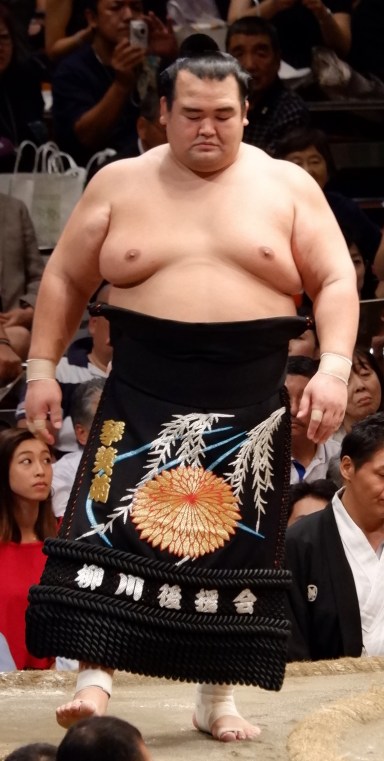
Yesterday, it was Kotoshogiku. Today, Sokokurai had his danpatsushiki. He also retired back in 2020 but has already made a very quick, successful transition into running his own stable. Arashio-oyakata has ushered the younger Onami brothers, Wakatakakage and Wakamotoharu, into the top of Makuuchi. Josh recently wrote about his success in more depth, here.
Sokokurai Prepares for His Bout
This is quite the transition since he had to lawyer up and fight just for the right to continue his career. He’d been caught up, wrongfully, in the match-fixing scandal and banned from the sport in 2011. While that all worked its way to a decision, he sat out of the sport for more than two years, staying in shape the whole time. When he won in 2013, he didn’t get to ease his way back in from Jonokuchi…they threw him back in with the wolves of Makuuchi, giving him the rank he had earned back in 2011.
Their success featured highly in the retirement ceremony with a bout between the brothers — something we won’t see in a tournament unless they’re somehow both vying for the title in a playoff. Wouldn’t that be exciting?!?!
He’s setting up a real family operation with his nephew and the Tanji brothers joining the Onami brothers. We’ve seen several other stables pick up brothers as recruits, like Gaia and Byakuen at Tatsunami-beya and I wonder if it’s a growing trend in order to increase recruitment.
Kokugikan hosted the retirement ceremony for Ozeki Kotoshogiku on Saturday. His 18-year career started in maezumo back in 2002, along-side his buddy and high school sumo rival, Toyonoshima. (Toyonoshima actually claimed the Jonokuchi title in their debut, with a win over Kotoshogiku along the way. Toyonoshima then beat Kotoshogiku in the Jonidan playoff to earn that yusho.) His career as an active wrestler came to an end near his Fukuoka hometown in November 2020. But his career as a coach has just begun, using the name Hidenoyama-oyakata.
We can blame the pandemic for the nearly two-year delay in getting his haircut, so newer Tachiai readers may not have seen Kotoshogiku compete at all, much less during his prime. On the dohyo, he was known for his sujo-pleasing “gabburi-yori,” hip-thrusting technique. What it boiled down to was this: he’d wrap his opponent up, ideally with a firm belt grip but sometimes just a big ole bear hug, and use those massive thighs to basically hop his opponent out of the ring. He also had a signature component of his pre-bout ritual where he would do this deep back-bend, the Kiku-Bauer (菊バウアー), his version of the イナバウアー.
(There was a famous German figure skater named Ina Bauer-Szenes who was known for deep back bends in the late 1950s. Her signature move, the “Ina Bauer”, was adopted and popularized by Japanese Olympian, Arakawa Shizuka in the early 2000s.)
The Chrysanthemum, featured here on his kesho mawashi, is a motif tied closely to Kotoshogiku because it comes from his surname, Kitutsugi (菊次) . The kanji character, 菊, is the character for Chrysanthemum and is pronounced either Kiku or Giku. It resonates with Japanese because of the symbolism of the Kiku and its ties to the Emperor. The Chrysanthemum Throne refers to the Japanese monarchy. Those learning Japanese will be familiar with how sometimes pronunciation changes, often to make it a bit easier to say, so Kiku becomes Giku. Try to say “Kotoshokiku” three times fast and you’ll see it’s just a bit easier to say, “Kotoshogiku.”
The Ozeki
In a testament to his longevity, his Ozeki run actually dates way back in 2011 as sumo returned to action after the match-fixing scandal forced the cancellation of the Osaka tournament and the calamitous Tohoku earthquake. That May, Hakuho was the lone Yokozuna while the Ozeki ranks were full with the likes of Kaio, Kotooshu, Baruto, and Harumafuji. Three tournaments and thirty-three wins later, Kotoshogiku debuted as Ozeki in front of his home-crowd in Fukuoka in November 2011. Kisenosato was promoted to Ozeki at the next tournament, and the two rivals would fight it out as fellow Ozeki for the next six years, until Kisenosato was promoted to Yokozuna and Kotoshogiku was demoted to Sekiwake.
I would be remiss not to mention his demotion and the grudge some sumo fans hold toward Terunofuji because of it. At the Haru-basho of 2017, he had already been demoted to Sekiwake after a terrible 5-10 showing in January. With five losses and three days remaining in the tournament, Kotoshogiku had to win out in order to reclaim his Ozeki rank. On Day 14, Kotoshogiku faced Terunofuji. The henka resulted in Kotoshogiku’s sixth loss making the demotion permanent.
Kotoshogiku continued to fight for nearly four years as a rank-and-file wrestler. There were some hopes that Toyonoshima, then down in Makushita and fighting to regain a slot in Juryo, might be able to rise high enough back into Makuuchi for the two rivals to fight again. But it was not to be. Toyonoshima was demoted back into Makushita in early 2020 and retired early in the pandemic, his last competitive bout during the Silent Basho. Kotoshogiku stayed until November when he closed out his career back in Kyushu.
The Delayed Retirement
A retiring Ozeki deserves a party. So Kotoshogiku waited until he could throw a proper party at Kokugikan. That means jinku singing, hanazumo, and hair-dressing demonstrations. It’s helpful to be a part of a storied stable like Sadogatake where there are three Makuuchi wrestlers so that no matter where you were in the audience, you got a pretty good view. Each of them also did their own versions of the Kiku-Bauer backbend as tribute to Kotoshogiku.
The retirement ceremony also featured a host of his old friends and rivals taking turns cutting his hair, including Toyonoshima, Kisenosato, Hakuho, and yes…Vader (aka Terunofuji). [Vader’s helmet was supposed to evoke a Japanese kabuto and I think of it every time I see Terunofuji’s oicho-mage.] His sons faced him on the dohyo for his final bout. His home Sadogatake beya also featured an 8-way round robin among their Sandanme and Makushita wrestlers, won by Kotohaguro. Up-and-comer Kototebakari lost to Kotohaguro in the first round.
I was glad to see a fitting tribute to Kotoshogiku’s great career. There’s quite a lot of coaches there at Sadogatake, with a couple of high-rankers, so I am curious if he will be able to wait to inherit the stable or whether he will have to branch out on his own, sooner. If anyone has any insight into the the future of Hidenoyama, please drop some knowledge in the comments. Tomorrow, we will see another retirement ceremony, this time for Sokokurai.
Wednesday the banzuke committee drew up the new ranking list for the Kyushu tournament. While the details will be held close to the vest for the next several weeks they did announce the promotions to Juryo, as is customary. Congratulations to Roga and Tsushimanada!
Roga (Futagoyama-beya) has spent the last two years near the top of Makushita, grinding for that elusive promotion slot. Even in the “promotion zone” kachi-koshi is not quite good enough, sometimes. But he’s made a good run with four consecutive kachi-koshi. He aims higher, hoping to catch up to his contemporaries, like Hoshoryu, Oho, and Kotoshoho who’ve already established themselves in Makuuchi.
Tsushimanada (Sakaigawa) also found himself grinding it out in Makushita after his amateur sumo career at Nihon University. He looks up to his senpai, Myogiryu and Sadanoumi. He picked up his fifth win against Gonoyama, clinching his own promotion in his final bout*. Good luck to you both!
* Edited to reflect that I was probably wrong about Gonoyama getting demoted.
Congratulations to Tamawashi on a well-deserved second yusho. He displayed Yokozuna-grade sumo on his way to a powerful 13-2 championship, two wins clear of anyone else. Along the way, he defeated the Yokozuna, all three Ozeki, two Sekiwake, and all of his direct challengers for the yusho head-to-head. In doing so, Tamawashi becomes the oldest modern champion, only the second man to win two yusho without reaching Ozeki, and arguably the best wrestler below that rank of his generation. Oh, and he’s accomplished all this while being the only sekitori and one of only four rikishi in his heya—the other three being his Makushita-ranked brother-in-law and two recent recruits in Jonidan. This is how the man has to train:
Now, let’s take a look of what the results of the Aki basho mean for the November rankings. With only a handful of wrestlers posting more than 10 or fewer than 5 wins, this is generally not a banzuke with a lot of big movements, unlike last time.
Yokozuna and Ozeki
Y1e Terunofuji will remain the sole Yokozuna, though I expect to see him on the banzuke but not on the dohyo in Kyushu. O1e Takakeisho (10-5) will stay at that rank, as will O1w Shodai (4-11), who will be kadoban and need a winning score to avoid losing his rank. O1w Mitakeumi (4-11) will lose his rank after just 4 basho and fall to Sekiwake, where he will have one chance to record 10 wins for immediate re-promotion.
Sekiwake
S1e Wakatakakage (11-4) will stay at that rank and aim higher. With his 19 wins at Sekiwake in the past two basho, an Ozeki promotion in November is not out of the question, especially given the current state of that rank, but it would probably take a yusho with a score of 13-2 or better. More likely, a good November performance would lay the foundation for a January promotion. S1w Hoshoryu (8-7) will join Wakatakakakage at the rank, while Mitakeumi will occupy S2w.
Komusubi
This is where things get interesting. K2w Kiribayama (9-6) clinched a stay at Komusubi but didn’t do enough to warrant a promotion to Sekiwake without a slot being open; I expect him to move to K1e. The other incumbents, absent Abi and 6-9 Ichinojo, will drop into the rank and file. That leaves one open slot, but more than one rikishi has a strong claim.
One is S2e Daieisho (7-8), as no Sekiwake with that record has been dropped to maegashira since 1992, and we’ve had about 50 instances since then. The other two are our champion, M3e Tamawashi (13-2), who seems impossible to deny, and the equally compelling surprise of the basho M1e Tobizaru (10-5), as no top maegashira with a winning score—much less double-digit wins—has missed out on promotion in over 50 years. So I am pretty sure that we will have four Komusubi, although their order is debatable. As that is already the most we’ve ever had, M4w Takayasu (11-4) is in all likelihood out of luck.
Upper Maegashira
Who will be fighting the named ranks in Kyushu? The list starts with Takayasu, who should be joined at M1 by M2e Kotonowaka (8-7). The slot Kotonowaka vacates is the only option for M2w Meisei (8-7). Then, it gets a little crowded, with M1w Midorifuji (7-8), M3w Ura (8-7), M6e Wakamotoharu (10-5), and M5w Sadanoumi (9-6) all deserving to be ranked at least M2, and Ichinojo also in the mix. In any case, these 5 in some order will fill out the ranks down to M4w. His late collapse will see M8w Hokutofuji (10-5) ranked just outside the joi, followed by the other double-digit performers, M10e Nishikifuji (10-5) and M12w Ryuden (11-4).
Juryo-Makuuchi Exchanges
There are three cut-and-dried exchanges. M15w Tsurugisho (5-10), M14w Yutakayama (4-11) and M16e Mitoryu (5-10) all have irredeemable rank-record combinations. Their places in the top division will go to the top three promotion contenders in Juryo: Azumaryu, Kagayaki, and Atamifuji. We’ll see if Azumaryu can finally manage a winning record in his 9th basho in the top division. Atamifuji’s debut is one of the more eagerly awaited ones in recent memory.
Final-day losses left M15e Terutsuyoshi (6-9) and debutant M16w Hiradoumi (7-8) on the bubble. Hiradoumi has a slightly better numerical case to stay, but also went make-koshi at the lowest rung of the Makuuchi ladder. At least M16w should still be on the next banzuke. I don’t think both will go down, as there isn’t a good enough fifth promotion claim in Juryo. The question is whether either trades places with J3w Tohakuryu (8-7), and if so, which. Tohakuryu’s case isn’t all that strong, and given his negative style of sumo, I wouldn’t mind it if he missed out.
Juryo-Makushita Exchanges
Dropping are lovable but ineffectual thruster J13w Tochimaru (2-13) and absent J5w Asanowaka (unless his withdrawal due to post-COVID effects rather than active infection receives unexpected leniency). Their spots should go to Ms1w Roga (4-2) and Ms4e Tsushimanada (5-2).
J12e Gonoyama (6-9) is on the bubble. He lost to Ms4w Tsukahara (4-3) on senshuraku, but it’s not clear whether this was a true “exchange bout.” With a marginally demotable score, Gonoyama could keep his spot anyway, or it could go to either Tsukahara or Ms5w Shonannoumi (5-2). Unlike other banzuke decisions, Juryo promotions will be released in a couple of days, so this mystery at least will be solved. For the rest, we’ll have to wait until October 31 (Halloween!). In the meantime, please leave your thoughts and questions in the comments.