Soon after each basho, the NSK holds the banzuke meeting. Although the full banzuke will be published only days before the next basho, the names of promotees to Juryo are announced immediately. This is done in order to allow new promotees and their heya to get ready with the necessary equipment for a sekitori: A silk mawashi (also known as a shime-komi), with stiffened sagari, a kesho-mawashi and an akeni (luggage box), as well as a tsuke-bito (manservant), a private room, and so on.
The list of juryo promotees includes Tachiai favorite Enho.

Enho has achieved sekitori status within the minimum required six basho (mae-zumo, followed by one each in Jonokuchi, Jonidan, Sandanme, then two in Makushita), and is only the fourth rikishi in modern history to do so.
“I couldn’t believe it”, said the shin-Juryo. “A result of 4-3 at Makushita #6 is not usually enough for promotion, though I had a tiny hope and my heart was throbbing. Today as I came out of the bath I was told I made it. ”
Enho has been appearing in zanbara, untied hair, throughout his career and has only achieved a young chon-mage for Miyagino’s senshuraku party. Now he will need more time yet to grow his hair for an appropriate oicho-mage.
Another new promotee to Juryo is the “elder” Taka Twin, Takayoshitoshi:
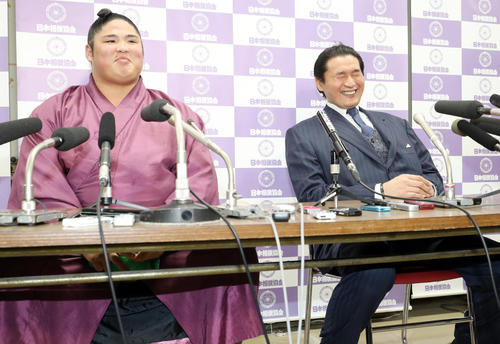
His advance to sekitori status marks the first time in history in which there is a pair of active sekitori who are twins.
Hint: to tell Takayoshitoshi from Takagenji, look for the mole on Takayoshitoshi’s right lip. If they smile an open smile, Takagenji will display a gap in his front teeth.
The other promotees to Juryo are all former sekitori. They include Yago (Oguruma beya), Terutsuyoshi my main man (Isegahama beya), Shimanoumi (Kise beya), Tobizaru the flying monkey (Oitekaze beya), and Akiseyama (Kise beya).
There has not been such a large group of Juryo promotees (7 in total this time) since the great purges of 2011 when nine rikishi were promoted to Juryo.


 Yokozuna entries have a width of about 2.8cm. Ozeki entries – 2.5 cm. Sekiwake and Komusubi – 2.1 cm. The remaining width of the frame is divided evenly into the number of maegashira on that side.


