These tours are a popular method of outreach for the Japan Sumo Association and it is a great way for fans to meet and mingle with their favorite wrestlers. I had the fortune of going to one such event this past summer. So, this picture is not from Miyazaki, but from Tachikawa. But I hope it gives a sense of the atmosphere. If you would like to read about my experience there, I wrote about it here. I encourage you to check out that post for background on Jungyo.
The Kyokai posted the schedule for the first event on Twitter. Takerufuji will be sitting for the oicho-mage demonstration and Terunofuji will have his rope tying demonstration and dohyo-iri, though he will not participate in bouts.
As for this tour, it starts in Miyazaki prefecture and will end in Okinawa. Miyazaki prefecture is a well known agricultural region in Japan. It’s known in particular for high-grade wagyu beef. That beef is celebrated in the Miyazaki Prefectural Government presents the Miyazaki Governor’s Award, which is a trophy in the shape of a cow. The winning wrestler receives the meat from one head of Miyazaki fine cattle, as well as chicken and produce.
This tour will also pass through Oita prefecture, whose Shiitake Cooperative provides the famous trophy filled with mushrooms. It will then go around Kyushu before passing over the Kanmon strait to Shimonoseki and hoofing it over to Hyogo and Osaka before flying down to the sun and sand in tropical Okinawa.
That brings us to the main reason I highlight these tours for foreign fans. They are a great way to get out of Tokyo and to see other areas of the country.
Interactive Tour Schedule
I’ve put an interactive map below with a tour schedule. This version allows the user to page through the Days as the tour progresses. I’ve defaulted to Day 2 so you can see the first leg of the long, circuitous path from Miyazaki to Okinawa. There are arrows on the left side, underneath “Tour Day”. Click on the right arrow to cycle toward Day 15 and the left arrow to go in reverse. Any feedback you have is appreciated.
In past posts, I have given a bit of background to our trip. In Part I, I talked about why now is a good time to go if you are on the fence or have not been before. In Part II, I briefly mentioned different areas of Tokyo with a focus on the Ryogoku area and why the Koto and Sumida areas are good “home base” areas for sumo fans. In this post, I will finally get down to business and start talking about our trip.
The top item on my list has been meeting with Honda Masataka of Ekoin temple. I was scouring through the Kyokai’s financial reports one weekend, as one does, and I noticed a few small property holdings listed among their assets. In particular was an entry for a tiny speck of Tokyo with the title, “Chikarazuke”. When I looked it up, it was a stone monument, like the Ozeki and Yokozuna stones. Except this monument is right down the street at a little temple called, Ekoin.
The Ryogoku Pilgrimage
For those sumo fans making their pilgrimage to Ryogoku, the arena at Kokugikan will likely be top of your agenda. It’s Sumo HQ, where all of the Tokyo-based tournaments take place, home to the Sumo Kyokai’s museum and gift shop, Sumo School and the community clinic, and it also hosts many amateur tournaments and non-basho events, like the retirement ceremonies of top wrestlers.
However, it’s not always open.
So, what else is in the area? There are a number of heya, the closest of which is Nakamura-beya which is basically a block over from the McDonalds. Speaking of Maccas, my son and I learned that there actually is a sumo-worthy reason to go to a McDonalds in Japan: macarons. They’re not exactly Pierre Hermes – which you can find in the Mitsukoshi Department Store – but still tasty and much less expensive. 190 yen each! There’s also the Chanko Kirishima and Ami offers up Isegahama-style chanko.
The spot that I would like to highlight and to get onto every fans’ list of Ryogoku sites to visit is the Ekoin Temple. This location is significant because the sumo that we know today evolved from sumo competitions held here at the Temple. As I mentioned above, it is home to the Chikarazuka. This Sumopedia episode from the NHK briefly mentions it and its importance to the history of sumo.
Getting There
Finding it is easy. If you come out of the main gate at JR’s Ryogoku station, Kokugikan is on the right. But most of the restaurants, hotels and business-happenings in Ryogoku are to the left. Cross under the railroad tracks and the road that runs in front of Kokugikan basically dead-ends at the Temple. Given the large buildings around it, though, the Temple entrance might seem a bit “non-descript.”
While I like walking around at night, I came back during the day.
Once you walk through the front gate, there’s a rather lengthy driveway which takes you to the main building. As you approach the building, pay special attention to the monument on your left. That was a gift from the Sumo Kyokai and is referred to as the Chikara-dzuka, or stone/mound of power (力塚). Rikishi go there to pray for strength.
Also on the left, a bit further in are stone memorials, those for individuals (including a Yokozuna or two), as well as larger monuments to past disasters. Historically, when a disaster struck Japan the government would send remains of the victims to be interred here. That practice ended after World War II and the effort to separate church from state. So, there is no memorial marker here for the earthquake this year, the earthquake and tsunami of 2011, the Kobe earthquake, etc.
History and Significance
You see, this temple was established after the great Meireki fire of 1657. Remains were sent here and the temple workers would tally and inter the dead. The total number of dead from that disaster is up to 100,000 people. Afterwards, the site hosted kanshin sumo events. These were very popular and became a regular thing and sumo tournaments were hosted here in temporary structures, built for the tournament. (Doesn’t that sound like the process of re-construction we know and love today?) In 1909, they moved into a fixed structure, “the Old Kokugikan” here.
The temple has many Ukiyo-e prints of the time, like the one on the NHK video. You will notice the popularity of the events. The folks at Ekoin would count the streams of people coming over the adjacent bridge to watch the sumo and gage its popularity, and how much they need to prepare. As you can see from these pictures, the events hosted many people, some people even being hoisted onto their friends’ shoulders to watch the action.
The bridge in the background is the famous Ryogoku bridge. That has been featured in many ukiyo-e artworks of the Edo and Meiji eras. For fans of ukiyo-e, it is worth noting that the Hokusai museum is just down the road and a few streets over is Hokusai-dori. Apparently, he was a product of Sumida-ku. One wonders if he was one of these massive throngs of people. Or if, like so many of us today, he struggled to find tickets to get in!
Just inside the building there is a foyer or genkan with a great dragon emblazoned on the ceiling, very similar to this one, featured on Tokiwayama-beya fabric from a few years ago. You’ll notice what looks like wooden lattice-work on the ceiling. Go stand in the middle of the room, under the dragon’s head, and clap. The echo will intensify and reverberate creating this wild effect where it sounds like many people clapping. Your friends, standing a few feet away will not hear the echos. Only those in the center will hear it.
Beyond this entryway is the room where services are held. There’s a lot of ornate decorations and an amazing statue of buddha and what looks like a framed mizuhikimaku over on the left. When I asked, “This is beautiful, may I take a picture?” Our host replied, “if I don’t know what you’re doing, I won’t know.” He then left the room and returned a few minutes later. (I shyly took one quick photo.)
Mizuhikimaku (水引幕)
I mentioned that the room had what looked like a framed mizuhikimaku. “Mizuhikimaku” are curtains that separate our world from the sacred world. Different colors have different meaning. White or black signify death. Other colors indicate other meanings, like celebration.
You are familiar with a purple one, emblazoned with the crest of the Sumo Kyokai (Association), that hangs above the dohyo during honbasho. There is a similar one for the Sumo Renmei (Federation) and this picture of Ekoin temple. The purple indicates the presence of something pure and sacred inside the curtain.
If you want to see the one for the Sumo Renmei, see below. This is from Kokugikan when they were hosting a middle school championship. The mizuhikimaku for those events is this cool claw-looking symbol for the Renmei. To be honest, it is probably barely discernable in that tiny picture, though. But next time you see a sumo event, check the curtain for which crest is on it. If it’s a sakura, that’s the Kyokai.
As you leave the temple, walk to your right and go behind the building next door with the Seven Eleven. Underneath the dozens of parked bicycles, you will notice a metal circle. That is the location of the old dohyo. When there is new construction in the area, like this apartment building, the construction teams often find remnants of the old venue.
I will sprinkle future posts with more pictures that I took, as well as of the ukiyo-e which were provided to us by the good folks at Ekoin.
Jūshoku
A word about the head of the temple, Honda Masataka. He is a very warm, engaging, knowledgeable guy, and particularly eager to discuss the history of the temple and its relationship to sumo. I encourage everyone to check out the temple. For those of you who speak Japanese there is a bit more outreach available. He is hosting events there open to the public for 500 or 1000-en.
My Japanese language skills are far from proficient so my wife was my translator. I must say she was thrilled to learn more about the history and significance of a place so close to her home. She’d been a bit nervous going to the interview. After we arrived, she was briefly freaked out when the assistant said she would return with “Jūshoku,” but he put her at ease very quickly.
Closing
In sum, I think sumo fans would like to add Ekoin Temple as an attraction on their pilgrimages to Ryogoku. They also have this amazing gallery online. Those of you who are amateur sumo enthusiasts — or even just fat bloggers with shirts that are a size or two too small — may want to pray for strength at the Chikarazuka. Strolling around the grounds is very peaceful and there is a lot of very interesting things to see. There is a decent amount of signage and materials in English. Leave comments if you have any questions.
I chose to revisit Kochi last time because of Toyonoshima and his retirement. This time, I chose Toyama prefecture for news of Asanoyama’s promotion to Ozeki. While there are several top rikishi from neighboring Ishikawa, Toyama has had very few. Asanoyama, who shall be known as Baiyaku-zeki (売薬関), is the first Ozeki from Toyama in more than 100 years. While I loved Kochi and hope to visit again on my next trip to Japan, I think Toyama will be first.
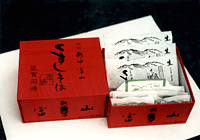
The top ranks of makuuchi, (Yokozuna & Ozeki) have been getting beaten up lately, as we discussed in our latest podcast. Perhaps it’s appropriate that a rikishi from Toyama would come knocking with his first aid kit to save the day! The area, particularly the region of Ecchu, is known for its pharmaceutical industry. It did not get famous this way because it sounds like someone sneezed. “Ecchu!” (I’m here all day, folks.) Traveling salesmen from Ecchu (gesundheit) would roam Japan selling their kusuri-bako (薬箱), lit., “medicine boxes.” These salesmen were known as baiyaku. There’s a great history written (in Japanese) at the Toyama prefectural government website.
Early in the Edo period, the Toyama domain had come under financial strain and its daimyo, Maeda Masatoshi, turned to traditional medicines as a novel way to boost local output. The area is still known for it today, though the kusuri-bako now look much more like the common first aid kits we know today.
Sometimes, I wonder if the universe is somehow reading my mind. While drafting this article, a #SumoTwitter account that I follow posted this, featuring the firefly squid of Toyama prefecture. She also mentions a friend from Toyama prefecture who claims residents and fishermen are able to catch them with buckets.
As the kids say these days, “I’m shook.” The harvesting of firefly squid from Toyama bay is a huge annual event that is featured in the first episode of this amazing series called, “Prime Japan.” It is included with Amazon Prime but worth a watch even if you don’t have it. During the plague-era we’ve been catching up on our movie-viewing. We were inadequately prepared for such full-on food porn so my wife had to grab fresh sushi for us for lunch from our local Japanese market. That only fanned the flames, however.
The firefly squid is bio-luminescent and these massive schools come close to the surface in Toyama-wan to spawn at the same time each year. The documentary showed what the friend of @OneLoveLulit described: massive shoals of squid and fishermen catching them en masse. Later in the episode, the host got to try some at an awesome looking sushi restaurant in the Nishiazabu area of Tokyo. This particular establishment featured a unique aged sushi. Personally, I love squid but I have never tried firefly squid. It is on my list for next time we’re there. Despite Asanoyama’s bio-luminescent personality, I do not think hotaru-iku is a catchy nickname.
Sites
Handmade Work In Progress
Sites to go see in Toyama prefecture include the Toyama Glass Art Museum. This is beckoning me, personally, because I have been learning how to make stained glass and fused glass artwork. After this heap of broken glass pictured above gets put in the kiln, it will be the first annual Tachiai Award, which I hope to present to the winner sometime after we’re allowed out.
There is somewhat of a sumo connection to glass art and glass-making that I plan to explore in a future post. As you know, I usually only need some tangential relationship to sumo to post about something. In and around the Sumida-ward home of Ryogoku and the Kokugikan are many Edo-kiriko workshops. The Edo-Kiriko Co-operative Association is in close-by Kameido. The tweet below shows a great example of an Edo-kiriko glass….that sure makes my attempt look amateurish. Wow, I have got work to do.
Back to Toyama prefecture…Another site of interest is the Toyama Prefectural Museum of Art and Design. The building and grounds themselves are worthy of a visit but many of these exhibitions look fascinating. I take it as my life’s mission to be “seriously unserious.” Or is that funnily unfunny? Probably just unfunny.
When Asanoyama, aka 売薬関, debuted in early 2016, there were only three other wrestlers from Toyama prefecture in Ozumo. One, Kazunofuji from Isegahama-beya joined at the same time but did not last the year and did not get out of Jonokuchi. So, until 2018 it was Asanoyama and two sandanme grinders from Arashio stable, Hidano and Tsunekawa. Because Asanoyama began his career with a privileged spot in Sandanme, he actually began his career as the top-ranked Toyama wrestler of the time.
Sakabayashi joined in 2018. After a streak of five successful kachi-koshi tournaments to start his career, he seemed to hit a wall in Sandanme and fell back to Jonidan. He has recently climbed back into the Sandanme. Tomiyutaka joined Tokitsukaze-beya in 2019 and also reached Sandanme but was kyujo from the silent basho in Osaka and will be in Jonidan if he (and sumo) come back for the next tournament. Lastly, Kirinohana made his maezumo debut during the Silent Basho for Michinoku-beya. Now is a much less than ideal time to begin a career in sumo so I hope these young men (Kirinohana is 15) do not become disheartened and leave the sport. We will be keeping an eye on their progress.
For the second installment of this G2KS series (catchy acronym), I cast about far and wide, from Hokkaido to Mongolia to Bulgaria, and even next door in Yamaguchi and Tottori. I am hesitant to do two in a row so close to each other so I really wanted to hop to a different region without hitting any of the big name locations* or any which I’ve previously written about just yet. However, the clincher was the recent news of Toyonoshima’s retirement so I have decided, yet again, to visit Kochi.
* 都道府県- Not all of the locations are “prefectures”. Tokyo is a “TO”, Hokkaido is a “DOU”, Kyoto and Osaka are “FU”, and the rest are “KEN”. So, we get Tokyo-to (東京都), Hokkaido (北海道), Osaka-fu (大阪府) and today’s topic, Kochi-ken (高知県). This doesn’t count foreign wrestlers whose shusshin are announced as the name of the country.
I have written about Kochi before because I have visited there and loved it. The people we met there were warm and hospitable and the scenery was beautiful. Since my wife and I were traveling with our son we didn’t have a chance to check out the nightlife but they had great restaurants, markets, and several attractions. Kochi was supposed to host an Amateur Sumo Tournament in March but it was cancelled due to the evolving SARS-CoV-2 (d.b.a. Coronavirus) situation. See the linked article for a rundown of all the Amazumo cancellations so far.
Geography
Heading south of our original stop in Shimane prefecture, we cross over the Inland Sea to the island of Shikoku. Kochi prefecture covers the southern portion of the island, is mountainous, and draped in forests. It is a narrow prefecture with a large coastline bounding Tosa Bay.
Sites
Prior to the Meiji Restoration around 1870, the province was home to the Tosa Domain. Though Commodore Perry’s black ships arrived off the coast of far off Shimoda, the event sent shock waves throughout Japan’s politics…kinda like how the Coronavirus is today. Debate raged around the nation and threatened to split it apart as loyalties for the Emperor in Kyoto and Shogun Tokugawa in Tokyo divided families. Many people wanted to keep the foreigners out while others saw no choice but engagement. The Shogun’s regime was referred to as the bakufu (幕府). Many of you kanji learners will recognize “幕” as the same character for “maku” as in makuuchi (幕内) and makushita (幕下), sumo’s top division and third division…and “fu” from our above discussion of “Osaka-fu.”
Many heroes of the period were from the area, most famously the pistol-packing ronin, Sakamoto Ryoma. There are several statues of him around Kochi city, the capital, including this big monument down along the shore, looking out at the sea. While he died a hero in Kyoto, assassinated at the Omiya Inn, others have less savory reputations and are remembered as brigands. In Kochi, aside from the monument there are a couple of great museums which explores his life, his role in the Meiji Restoration, and his legacy — which includes founding the first corporation in Japan, the Kaientai, which would become part of Mitsubishi which itself was founded by another famous man from Tosa, Iwasaki Yataro.
Andy and his son stroll along the Shimantogawa
Another key figure of the time, and as we will see someone with more relevance to sumo, was the head (or 大名 – lit. “great name”) of the Tosa Domain, Yamauchi Toyoshige (山内豊信). You will recognize the first character of Toyoshige (豊) from many shikona, including Toyonoshima and his former Tokitsukaze stablemate, Toyoshimizu. The characters for “Tosa” (土佐) also feature prominently in shikona for men from Kochi.
An interesting boat in the Shimantogawa
With all of this history rooted in Kochi, there are several museums to go visit, as well as statues. The monument to Ryoma, shown above, is at the Katsurahama beach south of downtown. Kochi Castle is considered one of the finest in the country. Nearby markets provide amazing fresh local fruit, vegetables, and fish since agriculture and fishing are two of the prefectures’ largest industries. Shishito, okra, and citrus fruits like yuzu are among the crops grown. I love yuzu. I eat it, I drink it… If I could take a bath in yuzu, I would….oh, wait, that’s a thing!!
Shimantogawa, or Shimanto river, is a brilliant blue river that snakes through Kochi’s forest-shrouded mountains. The river is the source of local shrimp, crabs, and other freshwater seafood while Tosa Bay and the surrounding ocean are a rich fishery. Kochi is famous for Katsuo tataki which is a seared bonito. The tataki method of cooking supposedly originated in Kochi. Okinoshima Suizan corporation on the island of Okinoshima offers what looks like amazing examples of katsuo tataki seafood.
Newly retired Toyonoshima and his Tokitsukaze stablemate, Toyoshimizu, are from Kochi. Both are from the southern tip of the prefecture. Toyonoshima is from Sukumo while Toyoshimizu is from Tosashimizu. I wonder where they got their shikona from? Tosayutaka is another former makuuchi wrestler from Tokitsukaze. And, for a brief period in 2011, Tokitsukaze-beya had another Kochi native, Takanoumi.
Tochiozan is currently Kochi’s highest-ranking wrestler. He debuted in 2005 and blazed a trail through the lower divisions, not registering a make-koshi record until he reached the rank of Maegashira 4 in 2007. For much of his career Tochiozan had another Kochi-born stablemate with him at Kasugano named Tochinohama, until 2018. Both are listed as from Aki city in eastern Kochi-ken.
Takasago-beya features another collection of Kochi-born wrestlers: Asaazuma, Asanojo, and Asanotosa. Asanotosa is from the city of Tosa and Asaazuma is from Susaki, both near the center of the prefecture, close to the capital, Kochi city. Asanojo, on the other hand, is from Aki in the eastern portion of the prefecture. The kanji for Aki is 安芸.
Onomatsu-beya has another trifecta of Kochi prefecture wrestlers, Tosamidori, Tosaeizan, and Genki. Herouth has a great set of videos from Tosamidori’s Jonokuchi yusho. He had fallen to Ura in his last bout meaning 6-1 and three-way play-off, which he won. He’s been climbing through Jonidan so far this year with solid kachi-koshi records. Tosaeizan made his return to Sandanme during fan-less Haru, and after his own 4-3 kachi-koshi will climb a few ranks when the banzuke is released this weekend. Genki, on the other hand, hit the Makushita joi wall hard and is sliding back down into the meat of the division.
Chiyonoumi is Kochi’s young gun. The Kokonoe stable stud began his career with yusho in the first three divisions before an injury setback…right after I wrote this article. Have I found the first victim of the Andy-hype curse? I am glad to see he is back on track and he should be a regular in the salaried ranks. Nankairiki, from Kise stable, had a great Haru going 7-0 in Sandanme, only losing in the playoff…to Ura. Lastly, Wakakaneko is a new recruit from Kochi city for Nishiiwa stable. At 15 years old and 95 kg, it will be interesting to see where he is seeded this weekend.
There will be a lot of banzuke drama in Kochi this weekend. Tochiozan faces certain demotion into Juryo and Chiyonoumi may fall out of the salaried ranks altogether but will likely just hang on to the bottom rung. Will Wakakaneko be ranked near Hattorizakura?