Jungyo Newsreel – Day 3

🌐 Location: Nara, Nara prefecture

The Jungyo continues through Nara prefecture, and I have to admit I’m disappointed that none of the photos and videos I collected for this report and the previous one contains any deer. 🦌☹️

So let’s get right inside the venue, and take a look at the rikishi practicing. Meisei is having a nice chat with onosho while taping his feet up.

Onosho himself is both taping and stretching.

Mitakeumi and Enho seem to be practicing or discussing moves or doing a mock fight, except…

…except, what is Enho doing rubbing his face against Mitakeumi like a cute little kitten? Is that some new kimarite we have never heard of before? “Kawaisugitaoshi” – “takedown by cute overload”?

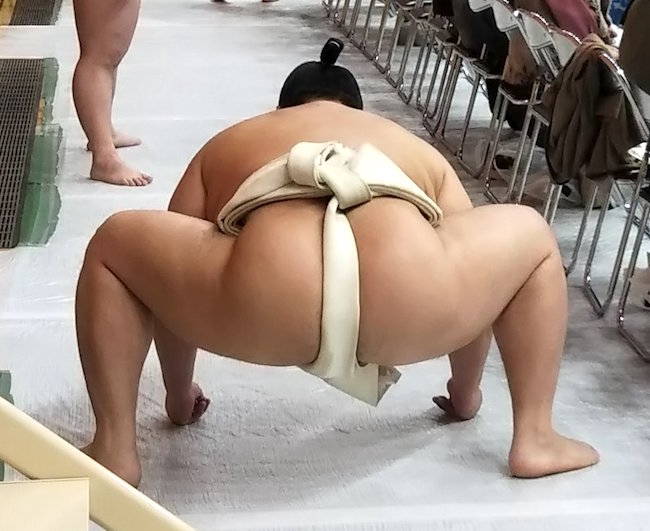
Takanosho is doing… what? The tweet says he has been repeating this for 30 minutes!

Please don’t tell me that this is a yoga exercise like the one Daishoho did yesterday.

As Kakuryu arrives at the Dohyo, everybody stands in line to greet him. Terutsuyoshi, however, takes his sweet time chatting with the Yokozuna

Once left on his own, Kakuryu practices squats with a load. Very nice posture:

Midway he becomes conscious of being filmed. That yokozuna is too cute for his own good. You’re supposed to be stoic, and preferably scary, yokozuna!

Daiseido is doing butsukari, borrowing Tochinoshin’s furry chest:

Tokushoryu, who was born and raised in Nara city, got butsukari from a Yokozuna yesterday. So today he has to settle for… Gagamaru?

Poor Tokushoryu – doesn’t get the privilege of a Yokozuna or Ozeki pushing him around, and has to contend with Gagamaru’s weight.

By the way, although on the official web site Gagamaru is described as weighing 199kg, it’s a lie. He usually asks for his weight not to be published, but it did leak out last year and it was 212kg. Yep, he weighs more than Kaisei.

So here are some practice bouts: Tomokaze vs. Abi, Onosho vs. Nishikigi.

Yeah, once Nishikigi got his mawashi, Onosho was doomed.

Practice over, it’s time to hit the shower. Or, in Japan, the shower and then the bath. And this means going out of the venue and off to some sento or onsen. And that’s exactly when fans want attention, autographs or photos taken. Takakeisho obliges, but also poses and directs the photographer:


“The lighting is better from that angle”

Tamawashi is all in a hurry and will not respond to fan requests… except ones shorter than 100cm.

It’s time for the Juryo dohyo-iri, and a very freezing Uncle Sumo makes his way to the venue.

Nice shoes. Match the fringe of the kesho-mawashi.

In fact, everybody is cold. Well, maybe not Tsurugisho:

Interesting Paisley design there, Enho. Must be a hand-me-down from Hakuho… shortened by about half a meter.

Once the Juryo dohyo-iri and torikumi are done, it’s time for the Makuuchi dohyo-iri. And listen to how Takakeisho is announced:

Makuuchi dohyo-iri usually ends with an Ozeki. “And last… shin-Ozeki, Takakeisho, comes from Hyogo, Chiganoura beya”.

Takakeisho said in an interview a couple of days ago that the Jungyo finally made him feel that he is an Ozeki for real. It’s not just the dohyo-iri. Look how he travels these days:

Yes. That’s a limousine. It’s good to be Ozeki.

That’s a mon-tsuki kimono he is wearing, so he is not just arriving from the hotel, though. He probably went on a shrine visit of some sort.

Time for the bouts! And what better time is there to goof around? We are back to our comedy duo from yesterday, Nishikigi and Shodai. This time, Shodai is the one fooling around with Nishikigi’s glasses while Nishikigi is busy signing autographs.

Nishikigi is off to face Onosho, and Shodai takes this opportunity to…

…smear some of the suki-abura from his head on Nishikigi’s glasses’ lenses. Nishikigi’s tsukebito, as you can see, is not going to refuse a sekitori.

When Nishikigi returned, by the way, he put on his glasses, and exclaimed the Japanese equivalent of WTF… then proceeded to wipe them on his tsukebito’s yukata. At that point, Shodai was already near the dohyo, so no way to take revenge… but karma prevails, and Shodai loses his bout with Daieisho. He returns all crestfallen and runs crying into mommy’s arms.

“Mommy” in this case being Tamawashi. “There, there, don’t cry, there’s a good boy”.

Now, this generous Twitter user (her nickname is “stomach ache” for some reason) who took most of the videos both of day 2 and day 3, took some bouts as well this time. We start with Yutakayama vs. Kotoeko. Inexplicably, three kensho flags are paraded for this bout.

As a result, this develops into one of the most gachinko (honest) matches in the Jungyo. Kotoeko gets the envelopes.

Mitakeumi vs. Tamawashi

Whoa, whoa, what was that? Tamawashi grabs da mawashi? And wins?? This bout was very entertaining.

Takakeisho vs. Tochinoshin:


Tochinoshin lands his favorite grip and it’s all over for the shin-Ozeki, who must be tired from that limousine ride.

Finally, Kakuryu vs. Goeido.

Mmm. The Yokozuna is not in a great shape.

So here is the high-quality summary video from Nara TV:

Tokushoryu: “Nara is said to be the birthplace of Sumo, but as there seem to be many people yet who have no idea of it, I will work hard to change the perception”.

Tokushoryu was honored with a Makuuchi bout today (vs. Chiyoshoma, as you can see in that video).

Finally, we are in our pin-up corner. It was a hard choice today. Should I have gone with the standard, namely, Enho?

Still not participating in the matches, but that doesn’t stop him from spreading fairy dust all over the venue. But maybe I should have gone with Arawashi instead:

Cute crow’s-feet. Nice teeth. Definitely pin-up material.

But I want to introduce you instead to a rather anonymous guy from Nishikido beya, serving, apparently, as Mitoryu’s tsukebito. He’s 20 years old, and this must be his first or second Jungyo. His name is Toshonishiki.

Definitely not Takarafuji

Jungyo Newsreel – Day 2

Venue at Gojo. A scrolling display is set up to show news of the new era name

🌐 Location: Gojo, Nara prefecture

Today the Jungyo hit the first of two stops at Nara prefecture – in the small town named Gojo, population 35,000 or so.

Early morning, and the sekitori started arriving at the venue through the cold weather:

You can see Yoshikaze and Enho there, but they are still not participating in any bouts. Yokozuna and Ozeki, by the way, may sleep separately from the rest, and therefore also arrive separately:

So let’s go around the venue and see what kind of practice the sekitori are having. Sadanoumi is giving his tsukebito some light butsukari practice:

And Daishoho is… what is Daishoho doing, exactly?

Maybe we shouldn’t show this video to anybody under 18.

At the Dohyo, Goeido is doing push-ups. Sort of:

If you recall, practice sessions on the dohyo consist mostly of moshi-ai sessions (winner decides who to call next), interspersed with higher-ranking rikishi going on the dohyo and giving all those who practiced in the most recent session some butsukari. So here are Mitakeumi and Shodai in one of those butsukari intermissions:

After the low-ranking rikishi finish their practice, it’s time for the sekitori to take the dohyo. Again, moshi-ai sessions commence – and Takagenji takes his (evil) twin.

…and this is exactly why Takanofuji is going to be out of that white Mawashi come Natsu.

The sekitori moshi-ai sessions are also punctuated by butsukari sessions. Today’s star is Tokushoryu, a native of Nara prefecture. He therefore gets treated to some Yokozuna butsukari. Kakuryu does the honors:

And here is the moshi-ai session between Tochiozan and Okinoumi, then Tochiozan and Aoiyama, then Aoiyama and Kagayaki:

Eventually, noon arrived, and with it the message to the Japanese nation: the new era that starts May 1st will be called “Reiwa” (令和). The whole nation is very excited about it, and head gyoji, Shikimori Inosuke, sets out to write the auspicious characters on a couple of large signs.

Gyoji serve as clerks when they are off the dohyo and out of their shiny outfits and headgear. They practice calligraphy from the moment they enter the sumo world (which, like rikishi, can be as early as age 15). Gyoji are in charge of writing all those signs with rikishi names on them, writing the banzuke, and so on. And of course, the head gyoji is also the head calligrapher.

And so, the Yokozuna were able to pay their respects to the name of the new era:

Kakuryu, “Reiwa”, Hakuho

By the way, the sharp-eyed kanji readers among you may notice that the nobori behind Kakuryu still has “Kisenosato” on it.

The sign (I think actually a second sign) ended up being hung inside the venue in time for the Makuuchi bouts.

Back to sumo activity, it was time for dohyo-iri. And Nishikigi was pestering Shodai incessantly:

Can’t exactly fathom why the old ladies believe that Shodai screaming is “kawaii!”.

Nishikigi wouldn’t let go of Shodai even after dohyo-iri:

Nor just before the bouts:

Literally, not letting the man go:

So here is a summary video with some actual bouts:

That is, Ishiura getting a mighty wedgie from Toyonoshima, Tokushoryu showing Takagenji why he may not yet make it to Makuuchi this time, and Takakeisho repeating his senshuraku performance with Tochinoshin.

Finally, how about a pin-up boy? I give you… Endo!

What do you mean “how do you know this is really Endo”?

Jungyo Newsreel – Day 1

Here we are back with the Jungyo reports, where we will be trying to quench some of your thirst for sumo while we are all waiting for the next tournament.

As a reminder, the Jungyo is a regional tour the sekitori – accompanied by tsukebito and support crews – go on during four of the even-numbered months, bringing sumo to small towns and giving the locals an opportunity to see some keiko and some sumo and interact with favorites.

The Haru Jungyo traditionally begins with a dedication at Ise Grand Shrine – the holiest shrine – located in and around Ise city, Mie prefecture.

🌐 Location: Ise Grand Shrine, Mie Prefecture

As this was a day of dedication ceremonies, it did not include the usual “shake hands with your favorite rikishi” part. The brass had to go perform ceremonies at the main shrines. The Ise Grand Shrine is actually a cluster of shrines. The two main ones are called Naiku and Geku. Ceremonies took place in both locations – about 6km apart.

The tail of the procession – current Ozeki, followed by a tiny shin-Ozeki

The rikishi and NSK brass offered prayers. The rikishi – including some additional san-yaku – were then purified by the priests

Not an easy walk wearing a kesho-mawashi!

The Yokozuna performed dohyo-iri, and the top six san-yaku rikishi then performed synchronized shiko – “sanyaku-soroi-bumi”, similar to that which is performed on senshuraku.

Heading back to more secular activities, perhaps I should start with a list of kyujo. Five rikishi are absent from the Jungyo altogether: Takayasu (lower back issues), Ichinojo (herniated disk), Ikioi (general wreck), Chiyonokuni (Still recovering from operation), and Juryo’s Hakuyozan (who broke a bone during the basho if I’m not mistaken).

In addition, some rikishi are present but not participating in torikumi. Hakuho is basically doing only dohyo-iri and ceremonial functions. Enho had issues with his shoulder through most of the basho and is not on the torikumi list, and Yoshikaze is also not on it.

Enho. Present but not fighting.

Some of the above will be back in action at some point in the Jungyo, and I’ll try to keep you posted when they are.

Back at the venue – which, as you can see in the photo above, is an open facility, but very nicely set up – keiko started out early in the morning. Here is Kiribayama’s practice with Shimanoumi:

This is the only practice video the NSK Twitter account offers – probably because its subject, Shimanoumi, was the star of the day, being a native of Shima city, Mie prefecture.

Following practice, the lower rank bouts, as well as the usual performances of Shokkiri, Jinku, and drum demonstrations took place, giving the sekitori time to have lunch and wear their kesho mawashi. Some kids got their photos taken with ozeki:

Ozeki are like quarks. Here we have a down ozeki, a strange ozeki, and an up ozeki.

This photo-op is what replaces kiddie sumo these days.

Waiting for dohyo-iri back in the venue was no mean feat. The venue, as already mentioned, is an open facility. And it was cold.

Even cold-blooded Mongolians suffered, never mind the poor, suffering Brazilian.

Some fans took the opportunity to ask for autographs and the like. Sadanoumi impressed the fans as he signed an autograph with a proper calligraphy brush:

While the lower divisions’ – including Juryo – bouts took place in the usual fashion, Makuuchi was split into two sets of competitions. The bottom to middle rikishi were in normal, one bout per rikishi fashion. The top, however, participated in an elimination tournament called the “Senshiken”.

In the previous Haru Jungyo, Hakuho won the senshiken, and so he had to hand back the yusho flag:

As top yokuzuna, he also led the senshi vow (“senshi” (選士) here is a word that means “chosen”, but I suspect it’s used as a combination of “athlete” (選手, “senshu”) and “rikishi” (力士)).

Of course, he did not participate in the tournament, and Kakuryu (as well as the Ozeki) were soon eliminated from it.

Eliminated Yokozuna not forgetting to low-five little hands

The winner of the tournament was Hokutofuji – a career first – and the jun-yusho went to Nishikigi.

Hokutofuji’s first yusho

Hokutofuji also won a nice little mini-shrine, which I believe is actually a useful item in a heya.

This concluded the event at Ise. Here is a summary video from Mie TV.

I think Kotoyuki’s bout with Chiyomaru is funnier than Shokkiri. Of course, Shimanoumi stars in this summary, but there are several other torikumi for your pleasure.

Ozeki Prediction Contest

We learned the other day that Takakeisho was denied an Ozeki promotion, for now. Obviously, it’s on him to perform well in March with potential promotion for May. In truth, he’s not the only wrestler on an Ozeki run. He’s also not the only wrestler on an Ozeki run with the strength of a yusho on his résumé.

Tamawashi enters the next tournament on 22 wins of the 33 “standard”. 10 wins is likely a bubble number but it would be very difficult to deny promotion with a repeat of 13 wins, however unlikely that may seem. Add Tochinoshin’s kadoban status to the mix and the composition of the Ozeki corps could be very different by summer.

So, how many Ozeki do you think there will be in May? Guess the correct number of ozeki for the May tournament, in banzuke order, and I will select one of the correct answers and send you a T-Shirt of your choice from the Tachiai Shop. My guess is five Ozeki: O1E Goeido (+ Osaka yusho), O1W Tochinoshin, O2E Takayasu, O2W Takakeisho, O3E Tamawashi.