どすこい、京の相撲ガール 全国初の創部から丸2年
Because of today’s headline, I will unveil the Tachiai Hiragana Guide. One could think of hiragana as the Japanese alphabet, except that it’s not an alphabet. It’s easier than an alphabet because it’s purely phonetic. No letters that sounds like other letters and nothing changes when combined with others. No diphthongs.
These are the only sounds in the Japanese syllabary. 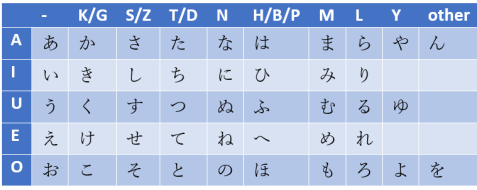 Everything comes from these sounds. There are a few tricks which I will point out but hiragana is covered in Japanese 101 and it should just take a week. Take two columns per day and you’re golden. I’ll talk briefly about the “dots” below. They change the pronunciation to the appropriate hard sound: so k becomes g, s becomes z, t becomes d, and h becomes b. H becomes P if there’s a little circle like degrees (°).
どすこい、
Today’s article starts with sumo related hiragana. Dosukoi is a sumo word and is also the name of the French blog run by Yohann. It’s one of those things that doesn’t have a translation; it’s just a sumo-related exclamation. I wanted to draw particular attention to this article because it shines a light on a topic close to me: sumo and women. We also see “dots,” kind of look like double-quotation marks, that changes TO into DO.
April is when the new school year starts in Japan. For these students in Kyoto, they’re starting another year as the female sumo club at their high school in Kyoto.
My daughter loves sumo. She’s four, wrestles her older brother (8), and she is brilliant. She’s super aggressive so sometimes I feel sorry for my son because he has to hold back since he’s about 1.5 times her size. So, naturally, I’d love to encourage her. Right now, the only real option around here will be judo, if I can find a good dojo around here. Another option is MMA and getting her into an octagon…but no. I’m not going to let either of my kids go that route. If they want to try physical sports, fine, but I don’t want them developing CTE or eating tons of creative like a former roommate of mine.
京の相撲ガール
Anyway, back to the article. The first kanji is the first character of Kyoto and you should quickly recognize “sumo.” The next little bit will introduce us to katakana which is an alternative writing system for the same sounds that you get in hiragana. It’s just that if you see something written in katakana, it usually means it’s a foreign loan word. In this case, we’ve got ga-ru (ガール) or Japanese pronunciation of “gal.” Again, we see “dots” next to the katakana KA that turns it into GA.
The katakana KA looks like the hiragana KA but unfortunately not all of the katakana are so similar to their hiragana counterparts, as we see with RU (ル) which bears little resemblance to the hiragana version (る). Don’t try to learn both at the same time. Get hiragana down cold, then move on to katakana. I’m a little surprised that they would use the term ga-ru in the headline. It’s quite informal.
全国初の創部から丸2年
Nationwide, this is the first division of its kind and they are starting their third year of the program. The first two kanji, zenkoku (全国), means nationwide. You should recognize the third kanji by now from several of our lessons, hatsu, “begin/start”. The circle looking thing afterward is the hiragana “no.” You also saw it in the first part: 京の. I’m not going to get into the meaning of these particles much, yet, I really just want people to recognize the hiragana first. Next is the kanji for when they established the club. Don’t worry about this kanji: (創). But, remember this kanji: (部). It’s pronounced BU and it’s used in this case as club but it can also be used in an office setting as a division or section. It’s pretty common. In this case, SOBU refers to the group that started this club. (丸) Maru means circle, but when used with a time frame like two years, ni nen, 丸2年 means two complete years. The two years were able to go through the entire cycle. Hiragana (から) “kara” means from, so “from the club’s establishment, two complete years.”

