Short one today, as I really have to get going with my packing…
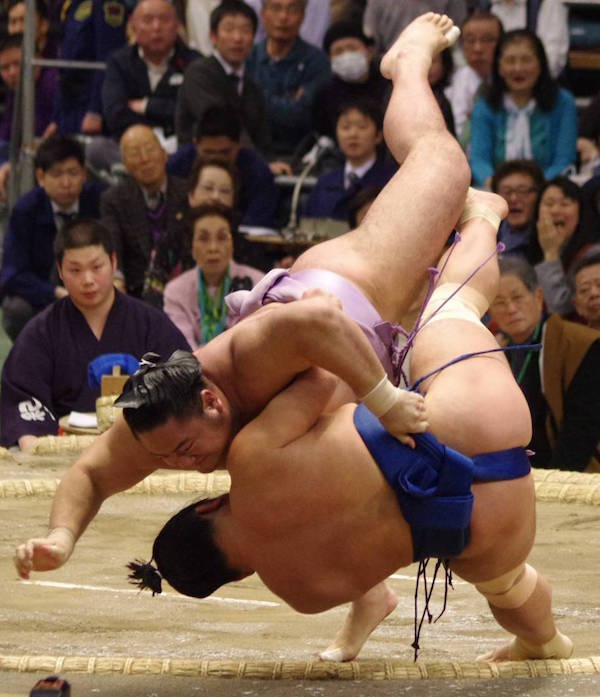
Kotoeko toppling Terutsuyoshi
Let’s start with Takanoiwa vs. Yago. This was a lovely, prolonged bout, starting with a bit of tsuppari and continuing as a mawashi fight, with experience talking at the end.
A point to note on the sidelines: Takayoshitoshi arrives late and out of breath. His bout was the one after the next, and he should have been there on time in case his side lost, to give the chikara-mizu.
Josh included a video of Enho vs. Wakatakakage in his Ones To Watch summary, but Enho’s bouts are so entertaining, so here is the One-And-Only version, from a slightly closer angle:
Enho definitely needs to get himself at least a Terutsuyoshi body, and will need to do so in Makushita at Natsu, unless a miracle occurs.
Terutsuyoshi himself, as well as all the rest of the Isegahama Juryo rikishi, lost his bout today, to Kotoeko, whom he usually beats.
Yet another entertaining bout. I think they should create a division for rikishi under 175cm. It will be a marvel to watch.
At Makushita, the torikumi masters once again matched up zensho winners to test their strength and cull the race. Midorifuji met Nakazono:
The slight Midorifuji was no match for the massive Nakazono, and is now 3-1.
At Jonidan, I thought I’ll give you a glimpse of the oldest active rikishi – Hanakaze – who is nearly 48 years old – almost as old as myself! Here he is matched with Chida, a 20-year-old whose parents are probably younger than Hanakaze.
Nice to see his expression as he manages to escape the tawara that first time.
Finally, here are two Jonokuchi bouts, courtesy of the… Hattorizakura Channel… Yes, it’s a thing. And it features some darn high quality videos.
First, you won’t get away without Hoshoryu. Here he is pitted against one of the touchstones. That is, a rikishi who is extremely heavy, and whom you need good thinking and execution to beat. Kenho weighs 238kg, or so says the video title.
Hoshoryu tries a bit of tsuppari, then turns the big boulder around, and shows him the way out.
And since we are on the Hattorizakura channel, here is Hattorizakura’s 100th loss, at 4K, for your pleasure:
Note to lower division fans: I’m going to skip tomorrow, as I need to get ready for my trip. On Tuesday I’ll probably do a combined Juryo/Makuuchi post. After that, I’m on my way to Japan, and I hope I’ll be able to post stuff I have seen live on Saturday.
Daniel Ivanov – aka Aoiyama. Image from Radio Bulgaria
Reader and commenter Chankoman was kind enough to translate an interview with Aoiyama and post it in the comments section. But it’s a great interview, and it really sheds a lot of light on a rikishi who appears to be headed strongly up the banzuke once more. It was just too valuable to not share, so here is:
Reader Chankoman –
This is an interview with Aoiyama in may 2015 in his small hometown back in Bulgaria. A town, 20 minutes driving from my own hometown. Many things have changed, of course, he was asked if he considers marriage, where he is almost convinced that this does not seem to happen anytime soon. It turns out that he meets his wife shortly after this interview happens. There might be something new that you can learn.
R: Hello, Mr. Ivanov, welcome back home! A: Good to be back. R: How do they call you in Japan? By given name (Daniel), Aoiyama or …? A: Aoiyama. R: Aoiyama, even the common people in the society (not associated with Sumo)? A: Yes, they call me with my Japanese name. R: Let us remind our viewers, how did you end up in Japan, you actually started with wrestling, what happened that you ended up doing sumo? A: I started doing wrestling while I was 11 years old, I started in Elhovo (his hometown), I trained for year and half and at the age of 13 I joined Sport Club CSKA. There, I continued wrestling for 6 years. During that time, in 2004, I took part in one Sumo World Championship for Juniors.It was then when I got very interested in sumo. After this Junior World Championship, I wanted to join the Sumo team, but there were too many people and I continued doing wrestling because I still wanted to do wrestling too. This continued to the year of 2006, when I enrolled the National Sport Academy’s sumo program. There I started preparing myself for World and European Championships. And so on, I think it was in 2007 when Kaloyan Mahlyanov (Kotooshu) came back in Bulgaria and people told me to meet him. He liked me as a wrestler. R: So it was him (Kotooshu) who gave you a hand to enter sumo? A: Yes, it was him and my sumo trainer back then in the National Sport Academy. We talked with him (Kotooshu), he told me “You can come and see what it’s like, and try.”. At first, I was scared because you go to such a different country, you don’t know what it’s like, and I know it has been hard for him too, far away from relatives, from everything. But time passed and in the year of 2009, I decided to go to Japan, it was April I think. And until now, 6 years and half, I am there. R: Do you remember your first bout there? A: Yes, I do remember. R: What did you feel – fear, confidence …? A: I was very determined to win. My first bout was with a Mongolian and I won. In my very first tournament, I had to do 3 bouts and I won them all. After that, they put us in the lowest divisions. After that, the amount of wins we have it determines how fast we rank up. I did it for 11 tournaments; a year and 10 months. R: You were among the Rikishi who climbed up very fast in the ranks. A: Yes, they told me I am the seventh fastest person to reach Komusubi from the beginning. This took me 18 tournaments. Kaloyan Mahlyanov (Kotooshu) reached Ozeki
or 18 tournaments, the second highest rank in sumo. R: Which is the highest rank you ever reached? A: The highest rank I reached was Sekiwake, the 3rd rank. It was 3 tournaments ago while I was still Sekiwake, I think. And because a small injury, my rank dropped. But this last tournament now in May, I have 9 wins and 6 losses so I will be in “okay” position. I hope to have more wins in the next tournament too. R: What was the price for you to reach all this? Determination, confidence, working hard? A: Yes, certainly. I had to forget about many things. This is how it is – you join a school (heya) and they tell you “From now on, you will be here.”. So I started living with these people, I do not speak Japanese, I do not know how people live there, I do not know how life goes on – what people eat, how do they train. And we start learning, like a young child. R: The regime was very strict in the beginning? A: It still is, but we get used. R: But as you get a higher rank, you have more privileges? A: Yes, you do not get to do some things anymore: no more cleaning, cooking, laundry. They clean, cook and do my laundry now. R: How many helpers do you have now? A: Four. R: Every person does something specific, or they do it all together? A: Usually, they have to do specific things, but whoever among the helpers have a higher rank he “supervises” them. R: What do they help you with besides making your haircut? A: About the haircut, we have a special hairdresser. We have 3 in our school (heya). 3 for 30 people. One haircut takes about 15 to 20 minutes. R: What is different in the haircuts? A: Well, the first haircut, which is an “everyday haircut” which they do after training is called “Chonmage”. The other one is called “Oicho”. Oicho symbolizes the Sun, they make it look like the Sun. This one takes about 40 minutes to make. And this is for every bout. One bout takes about 5 seconds. R: It takes more time to have a haircut than a bout? A: Yes. R: Which was your longest bout? A: My longest bout was with one Brazilian, his name is Kaisei. It took about 2 minutes. R: This is a lot in sumo! A: Yes, a lot. It was very exciting and I won. Luckily! R: And the shortest? 5 seconds? A: The shortest was 2 seconds, I think. We hit each other in the beginning and I pushed him out. R: Do you have a favorite technique in sumo? A: Well, when you look up my profile, it says which techniques I use the most. The first one is called Oshidashi, with both hands you push the opponent out of the dohyo. R: Tell us something interesting about the Japanese culture, what impressed you the most there? A: What impressed me the most … they are very compact. Everything is under the clock. When something has to happen, it happens in the exact time, everything is under control. There is nothing that can go wrong. That is how they do it. Everything, the lifestyle, the food, the training, everything is in the specific hour. R: Not just the people who do sports? A: No! Everything is like this. R: Did you get used to their food? A: Yes, I got used to the food. The lifestyle – so-so. While I was still in the school (heya) it was not comfortable because I had to live with 25 other men, mostly in one room. But since 6 months, I live alone, in a rent. Whenever I have to train – I go there, when I’m done – I go back home. R: What do you tell to your teammates about Bulgaria? A: Only good things. I am telling them how beautiful Bulgaria is. Now there are many Japanese who come here for tourism. When I go out (in Japan), I meet people who are telling me “I was in Bulgaria!”. So I ask them, “Did you like it?” and they all say “Yes!”. “Delicious food, beautiful nature, very welcoming people!”, that is what they tell me. We Bulgarian people are welcoming indeed, while the Japanese … not that much. R: They are colder. A: Not just colder, a lot colder in this regard. R: Let us go back to the competition again. What is to happen next? A: This year, we still have 3 tournaments remaining. My next tournament starts in July 12, in the city of Nagoya. September – in Tokyo and the last tournament for the year, in November in Fukuoka. R: How long does one tournament last? A: 15 days. R: What do you need to achieve in order to rank up? A: Out of 15 bouts, you need to win at least 8, a positive result. More wins, more ranking up. More the losses, the more you go down. R: The best Rikishi in Japan, Hakuho. You have met him several times. A: Yes. This is one of my dreams that I want to achieve and I will give my best to do it until the end of the year. R: You will meet him in the next tournament? A: Yes, we will have a bout next tournament, hopefully, if we are healthy. R: Tell us about Kotooshu, about your friendship. He is not an active rikishi anymore, only a trainer. A: Yes, he is co-trainer in his old school (heya) where he was as a competitor. He teaches the younglings to do better in sumo, and not only. He teaches them to be better people. R: Can you change your school (heya)? A: No. You start in one and you finish there. However, there are small exceptions like in my case. My first heya’s trainer (oyakata) passed away and the heya was abandoned. When this happens, the trainer’s wife decides which heya will all rikishi enter now. So it happened, I got transferred to the heya I am in right now. R: Only in such cases, a transfer can happen? A: Yes, only in such cases. Or if the trainer retires and the heya is abandoned if there is no other trainer who can continue taking care of the heya. R: Do you still meet Kaloyan (Kotooshu)? A: Yes! Now we meet a lot more, he has a bit more free time, I am not living in the heya. I have more time for myself, for friends. R: How do you like to spend your free time, after the tournaments? A: Usually we train all the time. After every tournament, (and they are 6 in total, every 2 months) we have one week vacation. What can you do for one week … You meet friends, you try to take a small break from sumo, from work. To refresh, like now I am in Bulgaria. For one week. It is a small amount of time, but I hope this will refresh me and give me some strength so I can perform better in the next tournament. R: You met some young wrestlers here in our school. The same school where you started with wrestling. What did you tell them, what is important in sport? A: Well, they are still young. They still take it as a game, I was just the same. One thing that improves the person is the will. The will to succeed. Everyone can say “I can’t do this.” and it is all over. When you can’t you have to start looking for a way to do it. This, by the way, I learned in Japan. When you can’t do it, start thinking for a way that will make it work. You should not be saying “I can’t do this”. This is the easiest escape. What is hard is to succeed. R: What are your plans for far in the future, do you want to become a trainer? A: Right now I am considering this, I was proposed to do it. Usually, few years before retirement a rikishi is asked if he wants to do it, to remain as a coach. They ask if I intend to do something else if I intend to go back to my home country … But to become a trainer (oyakata), I have to renounce my Bulgarian Citizenship. I must become Japanese. This is why I am still considering it. I don’t know what will happen … It’s a hard question. R: How many years usually a rikishi competes? A: Well, here is the thing, most people ask this question but the real answer is – until one feels fit. There is no age limitation. The more one can compete … I want to compete for many more years, God willing. R: You feel fit? A: Yes. I feel good. R: You still have many peaks to conquer? A: Yes, exactly. There are still more steps in the ladder. R: Do you do anything before a bout, like a ritual? A: Usually, whenever I win, for example, I remember what food I ate and the next day I eat the same food. If I win again, the same thing – I eat the same food. I do not really do it on purpose, this is just how my brain wants me to think – “If you do not eat this again you will lose!”. Or calling my parents – I call my parents and I win. If I do not call my parents – I lose. Something like this. R: You have to call them every time! A: Yes, I have to! R: Now here in Bulgaria, as a Christian, do you believe in God, is there any force that helps you? A: Yes, I do usually pray for the most important – not to have injuries, the tournament to end up with a good result and I pray for good health for my parents. If everyone is feeling well, doing well, this gives me strength. R: How about your personal life, have you considered marriage, children … A: Hm … they ask me all the time, but … I think I haven’t met the right person yet. One to stand beside me. I don’t know … When the right time comes. R: How do you say in Japanese “Thank you for this interview.”? A: Kono interviu wa arigato gozaimasu. R: I will not be able to repeat it! Thank you, in Bulgarian! A: Thank you too! R: We hope you will keep up representing Bulgaria in the sumo! A: Thank you, certainly!
The second week is underway now for Haru. Act two is working as expected, as the number of rikishi who can contend for the cup keeps narrowing. At this point, the contest is centered on Yokozuna Kakuryu. He has performed masterfully thus far and has certainly shown his detractors as fools.
That said, the dark horse contender, Maegashira 6 Kaisei, is a storied veteran who has held San’yaku rank in the past. At some point in the next week, it’s likely we will see Kakuyru and Kaisei meet on the dohyo.
Highlight Matches
Ikioi defeats Kyokutaisei – The gyoji originally awards the match to Kyokutaisei, but the Monoii reversed that. An eagle-eyed judge caught Kyokutaisei’s right hand touch the dohyo as he was chasing down Ikioi to finish pushing him out. The crowd goes wild as local man Ikioi racks another win.
Daiamami defeats Nishikigi – Nishikigi put up an excellent fight, but Daiamami wins again to remain only one win behind the leaders. After going chest to chest, the two stalemated in the center of the dohyo for a considerable period of time, but Daiamami rallied and finished Nishikigi by yorikiri. As Maegashira 16, there are many higher-ranked opponents he might face as a “test” of how firm his score is.
Aoiyama defeats Daishomaru – The Bulgarian pulls down Daishomaru with his enormous reach to remove Daishomaru from the group 1 behind the leaders. Quick, effective and uncompromising.
Sokokurai defeats Asanoyama – Asanoyama took control of the match early, and they went chest to chest. Asanoyama began moving forward, but Sokokurai unloaded a fluid uwatenage against Asanoyama. Nice win for Sokokurai.
Ishiura defeats Hidenoumi – Dare I say it? Ishiura seems to be gaining confidence, and his sumo is looking better day by day. He dominated today’s match, and Hidenoumi was always a half step behind.
Myogiryu defeats Kotoyuki – Kotoyuki has yet to pick up a single win and is now make-koshi. It’s been a disastrous basho for Mr 5×5.
Yutakayama defeats Kagayaki – Kagayaki seems to always put up a good match, but today Yutakayama proved the stronger in this shoving battle.
Abi defeats Chiyonokuni – Excellent sumo from Abi today, he did not get too far forward, and he kept Chiyonokuni reacting to his sumo. His initial attempt to pull Chiyonokuni down failed, but he recovered to land a right-hand grip, which he then used to throw Chiyonokuni. I love the fact that on his way to the clay, Chiyonokuni tried one last attack – a foot grab, that nearly paid off.
Kaisei defeats Okinoumi – Kaisei picks up his kachi-koshi on day 8 and is a legitimate contender for the Emperor’s cup. His match against Okinoumi had more in common with the day to day functions of earth moving equipment than it did with sumo. Kaisei lowered the blade, engaged the treads, and cleared the dohyo.
Ryuden defeats Hokutofuji – Readers, know I am a sucker for a strength battle between two rikishi, and these two put on quite a show. They went chest to chest early and battled with vigor for any advantage. Unlike some matches that turn into a leaning contest, Ryuden kept pushing for a superior grip, and Hokutofuji kept blocking and breaking. Ryuden, unable to achieve any mawashi grip with his left hand, resorts to a boob-grab, much to the discomfort of Hokutofuji. This turned out to be the winning move, and he was able to keep Hokutofuji high and move him back and out. Although listed as yorikiri, I wonder if a new, breast specific, kimarite should be coined. We saw Harumafuji use this technique in the past against rikishi.
Takarafuji defeats Chiyomaru – Thank goodness Takarafuji finally wins one. I will be so glad if he can rally now, and actually achieve kachi-koshi. Chiyomaru was slapping him relentlessly, but as Takarafuji tends to do, he just kept working to get his position, which he achieved. From there it was a quick set of steps to heave Chiyomaru out.
Shodai vs Tamawashi – Ok, are we back go the “good” version of Shodai now? I would like this one to stay. The discouraged, ready to quit one should go on vacation, and maybe never come back. Shodai was still too high at the tachiai, but Tamawashi could not move forward, and ended up with his heel on the tawara. Anticipating his counter-advance, Shodai used Tamawashi’s forward push to swing him down.
Ichinojo defeats Arawashi – Arawashi injured and make-koshi. Ichinojo absorbed Arawashi’s initial vigorous attack, and then calmly took him outside the ring.
Endo defeats Chiyotairyu – Endo’s head snapped back from the force of Chiyotairyu’s tachiai, but his right hand latched shallow on Chiyotairyu’s mawashi. This probably saved him from being down and out immediately. It also seems to have really fired Endo up, as he came back strong, and in a blink of an eye he pushed Chiyotairyu out. Good work from Endo to even up to 4-4. Worth a re-watch on slow motion, that right hand grab was only active for a moment, but it was the key to his win.
Tochinoshin defeats Mitakeumi – The big Georgian forcibly removes Mitakeumi from the hunt group. Mitakeumi shifted at the tachiai, attempted a tottari, then came on strong. Tochinoshin gave ground, but quickly ran out of room. But he had enough of a grip to swing down the King of the Tadpoles for his 6th victory. [Mitakeumi looked to be limping after this bout; we all hope he’s ok. –PinkMawashi]
Takayasu defeats Takakeisho – Blink and you will miss this one. Takakeisho reaches for a left hand grip, but before he is set, he tries to pull the Ozeki down. Takayasu is ready, shifts to his right and pushes with considerable force. Takakeisho is out in a blink of an eye.
Goeido defeats Kotoshogiku – Kotoshogiku gave him a very good match, but could not set up his hip thrusting attack. Goeido was off balance a few times, but manage to stay stable, and control the match. Both Ozeki are at a respectable 6-2 starting the second week.
Kakuryu defeats Shohozan – This was always going to be a tough match for the Yokozuna. Shohozan is a tough, brutal and fast rikishi. He prefers to pummel his opponents on the way to winning. Kakuryu started strong, looking to finish him early before anyone got hurt, but Shohozan rallied and began the pursuit. Kakuryu is incredibly mobile, and kept shifting, robbing Shohozan of each opportunity to rain blows down on the Yokozuna. As he moved, he kept striking Shohozan on the head, disorienting him. This worked, and he was able to slap down Shohozan for the win. Kachi-koshi for Big K, and he is the man to beat for the cup.
If you’ve been reading Tachiai this week, you’ll no doubt be aware of the fantastic coverage that Herouth has been givingthe lower divisionseachday. That makes my job in rounding up the progress and goals for our “Ones to Watch” much much easier. As mentioned, I was at the EDION Arena on Day 8 and so was able to grab a couple more of my own videos to throw in with the footage that Herouth has collected over the week. Let’s get into it:
Makushita
Ms1 Hakuyozan (Takadagawa) – As we mentioned at the outset of the tournament, the well traveled 22 year old is in the ultimate position of needing only a kachi-koshi to make his professional bow. And he has achieved that with his 4-0 start, so we will be seeing him in a kesho-mawashi when the basho returns to Tokyo in a couple months. ay 9 he visits Juryo for the second time – having already seen off the overmatched Enho, he’ll try and take his oshi-attack to the similarly fortuitously promoted Takayoshitoshi.
Ms1 Wakatakakage (Arashio) – The Hatsu yusho winner has been on great form, having already featured five times and sporting a 4-1 record, with two successful trips to Juryo, also at the expense of Enho and Takayoshitoshi. His lone black star came to Hakuyozan, as he attempts to also emphatically book his ticket from a position where the minimum would actually do. Let’s check out Day 8’s bout against Enho courtesy of me:
Ms5 Chiyonoumi (Kokonoe) – The callow 25 year old will be rewarded for his 3-1 start to this basho with a date with Jokoryu on Day 9. The way things are shaping up both at the top of Makushita and bottom of Juryo, he’d be very much an edge case in the promotion picture at the moment, so not only will he need to beat his veteran counterpart, he will need at least another win beyond that to make his case.
Ms11 Ichiyamamoto (Nishonoseki) – The 24 year old man who has made a blazing start to his career is on the verge of yet another kachi-koshi, having raced out to a 3-1 start care of a pair of slap down wins in his last two matches. If he can finish strongly then he has a chance of finding himself in a good position for promotion next time out.
Ms13 Murata (Takasago) – Murata has bounced back from the setback of Hatsu’s make-koshi in strong terms, having already secured his kachi-koshi with a 4-0 start. He’s faced decent opposition so far, and gets to participate in the narrowing of the yusho race with a match against fellow undefeated rikishi and former Maegashira Fujiazuma on Day 9. He misses out on a matchup with top man Hakuyozan due to the latter’s being called up to Juryo, but should both men prevail then they will almost certainly be each other’s 6th opponent.
Ms17 Ryuko (Onoe) – I predicted Ryuko would lose to Tomokaze, and he did. I did not, however, predict that he would lose his next two matches as well. He has not been able to establish his pushing attack and has been out-thrusted in a couple matches. At 1-3, he still has time to grab the kachi-koshi that I felt would signify good progress after a storming start to his career, but he’s got to win out.
Ms18 Tomokaze (Oguruma) – If Tomokaze is involved you can pretty much guarantee the final result will be an oshidashi for someone, usually him. He knocked off Ryuko and has gone on to post a 3-1 record leaving him in a good position to make a nice jump up the banzuke. He bested Hokaho today in a good match – though it was also notable for the fact that Hokaho might have a shiko to rival that of Abi.
Ms46 Tochikodai (Kasugano) – I was really excited to see Tochikodai make his debut in the division following an incredible tournament last time out, but alas he’s been kyujo for all of the first week, debuting on day 8 with a loss to a struggling rikishi in Sasayama. This has been disappointing for everyone concerned, but since I make the rules on this feature we’re going to sub in another exciting rikishi to make up for the fact that he’s been AWOL.
Ms47 Nishikifuji (Isegahama) – After Nishikifuji’s illness-riddled Hatsu, I was expecting to see a bounce back and he has so far delivered to the tune of a 3-1 record. If he can keep up the pace then at Natsu we’ll get to see whether he can recover his early career form to challenge for a spot nearer the top of the division.
Ms56 Fukuyama (Fujishima) – My comments on Fukuyama were that he might struggle given Tanabe’s struggles around the same area of the banzuke last time out, given that the two of them had tracked results quite closely to open their careers in the bottom three divisions. That has indeed borne out as Fukuyama needs to win out to avoid following Tanabe’s path back to Sandanme next time out.
Sandanme
Sd2 Musashikuni (Musashigawa) – My “draft and follow” choice and first of three Musashigawa selections in the division had a narrow make-koshi last time out and has featured mixed results this time en route to a 2-2 line thus far.
Sd12 Tanabe (Kise) – What a time to be a Kise-beya rikishi, what with all of the action in the stable around the sekitori promotion line. Tanabe made fast moves but stumbled last time out and I expected him to rebound, regain his promotion and join all his mates up at the top of that division. He’s very close to fulfilling my expectations and likely that of his oyakata with a 3-1 start and a variety of kimarite mixed into the bargain.
Sd37 Shoji (Musashigawa) – The grappler stumbled to a narrow make-koshi last time after a pair of zensho and I was hoping his development would see him back on track. He won the first three matches this time out to set him up for a strong promotion challenge, and then I showed up and filmed him which is basically the curse at this point for talented young rikishi. Let’s check out some VT of the zanbara-clad man’s “oshidashi” (looked to me like he was forced out rather than pushed) loss today to Wakanofuji:
Sd89 Wakaichiro (Musashigawa) – As we covered earlier, the Texan sumotori dropped his Day 8 bout to Ginseizan, leaving his effort to consolidate his Sandanme position somewhat in the balance as he’s now followed 2 opening wins with 2 losses. That being said, he’s clearly showing a much higher level of skill, ability and ring sense in his second crack at the division, and there’s no question he belongs at the level, so we will hope he can grab those 2 additional wins to secure his spot for Natsu.
Bonus! Sd100TD Kizakiumi (Kise) – Tochikodai’s kyujo week led me to insert Kizakiumi, younger brother to Kise’s Kizaki (previously featured on this rundown, who’s been floating around the top of Makushita for a minute). Kizakiumi’s advanced debut as Sandanme tsukedashi and his performance in that debut give rise to the thought that the 22 year old could scale similar heights before long: he finds himself fresh amongst a yusho challenge, albeit one where he has faced almost exclusively Jonidan challengers so far and he will get another one on Day 9. Should he win, it would be good to see him get pulled up to take on one of the multitude of unbeaten rikishi higher in the division.
Jonidan
Jd5 Hayashi (Fujishima) vs Jd5 Torakio (Naruto) – The pair have mirror records heading into the final week. Hayashi is having some trouble fulfilling his earlier promise at 1-3, while Torakio has recovered well from his injury riddled Little Hatsu of Horrors to put himself a win away from a re-promotion to Sandanme.
Jd42 Kototebakari (Sadogatake) – He’s bounced back nicely from an opening day loss to Tsukuhara (who also won the Jonokuchi yusho at his expense and is doubtlessly wondering what he needs to do to get featured here) to post a 3-1 record. They’re starting to build a decent rivalry for two youngsters and this big bopper of an 18 year old will want to finish strongly. Most of the rest of his stable are either hanging around the lower tiers with middling results or are sekitori who are falling apart, so it’s a good time to make some waves.
Jd78 Yoshoyama (Tokitsukaze) – One minute you’re the most exciting debutant in the game and then next month the bloodlines of two of the greatest of all time take over all the headlines. Anyway, while all the spotlight has been on the next two characters, Yoshoyama has somewhat quietly put a 4 spot on the board to open Haru. He takes on the 14 slots higher ranked Terumichi on Day 9 as the schedulers start to thin out the yusho herd.
Jonokuchi
Jk18 Naya (Otake) – Taiho’s grandson has been mowing down the opposition, including the next man on our list, en route to a 4-0 start. He draws Isegahama’s Osumifuji on Day 9, who is probably reconsidering his career choices. It’s too early to draw too many conclusions apart from the fact that it would take a seismic shift to stop him winning the yusho: he is both massive and has technique, either of which would be good enough to coast at this level but taken together makes him unstoppable for the time being. He has the body of a rikishi ranked divisions higher. We’ll see him there before long.
Jk19 Hoshoryu (Tatsunami) – Asashoryu’s nephew is also making a strong debut, simply having been outmuscled by Naya as Herouth posted earlier in the week, en route to his current 3-1 record. I was partially hoping that the schedulers would be cruel enough to throw Hattorizakura to the wolves and see what would happen when worlds collide, but they have not done that because they are nice. Instead we’ll watch as Hoshoryu continues to develop his rivalry with Naya, wait until the next time they face each other, and watch him push for as big of a promotion as he can get for Natsu, likely by way of 3 more wins.
Finally, our man Hattorizakura gets the newly renamed Houn on Day 9, a man with two career wins, both of whom came against Hattorizakura. Perhaps he can do the unthinkable?