Jungyo Newsreel – October 26th

🌐 Location: Tottori

Limelight bathing Ishiura and Terunofuji

Today the Jungyo landed in the one prefecture in Japan where nobody is going to tell Terunofuji to “Go back to Mongolia”.

The true Tottori Shushin is, of course, Ishiura. And the official news sources (such as there were) gave him preference, as you can see in this video:

(Asahi shimbun)

Ishiura: “The last time I was on a Jungyo in the Tottory prefecture, I was in the Juryo division. I’m happy to be here now as a Makuuchi wrestler. I felt invigorated here today, and I repaid by doing good sumo”.

As you can see in this video, there are some serious wanpaku wrestlers (child wrestlers – these were all primary or secondary school children, so no more than 15 years old!) in Tottori. I think it actually wasn’t fair to counter by tsuppari to the face, because that’s forbidden in wanpaku sumo (only allowed to professionals).

Ishiura wasn’t taking any risks wrestling with those kids himself, and left the hard work to a sekiwake, opting to play the gyoji:

ishiura-not-taking-risks

Whoa.

But he did win his bout with Takekaze today by Okuridashi.

Edit: A video with some bouts materialized! Ishiura cleared of henka charges!

This also allows us to keep up the tally: Hakuho 7 : Kisenosato 4!

Edit2: A full video of the Kisenosato/Hakuho bout, full version including chikara-mizu and full shikiri, plus yumitori at the end:

The chikara-mizu also tells us that Kakuryu has beaten Goeido (and that Terunofuji also won, but we knew that from the previous video).

Ishiura-Takekaze including tachiai (different angle):


So why did I open with Terunofuji? While the official channels celebrated Ishiura, most tweets I found were more around the theme of “Terunofuji is back! And he’s genki!”. “It was great to see Teru again!” and so on.

The Tottori crowd considers Terunofuji to be a local, as he started his career in the famous sumo program of the Tottori Johoku high school, headed by none other than Ishiura’s father. It was Ishiura senior who noticed the young kaiju’s unbelievable strength, and advised him “If your opponents get a grip on your mawashi, bear-hug them”.

Terunofuji was in a bright mood, and practiced with Shodai and Daieisho. Here you can see him in a reverse butsukari:

terunofuji-reverse-butsukari

And here, in what seems to be a rather painful (for Daieisho) uwatenage. Notice the rapt attention on the faces of Takarafuji and Onosho:

terunofuji-uwatenage

His bout of the day is also included in the second video above, as is Takanoiwa’s, who was also in the same school (Ichinojo, too, but he is currently off the Jungyo).

Interviews

To compensate for the complete lack of bout information (in the first version of this post), here are some Jungyo interviews (these are from the beginning of the Jungyo, but surfaced on Twitter only today):

Kisenosato

Q: Do you feel pride for being the only Japanese-born Yokozuna?

A: Being a Yokozuna, one usually has both self-awareness and self-confidence to wrestle steadfastly and produce results.

Q: You won the All-Japan Rikishi Championship tournament on October 2nd. What is your response?

A: It was only hana-zumo, but I am happy I produced a good result. I want to steadily develop a winning habit.

Q: You had to go kyujo in the middle of the Nagoya basho, and did not participate in the Aki basho at all. What are your feeling as you head towards the Kyushu basho?

A: I want to take the challenge of the honbasho by working on tuning my condition and my rhythm, and increasing my power during the Jungyo.

Harumafuji

haruma-interview
There’s a frood who really knows where his towel is!

(I think he’s the only Yokozuna ever to have his interview accompanied by a picture with a towel on his head. To compare, Kisenosato’s picture was one with his oicho-mage)

Q: You were the only Yokozuna to ascend the dohyo in the Aki basho. Did you feel any pressure?

A: I concentrated on doing my bouts one at a time. During the playoff bout I felt nothing but fighting spirit.

Q: Tell us about about your readiness for the Kyushu basho

A: There is still some time before the basho, and my wish is to work slowly and diligently, listening to my body, towards the basho.

Q: Do you enjoy anything about the Jungyo?

A: It’s a good opportunity to raise the knowledge of sumo among the fans. I would like everybody to enjoy the atmosphere of the Jungyo where, unlike honbasho, you can take pictures and get in contact with the wrestlers.

Asanoyama

Q: The Aki basho was your 10th straight kachi-koshi. What were your feelings as you faced it?

A: As always, I faced is as a challenger. I think that may have brought me the special prize.

Q: Aren’t you under pressure to improve your kachi-koshi record in the kyushu basho?

A: I intend to face the challenge with all my heart, not giving up regardless of the results.

Endo

Q: After having undergone surgery in July in your left ankle, you ended up with a double-figure winning record in the Aki basho. How did you control your feelings?

A: I did not recover completely before the basho. I am glad that I could relax well enough to be able to wrestle without worsening my condition.

Q: Are you aware of the common opinion that you have a beautiful shiko?

A: I don’t try to perform it in an especially pretty way. My shiko now is the same as I was taught when I was a boy.

Chiyomaru

Q: Your little brother is also an active rikishi. What kind of an influence does that have on you?

A: I want to be better than my little brother, so I regard him as a rival.

Q: Do you feel the weight of the “Chiyo” in your shikona?

A: I was very happy when I was given my shikona. I finally felt that I was truly a member of the Kokonoe beya, and this motivated me.

Onosho

Q: How do you feel about having the Jungyo in Chiba, where your heya is located?

A: I feel stimulated by the support of the local people.

Q: Many people don’t know how to pronounce your shikona. What do you feel about that name?

A: I feel I was given a good name. I’ll gambarize to make more people remember my name.

Short Jungyo Newsreel – October 24th and 25th

Yes, I know, I know. You expect two days’ worth of Jungyo goodness. But the Japanese media is not obliging. Most papers only have updates on Nishonoseki Oyakata. Unfortunately, the updates only say “No change, he is still unconscious”, with some, rather indelicately, I think, adding that “He will be absent from the entire Kyushu basho”. No s–t…

So first, for those readers who do not follow Tachiai on Twitter: if you’re interested in seeing bouts not just of the top echelon but of the entire Makuuchi from Asanoyama through the various Chiyos and Fujis, head back to the Osaka post, where I edited in a video of the complete and yummy set of Makuuchi bouts.

Now on to the meager fare of the past two days:


🌐 Location: Okayama

Kakuryu keeps his word

A few days ago, when he was interviewed about his san-ban with Asanoyama, Kakuryu said that Asanoyama was a good yotsu rival, but that next time he was going to look for an oshi-zumo specialist to continue honing his own skills.

kakuryu-daieisho

And true to his word, his preferred san-ban opponent this day was Daieisho. This consisted of 10 bouts, all of which the Yokozuna won.

When asked about the condition of his ankle, he said “I felt no difficulty, neither when I braced myself against it, nor when I moved from side to side”.

Later on that evening, he also added a win against Goeido to those 10 practice wins.

Kisenosato beats Hakuho

Kisenosato exhibits his usual tenacity and finally manages to shrink the gap to 6:3.

(Sorry for the shaky video)


🌐 Location: Yabu

News were even scarcer here. Apparently, Several sekitori from Hyogo prefecture (e.g. Takakeisho, Myogiryu – Terutsuyoshi doesn’t seem to be participating in the Jungyo) shared the adoration of the local crowd. Currently no toriukmi videos, only photos.

hakuho-kise-25

Hakuho wins, bringing the balance to 7:3.

As usual, keep your eyes peeled. If any video materializes, I’ll be sure to add it.

Legends of the Dohyo #4: A Family Divided Part One

Takanohana Wakanohana 2

Sports have a unique power to bond and connect us. New friendships begin on rinks, courts, and fields all over the world, and many a companion has been made cheering for the home team. Even the bond between siblings can be strengthened by a shared love of sports, and the storied history of athletics is full of brothers competing side by side, and sometimes, against each other. Competition drives us to become better, to push each other to new successes. But just as it can strengthen us, competition and the will to succeed can turn family into foe and tear the bonds of brotherhood apart. Such is the case of the Hanada brothers, Takanohana II and Wakanohana III.

The Hanada brothers were born into sumo royalty. Thier uncle, Yokozuna Wakanohana Kanji, was one of the most popular rikishi of the 1950’s. Nicknamed the devil of the dohyo, he had a prosperous career spanning twelve years and ten yusho championships. Wakanohana I opened the highly successful Futagoyama beya upon his retirement in 1962. One of his most promising students was his own younger brother, Ozeki Takanohana Kenshi. Although Takanohana never went on to reach the rank of Yokozuna, he was incredibly popular with fans throughout the 1970’s. Like his older brother before him, Takanohana would open his own stable (Fujishima beya) in 1982. After a successful junior high sumo career, Takanohana’s youngest son Koji joined his father’s stable in 1988. Not wanting to fall behind, he was soon joined by his older brother Masaru, and the two began to train together. Heya life would be an adjustment for the two brothers. When addressing their father, they were instructed to use the traditional name of oyakata, and they lived alongside their fellow rikishi in the stable, performing all the duties of rookies, regardless of their lineage.

Koji and Masaru adopted the shikona of Takahanada and Wakahanada respectively, and made their debut in March of 1988 alongside future rival Akebono. They made quick progress through the lower ranks amid much fanfare, as it was believed by many that the two “princes of sumo” were destined to continue their family’s prestigious legacy. Both earned promotions into the Maegashira rank in 1990, and by 1993 the brothers had become sumo superstars. With a combined four yusho and six jun-yusho, the brothers were widely credited for the sport’s restored popularity. 1993 also saw both men earn ozeki promotions, with Takahanada’s coming in March and Wakahanada receiving his in September. With these promotions the two were permitted to adopt the shikona of their father and uncle, officially becoming Takanohana II and Wakanohana III. Within six years, the Hanada brothers had taken the sumo world by storm, yet their greatest achievements and most challenging trials were still ahead of them.

End of part one.


Takahanada (left) vs. Chiyonofuji (right), Natsu basho, 1991.


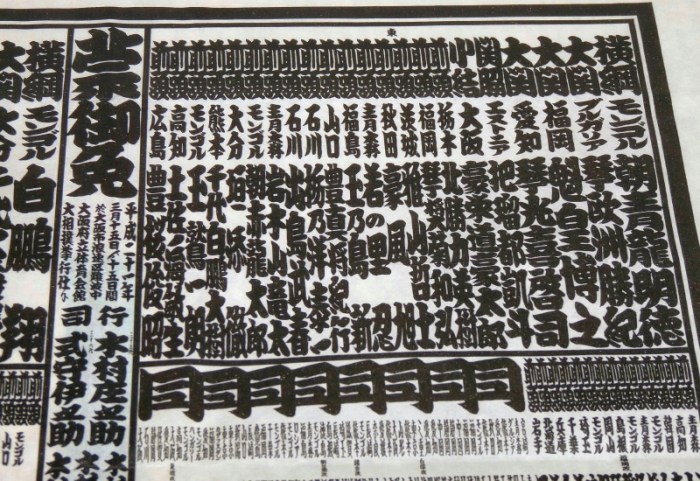
Tachiai’s Countdown to Kyushu

banzuke

As of this morning, there are 5 days left before the Kyushu banzuke is posted, and then it’s a mad dash to the start of what may be the highlight basho of the year. Given the events during the jungyo, I am starting to be cautiously optimistic that we may in fact see a full card of Yokozuna, as well as many favorites in fairly good fighting form for November.

As we wait for Sunday’s (US time) banzuke announcement, here are some of the stories leading up to Kyushu we are trying to research:

Takayasu – He was injured at Aki, and has not been part of the PR tour. He will enter Kyushu as a kadoban Ozeki for his first time, and we really don’t know how healed his thigh injury is.

Terunofuji – Demoted to Ozekiwake, he has to score 10 wins to regain his rank. There have been encouraging signs from jungyo, so fans of the big kaiju are hoping for success.

Ura – News sources have been very quiet about the condition of the man in pink. Everyone wants to see him back and healthy, but how damaged was that knee?

Wakaichiro – First time in Sandanme, the competition is going to be tough, will the man from Texas prevail?