Hello Tachiai readers. Hohisashiburi! Today, not many of the big names of the lower divisions were in play – there’s going to be a big burst of them tomorrow – but still, I collected several bouts for you, including three loose themes:
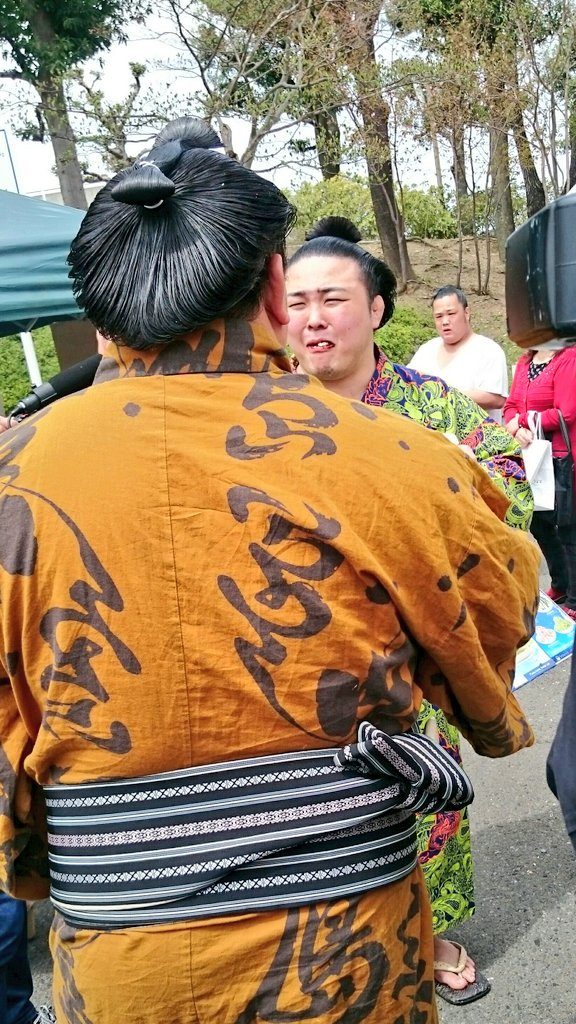
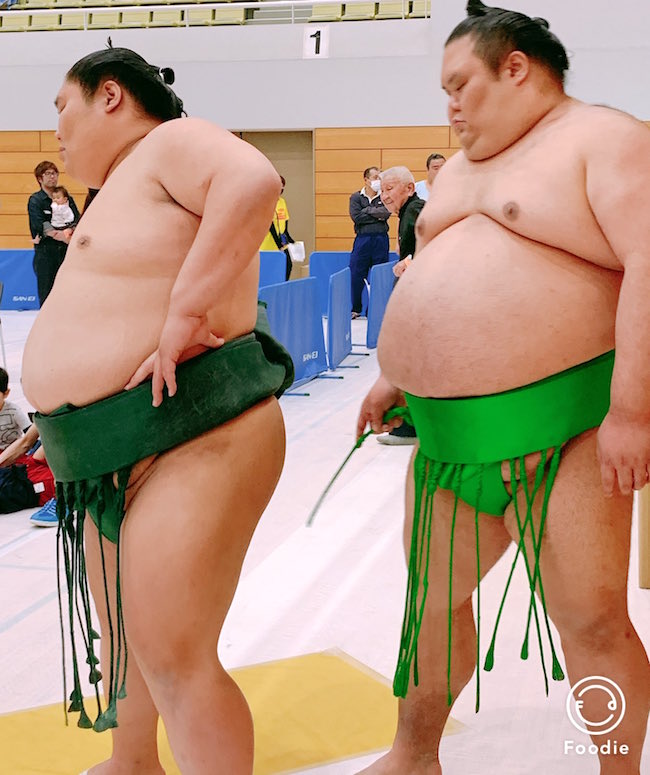
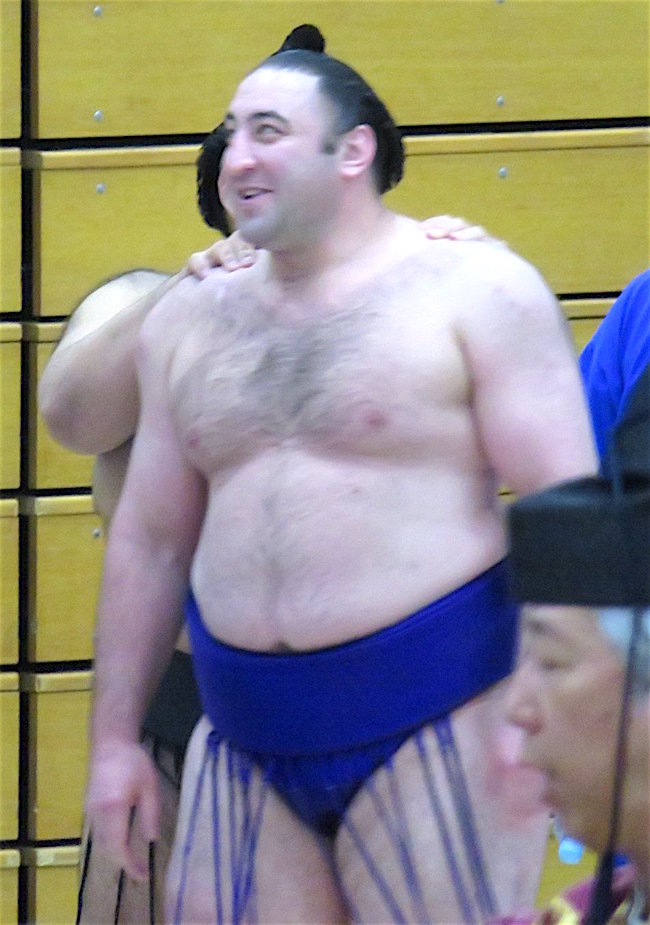
Homarefuji and Hakuyozan – image of Jungyo past – fall into the third category
Bruce’s “Ones To Watch”
Hakuho’s Uchi-deshi
Wrestlers of past glory trying to work their way back
No prizes for guessing who came in heaviest in the latest weigh-in…
Unlike last year, this May’s Yokozuna Deliberation Council soken – an event held before the Natsu basho where rikishi work out in front of the YDC and are appraised thusly – was closed to the public. We had a friend in the media on hand, who furnished us with the media handout detailing the height and weight updates that were taken and published earlier in the week by the Sumo Association.
This is by no means incredibly “new news,” but I thought it would be fun to give a brief update on some easily digestible stats published from this document, in case anyone’s interested:
Height
Tallest rikishi (Makuuchi): Kaisei, 195cm. Closely followed by Ichinojo and Kagayaki, both 193cm.
Tallest rikishi (Juryo): Ikioi immediately becomes the tallest in the division upon his demotion, at 194cm. Closely followed by Takagenji, Kyokushuho, Azumaryu, all 191cm.
Shortest rikishi (Makuuchi): Enho, 168cm. Terutsuyoshi is just taller at 169cm, followed by Ishiura at 174cm.
Shortest rikishi (Juryo): Toyonoshima, 169cm. After him it’s all the way up to Daishomaru at 174cm and Tobizaru at 175cm.
Weight
Heaviest rikishi (Makuuchi): It’s Ichinojo and it’s not even close. He’s up to 227kg, which is a gain of 1kg from the previous weigh-in. After him, the next closest is Kaisei, at 204kg. So, it’s fairly astonishing that there’s a 23 kg difference (a quarter of an Enho) between the heaviest and second heaviest rikishi in the top division.
Heaviest rikishi (Juryo): Mitoryu now clocks in at an even 200kg. This makes him 1kg heavier than the next heaviest Juryo rikishi, Gagamaru.
Lightest rikishi (Makuuchi): No surprise here, it’s Enho, at 99kg (and according to the NSK he’s actually lost a kilo). Again, he’s followed by Ishiura (115kg) and Terutsuyoshi (116kg), who were both even.
Lightest rikishi (Juryo): Wakatakakage (125kg), followed by Kiribayama (129kg) and Tobizaru (135kg).
Biggest weight gain (Makuuchi): Chiyomaru added an incredible 8 kilos, and is now at 193. Asanoyama (177kg) and Chiyotairyu (198kg) both added 7kg. So, it will be interesting to see how they’re all moving.
Biggest weight loss (Makuuchi): Stablemates Tochinoshin and Aoiyama both dropped 5 kilos, landing themselves at 170kg and 193kg respectively. Veteran “Big Guns” Shohozan also shed 5kg, to end up at a more trim 137kg.
Averages
Average Makuuchi stature: 183.4cm, 163.9kg. On the whole this is a decrease in 2.3kg from the previous weigh-in. This means the average top division rikishi would be of a similar build to Goeido (184cm, 160kg) or Shodai (184cm, 165kg).
Average Juryo stature: 183.4cm, 159.8kg. While Juryo rikishi are 4kg lighter than their top division counterparts on average, the group did increase by 2.7kg on average. Much of that can probably be explaining by swapping in Ikioi for Enho. The average Juryo rikishi would be of a similar build to Takanosho (183cm, 161kg).
While these kinds of numbers don’t necessarily tell us a whole lot in isolation, they can be helpful when it comes to understanding the performance of a rikishi relative to his previous tournament, as well as and understanding of his potential physicality compared to others in the division.
Edit: Our friends over at Inside Sport Japan have shared a shot of the full list (in Japanese):
Unlike our previous location, which boasted a local sekitori, a local tsukebito, and a semi-local former Yokozuna’s nephew, Gunma prefecture is really short on famous or high-ranked local boys.
The local organizers gave Hikarifuji and Kayatoiwa their due glory, but their real pride and joy is not regularly a part of the jungyo anymore. He was brought in specifically for this event.
That, of course, is 42 years old Satonofuji, the grand master of the bow, who hails from Gunma prefecture. And while all the other low-ranked rikishi were working on the dohyo, Satonofuji was working with the struggling new performer, Shohoryu, giving him a master class.
This was just one of the various outdoor activities today. The weather was deemed warm enough to have the handshaking sessions outside:
Though the sky looks pretty gray, if you ask me. Not all the rikishi just stand for handshakes. Some famous veterans sit in a separate corners, and fans can go and have a photo taken with them:
But actual practice takes place inside the venue. The first sekitori arrive and pull their taping kits:
Asanoyama, get, set, tape!
Others start stretching:
Some squatting and suri-ashi are in order:
Takarafuji is showing us his his good side.
Wakamotoharu works on his upper body:
But then he and Mitakeumi decide to gang up on poor Enho:
With everybody fed and in good order, it’s time for the afternoon part of the day. We begin with a Jonidan bout, because of course we don’t want to miss Satonofuji:
And we are up in Makuuchi. And the dohyo-iri there is not free of sin, either:
No, no, you have to wait for the Ozeki!
For some reason, Chiyotairyu decides that facing the spectators is just too much for him and turns around in the middle of the dohyo-iri. Abi tries to argue with him.
Takakeisho, by now getting used to all the “shin-ozeki” stuff, receives gifts of local produce – rice, meat, etc.:
The bouts start, and Yoshikaze has a wardrobe malfunction:
And after Kakuryu beats Takayasu (sorry, no video), comes the part everybody has been waiting for – good old Satonofuji’s yumi-tori shiki. Watch it, then go back to previous reports and compare with Kasugaryu, never mind poor Shohoryu. This is the work of a true master:
Today the Jungyo lands in Saitama. The prefecture boasts one of the finest high-school sumo departments at Saitamasakae high, and accordingly, also boasts many rikishi who call it home. In fact, two top-notch sekitori are in the home-boy position today: Abi and Hokutofuji.
And while Abi has a long line for photos and handshakes inside, Hokutofuji distributes safety pamphlets and shakes hands outside the venue:
Inside the venue, Ichinojo is practicing his shot put. The one tiny thing missing is the shot, of course:
In the “Everybody loves Enho” series, today it’s Kagayaki’s turn to play:
Finally, a video has turned up which will show us what it is that Kakuryu is doing with that strange combination of rubber tube and a towel. I’m sure it will make perfect sense once we watch it:
Takayasu is in a mentoring mood this Jungyo. A couple of days ago he tutored Onosho. Today he is giving a proper class to his army of tsukebito. And we finally get to see what the mystery move he was teaching Onosho was:
Why, he is teaching them how to dance like Cossacks!
If you’re wondering, normal sekitori only get to bring one tsukebito to Jungyo. But Ozeki may bring five, and Yokozuna, eight.
This is Tatsunami oyakata:
Aside from being a good-looking fella, he has also been in charge of preparing some of the events – interacting with the sponsors and the like.
Tatsunami oyakata runs a modest heya up in Ibaraki, far away from the sumo hub at Ryogoku. And in that modest heya, he has acquired a gem not long ago. Namely, this guy:
This is, of course, Asashoryu’s nephew, Hoshoryu. Tatsunami oyakata knows quite well this one has a huge potential, and he is doing everything he can to get the boy the best environment in which to develop. That includes apprenticing him to his only sekitori, Meisei, and sending him off to practice at Miyagino and at Isegahama, outside his own ichimon.
I’m pretty sure the plan when setting him as Meisei’s tsukebito was for Hoshoryu to do the Jungyo as early as possible and hobnob with sekitori as much as possible. But the problem is that the NSK introduced a new rule recently, that minors are not to join the Jungyo unless invited by the sponsors. And Hoshoryu is not 20 yet.
So Tatsunami somehow brought him along with him to this event. Not sure exactly what the pretext was, but bottom line, Hoshoryu got to participate in his first Jungyo today. This included all sorts of good stuff like a butsukari session with Tochinoshin. “Wow, Ozeki are that heavy” commented the youngster.
Now, Hoshoryu was only 4-3 last basho, but that doesn’t mean anybody should dismiss him as too weak for the top of Makushita. Take a look at this practice – apparently with Takanofuji (former Takayoshitoshi):
Oh, did he just beat a sekitori? But you may notice Tochinoshin watching him from the side lines. He told him his wrestling style invites his opponent in, and is also dangerous for his knees. “Be careful not to be injured!” admonished the still-Ozeki, who knows what he’s talking about.
Hoshoryu also got workout advice from Kotoshogiku:
Jumping ahead a little, here is his bout with Ichiyamamoto:
Practice time over, let’s move on to the afternoon part. Today the Makushita bouts were in the form of “kessho-gonin-nuki”. This means five rikishi on the West face five rikishi on the East. Each takes his turn, and if he wins, he stays on the dohyo with the next opponent from the opposite side. The winner is the first who beats all five opponents. I don’t have the bouts themselves, except the one we have seen with Hoshoryu above. But I do have the gonin-soroi-bumi. That is, the five wrestlers on each side go up on the dohyo and perform synchronized shiko, similar to the san-yaku-soroi-bumi we see at the end of events just before the last three bouts:
In this case, a rather casually seated Shikimori Kinosuke, from Sadogatake beya.
While the Makuuchi rikishi show off their kesho-mawashi, the Yokozuna’s tsukebito work hard at making him pretty for his own dohyo-iri:
Shame on you if you don’t know which Yokozuna that is…
OK, with all dohyo-iri done, it’s time for… what, you thought it’s time for bouts? As far as the Makuuchi rikishi are concerned, it’s time for playing games and goofing around, that’s what it is.
You know sumo wrestlers love sumo when they opt to do sumo to pass the time before they do sumo:
On the other side, four rikishi play rock-papers-scissors. Daieisho is mightily relieved when he wins it. It’s probably another one of the “lose and you get… pain” games that rikishi love so well:
Looks like a group version of atchi-muite-hoi, but I can’t imagine what the rules are when there are three fingers pointing.
Ichinojo checks the order of matches but the fans call from behind. The big man seems to be a bit bewildered by all the attention. Look, there’s even some grandpa aiming a phone at him from the second floor:
“Look over here, Ichinojo zeki!”
That’s what happens when you win too many bouts in honbasho, dear boulder.
Of course we can’t do without our favorite pair of clowns, Nishikigi and Shodai. This time they find a back room in this sports facility, and strain a poor vaulting box that never thought it would have to take that much weight:
The goofy mood spreads all the way to the top, as Takayasu gives Tochinoshin a hearty massage:
Takayasu is generally in a good mood today:
This seems to be post-bout, so he must have beaten Kakuryu in their daily match.
The only match I have today is an “off the list” – an extra bout between local boy Abi and Meisei. Why Meisei? I guess the sponsors wanted a duel of pretty shiko: