Jungyo Newsreel – Day 6

🌐 Location: Uji, Kyoto

The Jungyo reaches Kyoto, the elegant former capital of Japan. And although this is merely a small town south of the actual city of Tokyo, this means very special spectators:

Local boy Narutaki, pretty boy Toshonishiki, and maiko

These are Maiko, apprentice Geiko (the term for Geisha in Kyoto). Since I’m a bit of a fan of Geisha culture, I can tell you that the rightmost one is a beginner, a “minarai”, in her first year of apprenticeship, while the one standing next to Toshonishiki is a senior maiko who may be only months away from the ceremony that will turn her into a sekitori… sorry… a full Geiko.

There are no sekitori hailing from Kyoto at the moment, and so, much attention went to brothers Narutaki and Kyonosato, born in the city of Kyoto (The “Kyo” in Kyonosato’s name is from “Kyoto”). The brothers got the honor to preach non-violence to the incoming spectators:

Not sure how anybody allowed Kyonosato to do this without a visit to the nearest Tokoyama.

They were doing this, apparently, at the same time the sekitori were doing their handshake duties. For example, this other pair of brothers:

Wakatakakage – Wakamotoharu

This was apparently a fine spring day, and some of the handshaking took place outside the venue. Mitakeumi was enjoying the sun:

At the entrance to the venue stands this big banzuke, called “ita-banzuke” (board banzuke).

On first glance, you might think it’s just a copy of the most recent basho’s banzuke. And well, the ranks in it are indeed the ranks from the Haru basho. But there are some differences from the banzuke we often see held by rikishi on banzuke announcement day. For example – it doesn’t have the ink frames. And the large “By Permission” in the middle column sticks out of the rectangular design.

But that’s not all. First, in honbasho banzuke, right under that “By Permission” comes the date and place of the basho, and then the names of the gyoji and shimpan. In this one, it starts right off with the names of the gyoji. The place of the event is actually at the bottom of the middle column – where usually it says “Japan Sumo Association”. Here it says “Uji Basho”.

Which means… the gyoji had to write this ita-banzuke, fresh, with brush and ink, especially for this event. And it’s not just Kyoto. They do it again and again – possibly for every Jungyo location.

So now that we are well-immersed in the 19th century, let us proceed to see what’s going on inside the venue. We have Toyonoshima signing autographs:

And at the dohyo, we have… oh, the Ravenous Bugblatter Beast of Traal has made it to Kyoto, I see. Who is this who is avoiding it so skillfully by wearing his towel over his face?

This is Yokozuna Kakuryu, who has a penchant for silly-looking exercises.

This… doesn’t look any better. The funny thing is he wears an embarrassed smile when he is filmed doing the most sane-looking of his rubber-tube exercises:

On the dohyo… here are the local brothers again, discovering that it’s not all fun and games being local boys. Narutaki gets some butsukari from Toyonoshima:

While his big brother Kyonosato gets butsukari from no less than (still) Ozeki Tochinoshin:

…which is a bit scary, because sumo, or mobility in general, are not his strong side. He was make-koshi at Jonidan 99 the last basho.

So let’s move on to some more balanced practice sessions – here is some Juryo moshi-ai: Takanosho vs. Shimanoumi, Takanosho vs. Chiyonoumi, and Chiyonoumi vs. Mitoryu:

Next, here is the “couple” – Takakeisho giving butsukari to Daieisho:

Some Makuuchi practice bouts. First, Nishikigi-Tomokaze, Asanoyama-Shodai, Tochinoshin-Asanoyama:

Interesting that Asanoyama went for a tsuppari in his bout with Shodai.

Next we have Kagayaki-Shohozan, Kagayaki-Kaisei, Tamawashi-Kaisei:

Yep, that nodowa again.

Practice time over. In Kyoto, more often than not, we get to see elimination tournaments. In this case, Makuuchi and Juryo were business-as-usual, but Jonidan, Sandanme and Makushita were in elimination format, and carried prizes.

Suspiciously, though, two of those tournaments were won by local boys. The Jonidan prize was given to Kyoto-born Umizaru, from Miyagino beya:

And the Makushita tournament yusho dropped in the lap of our friend Narutaki:

By the way, “Narutaki” means “rumbling waterfall”.

During the intermission, due to the lack of any local sekitori, the hair-dressing demonstration was performed by the ever-popular Endo:

Imagine him with a Mohawk

I’m sorry to say I have absolutely no bouts from this day. I have a couple of pics – one of Abi pulling the oldest trick in the book on Onosho:

Giving the salty ladle, of course. He promptly scarpered.

The other is this, which tells us that Tochinoshin lost today’s bout:

Hmmm… I think they have been going see-saw pretty regularly this Jungyo. Seriously, anybody who wants to judge how well Tochinoshin is recovering or if Takakeisho is ready for the next level, should not judge that by the results of the Jungyo bouts. Instead, watch out for technique and mobility during practice bouts.

So we come to the close, and our pin-up boy of the day is the oft-overlooked Takanosho:

Jungyo Newsreel – Day 5

🌐 Location: Toyooka, Hyogo prefecture

Today was the second day in Hyogo prefecture – but right on the opposite side of it than Day 4’s event. Early morning, the dohyo is already consecrated from the day before.

And… what’s this parking right in front of the entrance to the venue?

Why, it’s Ryota Hama’s Chanko Nabe bus!

While in Tokyo or Osaka honbasho you rely either on the food supply inside the venue or the regular restaurants around it, events in small towns rely on mobile stalls. So as yobidashi Hiromasa calls the townspeople with his drum, a little matsuri is being set up around the venue.

And early-bird Hama got the most lucrative location, right at the entrance! Mmmm… chanko!

But not yet, the stalls are just being set up. First, it’s time to shake hands with some favorite rikishi. For example, Hyogo local Terutsuyoshi.

Ah, the contrast between the beautiful kimono of those ladies gathering around him, and his own ratty yukata…

Yokozuna in the house!

Low-ranking rikishi practice on the dohyo, while around it some sekitori are starting to stretch and exercise:

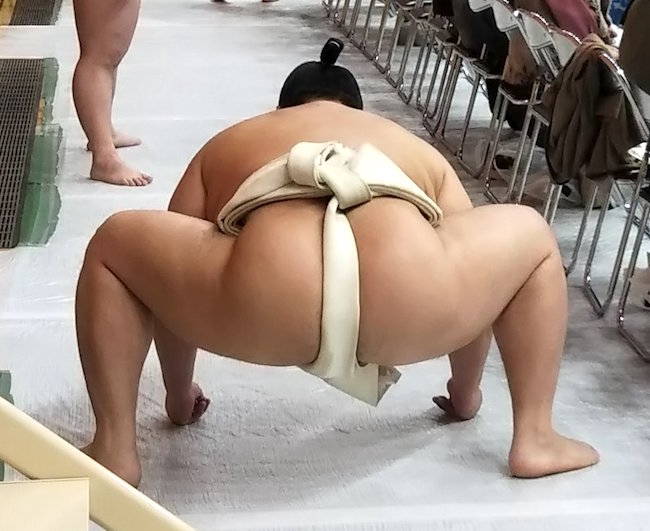
Very entertaining squats on the left side there.

On the sidelines, Sadanoumi practices his oshi:

Ando is doing suri-ashi:

And so does Aoiyama, though in a totally different style:

It’s time for the Juryo rikishi’s practice on the dohyo. We have Kyokushuho with Wakamotoharu, then Kyokushuho with Azumaryu:

And in the session’s closure, Takakeisho gives butsukari to Wakamotoharu:

Then Makuuchi gets into the picture. Aoiyama faces Meisei, then Okinoumi, then Asanoyama, then the latter takes over and faces Ryuden.

This is not the end of the road for Ryuden, who later gets Mitakeumi (for some reason this bout appears twice in this video). Then we can see Mitakeumi vs. Tochinoshin:

Practice time is over, and we can relax and enjoy Shokkiri. Here is the full performance.

Apparently, in this Jungyo, the gyoji is getting creative. When the two performers fall down together, he leaves the dohyo, and consults with some spectator – preferably a child: “I should call that dotai, right?”.

“Dotai” is when both rikishi touch ground at the same time. In a normal bout, the gyoji doesn’t call it – the gyoji always has to point the gunbai one side or the other – and this is settled with a monoii and a torinaoshi. In shokkiri, of course, the gyoji makes all the decisions himself. Or with the help of a child, as it turns out.

Next up is the Jinku performance. And once again I have the full version:

But hey, aren’t you hungry? It’s nearly noon and we haven’t tasted that chanko, yet!

Apparently they also serve Udon. But who cares? Chanko!

There is also a mobile Takoyaki stall if you’re tired of Chanko, as some rikishi are

Both lunch and Jinku over, it’s time for the Juryo dohyo-iri. And Sokokurai is arguing some point with Gagamaru:

Skipping the Makuuchi and Yokozuna dohyo-iri, right before Makuuchi, Takakeisho, the local hero, receives a bale of rice as a gift – and apparently, a large amount of beef.

The area of Toyooka is known for its stork-friendly rice. Apparently, Japanese storks have been on the decline, and the city of Toyooka is making an effort to bring them back, by raising rice that coexists with the creatures that storks feed on to sustain themselves. So Takakeisho got a bale of stork-friendly rice. I don’t know how stork-friendly the beef is, though.

So let’s see some bouts! Here we have a series of bouts from Juryo:

  • Daiseido-Kiribayama
  • Kyokushuho-Azumaryu
  • Daishomaru-Tokushoryu
  • Daiamami-Chiyomaru
  • Shimanoumi-Kotoyuki

This is followed by bouts from Makuuchi:

  • Ishiura-Yutakayama
  • Kotoeko-Toyonoshima
  • Tomokaze-Kagayaki
  • Shohozan-Yago
  • Sadanoumi-Terutsuyoshi
  • Aoiyama-Asanoyama
  • Chiyotairyu-Okinoumi
  • Kaisei-Nishikigi

Tochiozan vs. Endo:

Sanyaku-soroi-bumi, and Mitakeumi vs. Tamawashi

Tamawashi’s killer nodowa does it again.

Takakeisho vs. Tochinoshin:

I think Tochinoshin forgot that he was supposed to let the local boy win.

Finally, Musubi-no-ichiban, Kakuryu vs. Goeido.

I think I have yet to see Kakuryu win a bout this basho.

Finishing with our pin-up… How about Nishikigi for a change?

The arms are strong with this one

Jungyo Newsreel – Day 2

Venue at Gojo. A scrolling display is set up to show news of the new era name

🌐 Location: Gojo, Nara prefecture

Today the Jungyo hit the first of two stops at Nara prefecture – in the small town named Gojo, population 35,000 or so.

Early morning, and the sekitori started arriving at the venue through the cold weather:

You can see Yoshikaze and Enho there, but they are still not participating in any bouts. Yokozuna and Ozeki, by the way, may sleep separately from the rest, and therefore also arrive separately:

So let’s go around the venue and see what kind of practice the sekitori are having. Sadanoumi is giving his tsukebito some light butsukari practice:

And Daishoho is… what is Daishoho doing, exactly?

Maybe we shouldn’t show this video to anybody under 18.

At the Dohyo, Goeido is doing push-ups. Sort of:

If you recall, practice sessions on the dohyo consist mostly of moshi-ai sessions (winner decides who to call next), interspersed with higher-ranking rikishi going on the dohyo and giving all those who practiced in the most recent session some butsukari. So here are Mitakeumi and Shodai in one of those butsukari intermissions:

After the low-ranking rikishi finish their practice, it’s time for the sekitori to take the dohyo. Again, moshi-ai sessions commence – and Takagenji takes his (evil) twin.

…and this is exactly why Takanofuji is going to be out of that white Mawashi come Natsu.

The sekitori moshi-ai sessions are also punctuated by butsukari sessions. Today’s star is Tokushoryu, a native of Nara prefecture. He therefore gets treated to some Yokozuna butsukari. Kakuryu does the honors:

And here is the moshi-ai session between Tochiozan and Okinoumi, then Tochiozan and Aoiyama, then Aoiyama and Kagayaki:

Eventually, noon arrived, and with it the message to the Japanese nation: the new era that starts May 1st will be called “Reiwa” (令和). The whole nation is very excited about it, and head gyoji, Shikimori Inosuke, sets out to write the auspicious characters on a couple of large signs.

Gyoji serve as clerks when they are off the dohyo and out of their shiny outfits and headgear. They practice calligraphy from the moment they enter the sumo world (which, like rikishi, can be as early as age 15). Gyoji are in charge of writing all those signs with rikishi names on them, writing the banzuke, and so on. And of course, the head gyoji is also the head calligrapher.

And so, the Yokozuna were able to pay their respects to the name of the new era:

Kakuryu, “Reiwa”, Hakuho

By the way, the sharp-eyed kanji readers among you may notice that the nobori behind Kakuryu still has “Kisenosato” on it.

The sign (I think actually a second sign) ended up being hung inside the venue in time for the Makuuchi bouts.

Back to sumo activity, it was time for dohyo-iri. And Nishikigi was pestering Shodai incessantly:

Can’t exactly fathom why the old ladies believe that Shodai screaming is “kawaii!”.

Nishikigi wouldn’t let go of Shodai even after dohyo-iri:

Nor just before the bouts:

Literally, not letting the man go:

So here is a summary video with some actual bouts:

That is, Ishiura getting a mighty wedgie from Toyonoshima, Tokushoryu showing Takagenji why he may not yet make it to Makuuchi this time, and Takakeisho repeating his senshuraku performance with Tochinoshin.

Finally, how about a pin-up boy? I give you… Endo!

What do you mean “how do you know this is really Endo”?

Haru Day 5 Recap

We had an interesting day today at the EDION arena in Osaka. Before I dive into the Makunouchi bouts, I’m sure the fans will be happy to see this:

Aminishiki finally lands a win

Aminishiki is in dire straits down at the bottom of Juryo, but he managed to get his first win today vs. Akiseyama – and do that moving forward!

So, fast forward through Juryo (Arawashi doing well this basho, Enho gets his second loss in a row), we begin with Yutakayama vs. Kotoeko. Kotoeko looking good this basho, and may just be able to get that Makunouchi kachi-koshi which has eluded him so far. He attacks Yutakayama with a harizashi, lifts his arm high, and sends him off to the arms of the time shimpan.

Due to Chiyonokuni’s injury, we have a visitor from Juryo every day, and today it was 0-4 Hakuyozan facing Ishihenka, I mean, Ishiura, who was 4-0. Ishiura tried to get under Hakuyozan’s attack, but as he pulls, his knee folds below him and he finds himself rolling. His first loss, Hakuyozan’s first win.

Toyonoshima slammed into Chiyoshoma and intended to railroad him with his bulk, as he is wont. But the nimble Mongolian freed himself, stepped sideways, and left the veteran to ponder the difficulties of age and sumo.

Kagayaki launches himself head-first into newbie Daishoho‘s chest, keeps himself low, keeps his opponent upright, and clears him from the dohyo. Basic and clean.

The TomokazeTerutsuyoshi bout ended almost as soon as it started, with a plain, almost dismissive, hatakikomi. I believe something is wrong with Terutsuyoshi’s legs. He keeps ending up with his center of gravity way ahead of his feet. There is an expression used for this state: “ashi ga nagaremashita” – “his feet have flowed away”. His legs don’t work as fast as he needs to support his lunge.

And the Isegahama pixie is not the only one in trouble. Yoshikaze also didn’t show up for today’s bout. He leads head-first into the tachiai, but Ryuden immediately lands a morozashi – two arms under the opponent’s arms – and Yoshikaze just goes limp. Ryuden is haveng a good basho with 4-1.

Meisei tries to take the initiative against Yago. Doesn’t quite land a grip. Short tsuppari ensues, and then the two engage in migi-yotsu. Meisei only has one layer of Yago’s mawashi, and the Oguruma man patiently maneuvers into a better grip and leads Meisei out.

An impressive Shohozan showed up today to face Sadanoumi. Starting his bout with a harizashi, he lands a grip, and then throws Sadanoumi in a beautiful uwatenage. I want more of this Shohozan.

Ikioi tries hard to keep Kotoshogiku‘s pelvis as far away from him as possible. But eventually the former Ozeki decides to use the pressure against him, moves, and shows him out. Ikioi limps back to his spot to give the bow.

Asanoyama has a good tactic against Aoiyama. Since he is a yotsu man and Aoiyama is known for his fierce tsuppari and soft knees, Asanoyama quickly drives in and gets a fistful of mawashi. But Aoiyama shows versatility, uses a kotenage to release himself from the Takasago man, complements that with a nodowa, and hands Asanoyama his second loss.

Abi starts his bout with Takarafuji, as usual, with that morotezuki and follows with tsuppari. Takarafuji is quite ready for that, patiently weathers it, moves slightly to the left and grabs Abi’s mawashi. Abi manages to release himself, tries a half-hearted hikiotoshi, and fails. Instead, the Isegahama man slaps hard, and Abi rolls all the way to the other side of the dohyo. Olé!

The next bout, Chiyotairyu vs. Okinoumi. Chiyotairyu does his locomotive tachiai. Okinoumi backs up and sidesteps. Chiyotairyu dives into the janome, hands first. And Kimura Konosuke calls it Chiyotairyu’s win! No monoii. I guess the shimpan trust Chiyotairyu’s heya-mate, Konosuke, too much. The replay clearly shows this was a mistake. Okinoumi’s feet are firmly on the tawara, so he is very much alive when Chiyotairyu hits the dirt.

Ichinojo starts off with a harite – it’s not a harizashi as there was no attempt to go for the belt – then follows with a kachiage, and finally paws Onosho down with both arms. Scary. Onosho finds himself in a heap as Ichinojo, as usual, worriedly checks if he hasn’t overdone things. I guess Ichinojo left his sleepy secret twin in Tokyo.

Endo gets a grip on Tochiozan‘s belt right off the tachiai, and rolls him like his favorite barrel of beer. Makiotoshi, Endo’s first win this basho.

Mitakeumi and Hokutofuji clash head-to-head. Mitakeumi leads at first, but Hokutofuji manages to stop the pressure, and it’s Mitakeumi who starts pulling back. Maybe it’s the knee, but whatever it is, the Mitakeumi magic is not working against his fellow komusubi, and after a short halt, again he pulls and finds himself below the dohyo.

After three losses, Tamawashi vindicates himself somewhat in this fierce battle with Takakeisho. Takakeisho leads at first and nearly bounces Tamawashi out the front side of the dohyo, but Tamawashi takes it in his stride, and returns with his own windmill. Tamawashi proves that even in oshi, Takakeisho is not invincible. With two losses in the first trimester, Takakeisho’s Ozeki run seems less certain than it looked before the basho started.

Nishikigi has run out of luck this basho. Takayasu slams into him with all his bear-power. Nishikigi tries an arm lock on the Ozeki’s left arm, but to no avail. Nishikigi is 0-5.

Kaisei and Tochinoshin lock into a “gappuri” stance – firm yotsu. Tochinoshin’s first attempt doesn’t work. There is a short impasse, and then Kaisei makes a mistake and tries to gaburi him, or at least, that’s how it looked. As a result, his center of gravity ends up just where the Ozeki wants it, and he actually lifts the heavy Brazilian – though he quickly abandons the idea. He then adds a couple of pelvis thrusts of his own, to bring his thick opponent across the tawara. 3-2, and his chances of clearing kadoban look slightly brighter.

Goeido treats Shodai like a ragdoll, and the Tokitsukaze man finds himself out of the dohyo almost straight out of the tachiai. What version of Goeido is this? Has his kernel been replaced?

Kakuryu butts heads with Daieisho (not a smart move in the long run, Yokozuna), then immediately pulls. Hatakikomi, and Kakuryu is visibly annoyed with himself. Trouble always begins when Kakuryu pulls. But the win is a win.

I’m not sure what’s going on with Hakuho. The bout itself looked fine. No dominance, but the Yokozuna leading with a kachiage, Myogiryu fending him off, and the Yokozuna coming in again and slapping his opponent to the ground. But like yesterday, he couldn’t quite stop his own movement after finishing his work. Yesterday he ended up in the crowd, and took quite a while to get up from there, and today he ended up doing the splits on top of myogiryu. Control of legs? Dizziness? We won’t know unless he goes kyujo and needs to publish yet another public proof of injury

So that’s the end of Act 1, and we have four men in the leader group – Hakuho, Goeido, Ichinojo and Kotoshogiku. Let’s see what the second trimester brings!