Jungyo Newsreel – Day 17

🌐 Location: Gyoda, Saitama prefecture

Today the Jungyo lands in Saitama. The prefecture boasts one of the finest high-school sumo departments at Saitamasakae high, and accordingly, also boasts many rikishi who call it home. In fact, two top-notch sekitori are in the home-boy position today: Abi and Hokutofuji.

And while Abi has a long line for photos and handshakes inside, Hokutofuji distributes safety pamphlets and shakes hands outside the venue:

Inside the venue, Ichinojo is practicing his shot put. The one tiny thing missing is the shot, of course:

In the “Everybody loves Enho” series, today it’s Kagayaki’s turn to play:

Finally, a video has turned up which will show us what it is that Kakuryu is doing with that strange combination of rubber tube and a towel. I’m sure it will make perfect sense once we watch it:

Errr…. no. It still looks absolutely ridiculous.

The other Yokozuna is getting his morning greetings while Goeido is smearing someone on the dohyo.

It occurs to me that by the time the good mornings are over, the spittoon at the corner of the dohyo is probably full to the brim. Poor yobidashi.

The kawaigari session there doesn’t seem to be related to this short one Goeido is having with Takanosho:

Takayasu is in a mentoring mood this Jungyo. A couple of days ago he tutored Onosho. Today he is giving a proper class to his army of tsukebito. And we finally get to see what the mystery move he was teaching Onosho was:

Why, he is teaching them how to dance like Cossacks!

If you’re wondering, normal sekitori only get to bring one tsukebito to Jungyo. But Ozeki may bring five, and Yokozuna, eight.

This is Tatsunami oyakata:

Aside from being a good-looking fella, he has also been in charge of preparing some of the events – interacting with the sponsors and the like.

Tatsunami oyakata runs a modest heya up in Ibaraki, far away from the sumo hub at Ryogoku. And in that modest heya, he has acquired a gem not long ago. Namely, this guy:

This is, of course, Asashoryu’s nephew, Hoshoryu. Tatsunami oyakata knows quite well this one has a huge potential, and he is doing everything he can to get the boy the best environment in which to develop. That includes apprenticing him to his only sekitori, Meisei, and sending him off to practice at Miyagino and at Isegahama, outside his own ichimon.

I’m pretty sure the plan when setting him as Meisei’s tsukebito was for Hoshoryu to do the Jungyo as early as possible and hobnob with sekitori as much as possible. But the problem is that the NSK introduced a new rule recently, that minors are not to join the Jungyo unless invited by the sponsors. And Hoshoryu is not 20 yet.

So Tatsunami somehow brought him along with him to this event. Not sure exactly what the pretext was, but bottom line, Hoshoryu got to participate in his first Jungyo today. This included all sorts of good stuff like a butsukari session with Tochinoshin. “Wow, Ozeki are that heavy” commented the youngster.

Now, Hoshoryu was only 4-3 last basho, but that doesn’t mean anybody should dismiss him as too weak for the top of Makushita. Take a look at this practice – apparently with Takanofuji (former Takayoshitoshi):

Oh, did he just beat a sekitori? But you may notice Tochinoshin watching him from the side lines. He told him his wrestling style invites his opponent in, and is also dangerous for his knees. “Be careful not to be injured!” admonished the still-Ozeki, who knows what he’s talking about.

Hoshoryu also got workout advice from Kotoshogiku:

Jumping ahead a little, here is his bout with Ichiyamamoto:

Whoa.

Here are some practice bouts. First, Shodai-Shohozan:

Hehehe… the guys really swamp Shodai there in an attempt to get his nod.

Ichinojo-Ryuden, Endo-Takarafuji, Aoiyama-Takayasu:

Practice time over, let’s move on to the afternoon part. Today the Makushita bouts were in the form of “kessho-gonin-nuki”. This means five rikishi on the West face five rikishi on the East. Each takes his turn, and if he wins, he stays on the dohyo with the next opponent from the opposite side. The winner is the first who beats all five opponents. I don’t have the bouts themselves, except the one we have seen with Hoshoryu above. But I do have the gonin-soroi-bumi. That is, the five wrestlers on each side go up on the dohyo and perform synchronized shiko, similar to the san-yaku-soroi-bumi we see at the end of events just before the last three bouts:

Next was the Juryo dohyo-iri. And of course we get an Enho sandwich:

One pixie, between two slices of Daishomaru and Daiamami

In the dohyo-iri itself, Akiseyama completely breaks the Japanese stand-in-line etiquette.

And Chiyomaru also looks like he is getting ahead of his turn.

The Juryo members change and wait for their bouts, and Chiyomaru decides to tickle Daishomaru in the ass a bit with one of his sagari rods.
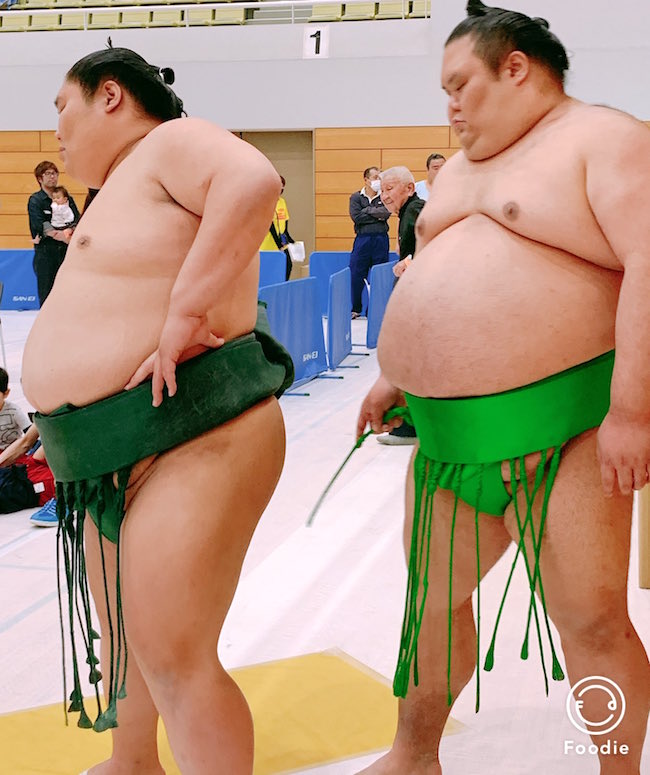
I think Chiyomaru may think again before he tries a prank on Daishomaru next time, as he finds himself slammed against the wall.

Whoa, whoa, aren’t you overreacting just a bit?

It’s time for the Makuuchi dohyo-iri. And just a reminder, the one who announces what’s going on is always a gyoji.

In this case, a rather casually seated Shikimori Kinosuke, from Sadogatake beya.

While the Makuuchi rikishi show off their kesho-mawashi, the Yokozuna’s tsukebito work hard at making him pretty for his own dohyo-iri:

Shame on you if you don’t know which Yokozuna that is…

OK, with all dohyo-iri done, it’s time for… what, you thought it’s time for bouts? As far as the Makuuchi rikishi are concerned, it’s time for playing games and goofing around, that’s what it is.

You know sumo wrestlers love sumo when they opt to do sumo to pass the time before they do sumo:

On the other side, four rikishi play rock-papers-scissors. Daieisho is mightily relieved when he wins it. It’s probably another one of the “lose and you get… pain” games that rikishi love so well:

Looks like a group version of atchi-muite-hoi, but I can’t imagine what the rules are when there are three fingers pointing.

Ichinojo checks the order of matches but the fans call from behind. The big man seems to be a bit bewildered by all the attention. Look, there’s even some grandpa aiming a phone at him from the second floor:

“Look over here, Ichinojo zeki!”

That’s what happens when you win too many bouts in honbasho, dear boulder.

Of course we can’t do without our favorite pair of clowns, Nishikigi and Shodai. This time they find a back room in this sports facility, and strain a poor vaulting box that never thought it would have to take that much weight:

The goofy mood spreads all the way to the top, as Takayasu gives Tochinoshin a hearty massage:
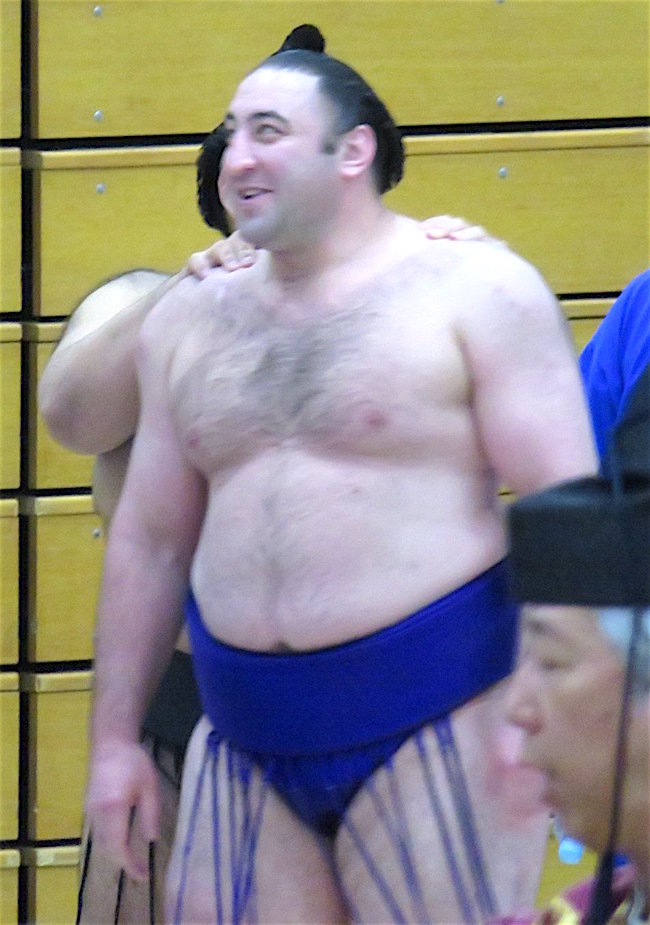
Takayasu is generally in a good mood today:

This seems to be post-bout, so he must have beaten Kakuryu in their daily match.

The only match I have today is an “off the list” – an extra bout between local boy Abi and Meisei. Why Meisei? I guess the sponsors wanted a duel of pretty shiko:

I think Meisei didn’t get the memo about letting the local boy win, though.

And I leave you with today’s pin-up rikishi, Kiribayama:

With a shikona like “Foggy Horse Mountain”, can you guess where he is from?

Jungyo Newsreel – Day 14

Guess who’s back?

🌐 Location: Yasukuni Shrine, Tokyo

After the fairly modest event we had up north in Ibaraki, the Jungyo returns to Tokyo for one of its permanent events – the dedication sumo event at Yasukuni Shrine.

As John Gunning mentioned in his recent article about Jungyo, this event is free of charge, and allows about 6000 spectators to enjoy a day of sumo right at the heart of the big city.

The upshot of all this is that there were a lot of visuals on the ‘net, and you are in for one long post. Clear up a couple of hours of your time, folks. Prepare a bento box, visit the toilet, tuck in the kids.

Continue reading

Jungyo Newsreel – Day 12

🌐 Location: Fujisawa, Kanagawa prefecture

Today we have a relatively short report, as the ladies of Fujisawa were less than diligent with their smartphones. More is the pity, as today’s schedule included a bout between Ichinojo and Terutsuyoshi. Alas, unless some footage turns out in the next few days, we’ll miss this clash of fire and ice.

Before describing this day, though, I want to take you back to Haru Jungyo 2003, and a photograph that shouldn’t have existed:

Asashoryu – Takanohana – Musashimaru

Three Yokozuna in 2003? That never happened. Takanohana, in fact, retired in Hatsu 2003, and Asashoryu was promoted only on the next banzuke, Haru 2003. You might think it’s a similar situation to what’s happening with Tochinoshin and Takakeisho now – Tochinoshin is still Ozeki due to the previous banzuke, and Takakeisho is shin-Ozeki as of the next banzuke, and both are treated as Ozeki this Jungyo. However, this doesn’t really happen with retirements, and besides, there is no Jungyo between Hatsu and Haru. Haru Jungyo comes between Haru and Natsu.

And yet, with the magic that is Jungyo, you see the retired Dai-Yokozuna side by side with the next Dai-Yokozuna, both in their tsuna. One can even see that Takanohana is already a lot thinner than he was when active.

OK, engage the flux capacitor. Let’s go back to 2019 – same town, same venue. It’s a beautiful spring day, and with more than 5000 people attending, it’s a good opportunity to get blood donations:

Inside the venue, rikishi are supposed to shake hands with the spectators. Instead, Mitakeumi gives Ichinojo a massage:

It’s hard to tell, with Ichinojo, whether he is pleased or disgusted with this.

The Onami family is in the building at full capacity, and in seniority order:

First, big brother Wakatakamoto. Second, second brother Wakamotoharu. Third, little brother Wakatakakage. Now we need a wolf to huff and puff and blow their house in… Furtunately, neither Seiro nor Roga are available at the moment.

Soon the subjects of the two previous pics get to the dohyo, and Ichinojo gives Wakatakakage a butsukari session:

Takakeisho was very busy on the dohyo today. He got butsukari from Goeido:

And he also had actual sumo practice for the first time this Jungyo. He engaged Hokutofuji:

And Myogiryu:

All in all, six bouts of which he won four: “I’m only starting. I need to get used to it again”. Said the shin-ozeki.

With practice over, the rikishi enjoyed some time off on the lawn outside the venue. Ryuden was enjoying himself, as usual:

And the children of Fujisawa were having the time of their lives:

After shower and dohyo-iri, they were at it again! Some of them were trying to make… thingamajigs… fly:

Or at least figure out what the things were supposed to do:

Some more serious people were still inside the venue doing their job:

“No, my job is not sweeping chimneys!

OK, “serious” may be stretching it. Abi is a bit bored by the oicho-mage demonstration. I can tell.

This demonstration included both him and Onosho, facing each a different section of the audience. Onosho, unlike Abi, was behaving well:

Then it was Kakuryu’s turn to show off his rope.

Behind him you can see Shohoryu, handing pieces of twine to the rope team leader (I think it’s Shinzan, not sure).

Today, the torikumi included an elimination tournament for the top of Makuuchi. All other sekitori had their usual bouts. Again, no footage. All I have is this photo of Kakuryu and Endo starting their match:

Somewhat surprisingly, Kakuryu won this tournament, winning ¥2,000,000 and a year’s supply of vegetables from the area. “I’m going to eat lots of vegetables”, chuckled the Yokozuna.

I still hope to find that elusive footage of Ichinojo vs. Terutsuyoshi. If I do, I’ll add it here. In the meantime, enjoy our pin-up of the day:

Arawashi is definitely supermodel grade

Jungyo Newsreel – Day 6

🌐 Location: Uji, Kyoto

The Jungyo reaches Kyoto, the elegant former capital of Japan. And although this is merely a small town south of the actual city of Tokyo, this means very special spectators:

Local boy Narutaki, pretty boy Toshonishiki, and maiko

These are Maiko, apprentice Geiko (the term for Geisha in Kyoto). Since I’m a bit of a fan of Geisha culture, I can tell you that the rightmost one is a beginner, a “minarai”, in her first year of apprenticeship, while the one standing next to Toshonishiki is a senior maiko who may be only months away from the ceremony that will turn her into a sekitori… sorry… a full Geiko.

There are no sekitori hailing from Kyoto at the moment, and so, much attention went to brothers Narutaki and Kyonosato, born in the city of Kyoto (The “Kyo” in Kyonosato’s name is from “Kyoto”). The brothers got the honor to preach non-violence to the incoming spectators:

Not sure how anybody allowed Kyonosato to do this without a visit to the nearest Tokoyama.

They were doing this, apparently, at the same time the sekitori were doing their handshake duties. For example, this other pair of brothers:

Wakatakakage – Wakamotoharu

This was apparently a fine spring day, and some of the handshaking took place outside the venue. Mitakeumi was enjoying the sun:

At the entrance to the venue stands this big banzuke, called “ita-banzuke” (board banzuke).

On first glance, you might think it’s just a copy of the most recent basho’s banzuke. And well, the ranks in it are indeed the ranks from the Haru basho. But there are some differences from the banzuke we often see held by rikishi on banzuke announcement day. For example – it doesn’t have the ink frames. And the large “By Permission” in the middle column sticks out of the rectangular design.

But that’s not all. First, in honbasho banzuke, right under that “By Permission” comes the date and place of the basho, and then the names of the gyoji and shimpan. In this one, it starts right off with the names of the gyoji. The place of the event is actually at the bottom of the middle column – where usually it says “Japan Sumo Association”. Here it says “Uji Basho”.

Which means… the gyoji had to write this ita-banzuke, fresh, with brush and ink, especially for this event. And it’s not just Kyoto. They do it again and again – possibly for every Jungyo location.

So now that we are well-immersed in the 19th century, let us proceed to see what’s going on inside the venue. We have Toyonoshima signing autographs:

And at the dohyo, we have… oh, the Ravenous Bugblatter Beast of Traal has made it to Kyoto, I see. Who is this who is avoiding it so skillfully by wearing his towel over his face?

This is Yokozuna Kakuryu, who has a penchant for silly-looking exercises.

This… doesn’t look any better. The funny thing is he wears an embarrassed smile when he is filmed doing the most sane-looking of his rubber-tube exercises:

On the dohyo… here are the local brothers again, discovering that it’s not all fun and games being local boys. Narutaki gets some butsukari from Toyonoshima:

While his big brother Kyonosato gets butsukari from no less than (still) Ozeki Tochinoshin:

…which is a bit scary, because sumo, or mobility in general, are not his strong side. He was make-koshi at Jonidan 99 the last basho.

So let’s move on to some more balanced practice sessions – here is some Juryo moshi-ai: Takanosho vs. Shimanoumi, Takanosho vs. Chiyonoumi, and Chiyonoumi vs. Mitoryu:

Next, here is the “couple” – Takakeisho giving butsukari to Daieisho:

Some Makuuchi practice bouts. First, Nishikigi-Tomokaze, Asanoyama-Shodai, Tochinoshin-Asanoyama:

Interesting that Asanoyama went for a tsuppari in his bout with Shodai.

Next we have Kagayaki-Shohozan, Kagayaki-Kaisei, Tamawashi-Kaisei:

Yep, that nodowa again.

Practice time over. In Kyoto, more often than not, we get to see elimination tournaments. In this case, Makuuchi and Juryo were business-as-usual, but Jonidan, Sandanme and Makushita were in elimination format, and carried prizes.

Suspiciously, though, two of those tournaments were won by local boys. The Jonidan prize was given to Kyoto-born Umizaru, from Miyagino beya:

And the Makushita tournament yusho dropped in the lap of our friend Narutaki:

By the way, “Narutaki” means “rumbling waterfall”.

During the intermission, due to the lack of any local sekitori, the hair-dressing demonstration was performed by the ever-popular Endo:

Imagine him with a Mohawk

I’m sorry to say I have absolutely no bouts from this day. I have a couple of pics – one of Abi pulling the oldest trick in the book on Onosho:

Giving the salty ladle, of course. He promptly scarpered.

The other is this, which tells us that Tochinoshin lost today’s bout:

Hmmm… I think they have been going see-saw pretty regularly this Jungyo. Seriously, anybody who wants to judge how well Tochinoshin is recovering or if Takakeisho is ready for the next level, should not judge that by the results of the Jungyo bouts. Instead, watch out for technique and mobility during practice bouts.

So we come to the close, and our pin-up boy of the day is the oft-overlooked Takanosho: