Ex-Kisenosato To Become Nishonoseki-oyakata; Nishonoseki-beya To Become Hanaregoma-Beya

Name changes and Heya moving

Over on Twitter, Herouth brought us some interesting news of a name change, and a stable moving.

With the looming retirement of Nishinoseki-oyakata, the kabu name and titular head of Nishinoseki-ichimon would become available. There are two The Japan Sumo Association has approved transfer of the name to former Kisenosato. The stable itself will become Hanaregoma-beya, and be run by former Sekiwake Tamanoshima (obviously now known as Hanaregoma-oyakata).

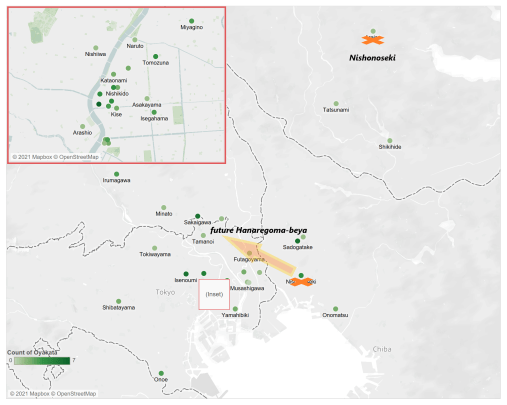
Hanaregoma-beya is under construction in the Adachi section of Tokyo, which borders Saitama. Current Nishonoseki is in Chiba, pretty close to the Tokyo border. For those who think of Narita airport when they think of Chiba, the current stable is about half as far from central Tokyo.

However, as we can see from the map, Adachi will not be that much closer to the hub of the sumo world at Kokugikan, than the current lodgings in Funabashi. But there are several stables in the surrounding area. Tamanoi and Sakaigawa-beya are there in Adachi now, and Oitekaze is very close — just over the border in Saitama.

If the reopening stays on track with more opportunities for degeiko, the move also brings the future Hanaregoma beya closer to fellow Nishonoseki ichimon stables of Minato (Ichinojo) and Tokiwayama (Takakeisho & Takanosho), while moving further from Sadogatake (think Koto-) and Onomatsu (Onosho).

The Pride of Yokozuna: A Proper Review

Sorry for the short notice and the brief little write-up about the documentary a few minutes ago. Casa Andy has a flurry of unanticipated (and unwanted) activity this Saturday morning. Anyway, there will be several other opportunities to watch the documentary. There are multiple broadcast times. Hopefully they will make it available as a video-on-demand. If they do not, it will be rebroadcast on Sunday and Monday. But it is difficult to write more than a cursory write-up when I hadn’t seen it. Now that I have seen it, I have one opinion: watch it. It’s a great documentary.

https://www3.nhk.or.jp/nhkworld/en/tv/documentary/20211219/4001407/

The interview provides insight into his mindset at pivotal times, not just for his own career but at multiple critical points in the history of the sport. The rise of Kisenosato, the yaocho scandal, the baseball gambling scandal, etc. And they make a nice effort to tie so many moments and pivotal bouts to Nagoya throughout the years.

It was interesting to hear other former Yokozuna, Kitanofuji and Kisenosato, struggle to define “Hinkaku,” that quality of the Yokozuna that is never defined but somehow they must live up to.

He definitely puts paid to my theory about that infamous penultimate bout against Shodai. Herouth had already reported this but he lined up at the tawara due to his lack of confidence in his knee. Since we frequently give Shodai a bit of gruff about his upright tachiai, my romantic ideals had created this rebuke which clearly did not exist. Out of concern for his knee and his own doubts about beating Shodai, he opted to totally avoid the tachiai.

But the most poignant parts were the interviews with the man himself, and with his trainer. His trainer had kept detailed notes on Hakuho’s mindset and things that he had said. Key among those things are the importance of the fans’ sentiment. At so many points the fans were with him, cheering him on. But sometimes, they hope for others to rise. Is it a betrayal to the fans to win, if the fans want him to lose? He beat Kisenosato and Terunofuji when they clearly would have loved to see his opponent win. It seems the documentary really dives into how he lives to serve the fans. His achievement, therefore, would serve to disappoint them.

“What is sumo? What is a Yokozuna?”

What is Hinkaku?

Regardless of the answers we may have, Hakuho makes it clear that his answer is, “winning.” (Not in the Charlie Sheen sense of the term.) His recruits will surely do quite a bit of winning from now on but he will certainly serve as a great booster for the sport of sumo in his new role with the Association.

Happy Birthday Akashifuji!!

While the DC area feels a bit of unseasonably warm weather, I’d like to extend warm Birthday greetings to Akashifuji, who turned 26 today. The pics in the tweet below are from an earlier year but with easing COVID restrictions, hopefully the young Tagonoura-beya rikishi will be able to spend a (responsible and socially-distant) night on the town.

I have updated the Birthday Calendar dashboard with data from the Kyushu basho. I also added a little more information in the “Career Tracker.” By hovering over a data point along a wrestler’s career path, you will see the rank (and old shikona) of the wrestler during that tournament. We can see that just before Hatsu 2020, Akashifuji had been Tagonofuji, borrowing the characters from his stable.

Akashifuji must have made the shikona change to honor his hometown in Hyogo prefecture. Akashi is in Western Japan, next to Kobe. It is on the coast, so along with Akashi Castle, there are beaches to visit. It is also convenient to Awaji Island which sits between the main island of Honshu and Shikoku.

Despite the 3-4 makekoshi record in Fukuoka, his rank has been trending upwards…coming very close to Makushita promotion earlier in the year. His best rank was Sandanme 6 during the Natsu basho. If plans hold, the Spring tournament will return to nearby Osaka in 2022, with even more fans in attendance. Perhaps that will give Akashifuji the drive to rise further and possibly earn that Makushita promotion!

Good luck in the New Year!