Legends of the Dohyo #2: Paving the Way

Takamiyama3


When one looks at the current banzuke, they are sure to find rikishi from all over the world. There are the Mongolians such as Hakuho and Terunofuji, Egypt’s Osunaarashi, the Bulgarian Aoiyama, and Wakaichiro from the United States. Foreign rikishi have become commonplace in Japan’s national sport, but for the vast majority of its existence, sumo was exclusively for those of Japanese heritage. That is, until Takamiyama Daigoro blazed a trial that countless rikishi around the globe have followed to this very day.

Takamiyama Daigoro, birth name Jesse Kuhaulua, was born on the Hawaiian Island of Maui in 1944. Even in his youth, he was known for his enormous size, standing over 6 feet tall and weighing nearly 300 pounds. Despite his impressive stature, he suffered from weak legs and hips as a teenager. He was encouraged by his high school football coach to join a local sumo club to strengthen his lower body. Takamiyama soon caught the attention of several professional rikishi visiting Hawaii from Japan, and in 1964 he accepted an invitation to join Takasago beya. At the 1968 Haru basho, Takamiyama became the first foreign-born rikishi to be promoted to the Makuuchi division. He would go on to have a long and successful career in sumo’s top division, spanning 17 years and a record 97 consecutive tournaments. This record for most consecutive basho as a sekitori stood for twenty-five years until it was surpassed by Ozeki Kaio Hiroyuki in 2009. Although not the most technically proficient rikishi, Takamiyama’s size and strength made up for what he lacked in skill. He regularly used his power to push his way to victory, and on many occasions would merely lift his opponents up and out of the dohyo.

In addition to his success on the dohyo, Takamiyama became a celebrity throughout Japan. His massive size, bushy sideburns, and jovial personality made him incredibly popular with fans, and he regularly appeared in advertisements until it was banned by the Sumo Association. The crowning achievement of his career came at the 1972 Nagoya basho when Takamiyama became the first foreign-born rikishi to win a yusho. To congratulate him on his victory, President Richard Nixon sent a letter that was read aloud after the presentation of The Emperor’s Cup. This marked the first time English was ever spoken on the dohyo. In addition to his yusho, Takamiyama was awarded 11 sansho special prizes and earned 12 kinboshi victories throughout his career.

In 1982, Takamiyama was given a heroes welcome when he returned to Hawaii. During this trip, he met a young Saleva’a Atisano’e, later known as Konishiki Yasokichi. This meeting would inspire the future first non-Japanese Ozeki to begin his sumo career. In 1984, at the age of 39, a debilitating elbow injury forced Takamiyama to end his career. Having become a Japanese citizen, he joined the Sumo Association and started his own stable, Azumazeki beya, the first foreigner to do so. His most promising student, Chadwick Rowan, would go on to become Akebono Taro, sumo’s first foreign-born Yokozuna. With his fighting days behind him, Takamiyama passed the torch to his fellow Hawaiians, Konishiki and Akebono, both trailblazers in their own right. They would, in turn, pass the torch to a generation of rikishi from across the globe, each of whom owes a debt to their forerunner, Takamiyama, the man who paved their way.


Takamiyama (left) vs. Asahikuni (right), Nagoya basho, 1972.


Links:
http://sumodb.sumogames.de/Rikishi.aspx?r=4050
https://en.wikipedia.org/wiki/Takamiyama_Daigor%C5%8D
Jungyo Newsreel – October 11

🌐 Location: Hamamatsu

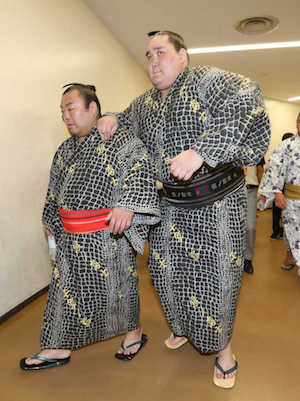
After a short break in which the rikishi went back from Ibaraki to Tokyo, they got on their buses again and traveled back to Shizuoka prefecture, venturing further than before, south to Hamamatsu. By now, even Aminishiki is gently complaining in his blog about the busy schedule.

That is, all got on buses but the Yokozuna, who instead took the Tokaido shinkansen along with their respective retinues, straight to Hamamatsu. It’s good to be the King.

It’s actually rare for all participating Yokozuna to travel together, as usually each makes his own arrangements (or has them made for him). This time they all had a reception to attend, and therefore traveled together.

Let’s see what they have been up to since finishing with their non-sumo obligations:

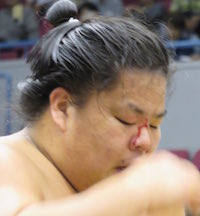
Kisenosato gives Daieisho a nosebleed

daieisho-bleedingKisenosato once again engaged Daieisho in san-ban. They did 10 bouts, of which Kisenosato won 8 and lost 2. And Daieisho, as you can see, also lost a bit of blood.

Sponichi reports that Kisenosato was in good form, used his left arm, and entertained the viewers with excellent mobility. Me? I’ll believe that when I see it. Unfortunately, it seems that no obasan was kind enough to record any of the events. If I see any video, I’ll be sure to edit it in later on.

Kakuryu practices with Asanoyama

kakuryu-asanoyama

Having been dumped by Kisenosato in favor of Daieisho, Asanoyama has been batting his pretty eyelashes at Kakuryu. Apparently Kakuryu couldn’t resist much longer, and offered him some Yokozuna love. That is, a sanban. I suppose Asanoyama’s tachiai is better than Shodai’s.

Harumafuji gives Ichinojo personal tutoring

Harumafuji, in addition to all the other responsibilities he seems to enjoy accepting, has taken it upon himself to give sumo lessons to anybody around the dohyo who is willing to listen. In the Natsu jungyo, he taught Goeido his arm and shoulders workout routine. In this Jungyo, at Chikusei, he picked Meisei and demonstrated waza to him (seemed to be ashitori), patiently placing Meisei’s hands on his own person to clarify the points. Today he took up Ichinojo.

ichinojo-harumafuji-lesson

While the other sekitori were busy with moshi-ai geiko (winner picks next opponent), the Yokozuna spent about half an hour making Ichinojo do suri-ashi repeatedly, and at the same time physically corrected his technique, such as the use of his left arm. “It was a tachiai practice. I just taught him what I know. But whether he’ll diligently ingest this or not is up to him,” said Harumafuji.

Ichinojo himself was dutifully thankful, and noted that it has been a long time since he received guidance from the Yokozuna. “If I can get this down pat, I’ll have confidence facing the next basho”, he added. The Yokozuna remarked: “That depends on him”.

Ichinojo himself paid it forward, picking Yago for butsukari:

ichinojo-butsukari-yago

Now, this makes a lot more sense than Nishikigi offering his chest to Yago. This is a butsukari whose video I’d love to find. I’m sure when those two bodies clashed, seismographs around Shizuoka went into the red.

Terunofuji achieves pole position in race for Darwin Award

terunofuji-leaning-on-shunba
Terunofuji, the knee disaster personified, announced today that he will… oy… be joining the… oy… Jungyo as of October 19th, when it stops at Kashiba in Nara. Sorry, it’s really painful for me to type this. Oy.

Reminder: last time the fallen Ozeki prematurely returned to action, it ended up as you see on the left. And he just refuses to learn. I wonder how much more of this Shunba can take.

A less painful addition to the Jungyo occured today, as the recovering Yutakayama joined forces with the rest of the Makuuchi.

Jungyo Day Off – Yokozunews

Today, the Jungyo was on a day off, and the tired rikishi went back to Tokyo to rest a little. So there are no torikumi or keiko to inform you about, and instead, here are a couple of Yokozuna items from the media.

Hakuho confirms his return on the 14th

hakuho-fasting
The Dai-Yokozuna has confirmed that he will join the Jungyo on October 14th, when it stops at Kanazawa. In the meantime, he is mainly doing shiko and teppo back in Miyagino beya. “I wish to bring my body back to a state where I can take butsukari”, he said, “though I’ll start from torikumi and build up from there”.

As it turns out, during the Aki basho Hakuho fasted for four straight days (he already did that once during his recovery from his last injury), and lost 10kg off his weight, of which he gained back 5kg by now, ending up with the scale pointing at 150kg. “I believe I’ll be able to do sumo more easily this way”, he said.

He added that he also found a new stretching method, and that now both mentally and physically he is back in shape.

Kisenosato invents new ways to puzzle the press

So yesterday I reported that all Jungyo-attending Yokozuna exercised outdoors, each in his own fashion. Kisenosato’s fashion, it appears, involves using a wooden sword:

kisenosato-wooden-sword

Apparently, the Yokozuna just found this wooden sword lying around. So he used it to improve his Shikiri. Does that need practice? “Yes, it’s a fundamental” said the Yokozuna. “That’s also important”. And the sword? He was not too forthcoming about the role of the sword.

My personal guess is that Kisenosato is trying to find ways to distract attention from his injured arm. Or he just likes to confuse the heck out of nagging sports reporters.

Famous nephew comes third in High-School championship

This is not really Jungyo-related, but somewhat Yokozuna-related. The famous young nephew of moto-Yokozuna Asashoryu came third in the National Sports Festival Junior Championship that took place two days ago. He repeated his wish to join the professionals in the forthcoming Kyushu basho, so watch out for the mae-zumo listings.

Who’s That Rikishi #2: Arawashi Tsuyoshi

Arawashi

Age: 31
Birth Name: Dulgoun Erhebayar
Home Town: Ulan Bator, Mongolia
Stable: Minezaki
Highest Rank: Maegashira 2

While some rikishi experience meteoric rises up the banzuke, for others slow and steady wins the race. This was the path that Arawashi Tsuyoshi took to sumo’s top ranks. Of all the foreign-born rikishi who have ever competed in the Makuuchi division, only one has taken longer to get there than the Mongolian born Arawashi. This long and arduous path began at a 2002 junior sumo tournament. From the beginning, it was obvious that Arawashi was talented. One noteworthy spectator at this tournament was Kyokushuzan Noboru, Mongolia’s first sekitori and veritable department store of sumo techniques. Kyokushuzan was impressed by Arawashi and commented on the young man’s skill on the dohyo. Later that same year Arawashi was invited to join Araiso beya and made his professional debut at the Kyushu basho. At the same time as his debut another foreign-born rikishi, future Ozeki Kotooshu of Bulgaria, was also beginning his career. Though they may have begun together, Kotooshu advanced quickly up the ranks leaving Arawashi behind. Unperturbed, Arawashi vowed to make it to the top division to once again compete against his Bulgarian rival.

Over the next three years, Arawashi made steady progress through the ranks. This progress was disrupted when a dislocated shoulder forced him to withdraw from competition and miss the first two basho of 2006. From this point on his shoulder was prone to dislocation and would afflict the young athlete on seven different occasions. Arawashi eventually relented to getting corrective surgery. While rehabilitating his shoulder, he began to study the techniques of Yokozuna Chiyonofuji, who had also suffered from shoulder dislocation issues throughout his career. In September of 2008, Arawashi relocated to Hanakago beya after his original stable closed due to the retirement of its owner. In the 2011 Nagoya basho, Arawashi was promoted to the Juryo division despite having a losing record in the previous tournament. This unexpected rise up the banzuke was due to the dismissal of several high ranking rikishi who had been implicated in the match-fixing scandal of 2011. Arawashi continued to float in and out of Juryo over the next three years. Hanakago beya would close in 2012 as a result of financial difficulties. Arawashi once again found himself transferring to a new stable. The move to his current stable, Minezaki beya, seemed to have a positive effect on Arawashi. He found more consistency in his sumo and would eventually break into the top Makuuchi division at the 2014 Natsu basho.

Debuting at Maegashira 16, Arawashi became the twenty-first Mongolian to compete in sumo’s top division. Despite reaching Makuuchi he was not able to fulfill his vow of once again meeting Kotooshu on the dohyo. Ironically, Kotooshu announced his retirement at the very basho Arawashi had been added to the top ranks. After a career-high 11-4 winning record at the 2016 November basho, Arawashi was promoted from Maegashira 10 to Maegashira 2, his highest rank to date. Although he only managed to record six wins at this rank, two were kinboshi victories over Kakuryu and Hakuho respectively. Arawashi primarily uses yori-kiri force outs and uwatenage overarm throws to win his bouts. His favorite grip is a migi-yotsu left hand outside, right hand inside hold. After Ishiura, Arawashi is the second lightest rikishi in the top division


Shodai (left) vs. Arawashi (right), Kyushu basho, 2017.


Links:
http://www.sumo.or.jp/EnSumoDataRikishi/profile?id=2512
http://sumodb.sumogames.de/Rikishi.aspx?r=2832
https://en.wikipedia.org/wiki/Chiyonofuji_Mitsugu