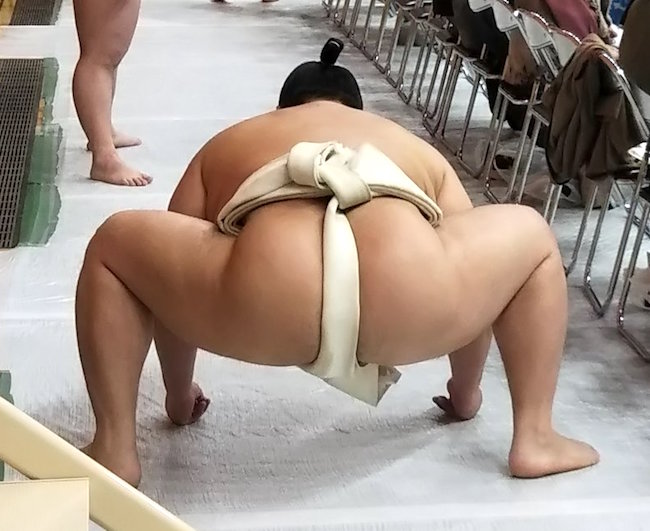
You can see Yoshikaze and Enho there, but they are still not participating in any bouts. Yokozuna and Ozeki, by the way, may sleep separately from the rest, and therefore also arrive separately:
If you recall, practice sessions on the dohyo consist mostly of moshi-ai sessions (winner decides who to call next), interspersed with higher-ranking rikishi going on the dohyo and giving all those who practiced in the most recent session some butsukari. So here are Mitakeumi and Shodai in one of those butsukari intermissions:
After the low-ranking rikishi finish their practice, it’s time for the sekitori to take the dohyo. Again, moshi-ai sessions commence – and Takagenji takes his (evil) twin.
…and this is exactly why Takanofuji is going to be out of that white Mawashi come Natsu.
The sekitori moshi-ai sessions are also punctuated by butsukari sessions. Today’s star is Tokushoryu, a native of Nara prefecture. He therefore gets treated to some Yokozuna butsukari. Kakuryu does the honors:
Eventually, noon arrived, and with it the message to the Japanese nation: the new era that starts May 1st will be called “Reiwa” (令和). The whole nation is very excited about it, and head gyoji, Shikimori Inosuke, sets out to write the auspicious characters on a couple of large signs.
Gyoji serve as clerks when they are off the dohyo and out of their shiny outfits and headgear. They practice calligraphy from the moment they enter the sumo world (which, like rikishi, can be as early as age 15). Gyoji are in charge of writing all those signs with rikishi names on them, writing the banzuke, and so on. And of course, the head gyoji is also the head calligrapher.
And so, the Yokozuna were able to pay their respects to the name of the new era:
Kakuryu, “Reiwa”, Hakuho
By the way, the sharp-eyed kanji readers among you may notice that the nobori behind Kakuryu still has “Kisenosato” on it.
The sign (I think actually a second sign) ended up being hung inside the venue in time for the Makuuchi bouts.
Back to sumo activity, it was time for dohyo-iri. And Nishikigi was pestering Shodai incessantly:
So here is a summary video with some actual bouts:
That is, Ishiura getting a mighty wedgie from Toyonoshima, Tokushoryu showing Takagenji why he may not yet make it to Makuuchi this time, and Takakeisho repeating his senshuraku performance with Tochinoshin.
Finally, how about a pin-up boy? I give you… Endo!
What do you mean “how do you know this is really Endo”?
So, fast forward through Juryo (Arawashi doing well this basho, Enho gets his second loss in a row), we begin with Yutakayama vs. Kotoeko. Kotoeko looking good this basho, and may just be able to get that Makunouchi kachi-koshi which has eluded him so far. He attacks Yutakayama with a harizashi, lifts his arm high, and sends him off to the arms of the time shimpan.
Due to Chiyonokuni’s injury, we have a visitor from Juryo every day, and today it was 0-4 Hakuyozan facing Ishihenka, I mean, Ishiura, who was 4-0. Ishiura tried to get under Hakuyozan’s attack, but as he pulls, his knee folds below him and he finds himself rolling. His first loss, Hakuyozan’s first win.
Toyonoshima slammed into Chiyoshoma and intended to railroad him with his bulk, as he is wont. But the nimble Mongolian freed himself, stepped sideways, and left the veteran to ponder the difficulties of age and sumo.
Kagayaki launches himself head-first into newbie Daishoho‘s chest, keeps himself low, keeps his opponent upright, and clears him from the dohyo. Basic and clean.
The Tomokaze–Terutsuyoshi bout ended almost as soon as it started, with a plain, almost dismissive, hatakikomi. I believe something is wrong with Terutsuyoshi’s legs. He keeps ending up with his center of gravity way ahead of his feet. There is an expression used for this state: “ashi ga nagaremashita” – “his feet have flowed away”. His legs don’t work as fast as he needs to support his lunge.
And the Isegahama pixie is not the only one in trouble. Yoshikaze also didn’t show up for today’s bout. He leads head-first into the tachiai, but Ryuden immediately lands a morozashi – two arms under the opponent’s arms – and Yoshikaze just goes limp. Ryuden is haveng a good basho with 4-1.
Meisei tries to take the initiative against Yago. Doesn’t quite land a grip. Short tsuppari ensues, and then the two engage in migi-yotsu. Meisei only has one layer of Yago’s mawashi, and the Oguruma man patiently maneuvers into a better grip and leads Meisei out.
An impressive Shohozan showed up today to face Sadanoumi. Starting his bout with a harizashi, he lands a grip, and then throws Sadanoumi in a beautiful uwatenage. I want more of this Shohozan.
Ikioi tries hard to keep Kotoshogiku‘s pelvis as far away from him as possible. But eventually the former Ozeki decides to use the pressure against him, moves, and shows him out. Ikioi limps back to his spot to give the bow.
Asanoyama has a good tactic against Aoiyama. Since he is a yotsu man and Aoiyama is known for his fierce tsuppari and soft knees, Asanoyama quickly drives in and gets a fistful of mawashi. But Aoiyama shows versatility, uses a kotenage to release himself from the Takasago man, complements that with a nodowa, and hands Asanoyama his second loss.
Abi starts his bout with Takarafuji, as usual, with that morotezuki and follows with tsuppari. Takarafuji is quite ready for that, patiently weathers it, moves slightly to the left and grabs Abi’s mawashi. Abi manages to release himself, tries a half-hearted hikiotoshi, and fails. Instead, the Isegahama man slaps hard, and Abi rolls all the way to the other side of the dohyo. Olé!
The next bout, Chiyotairyu vs. Okinoumi. Chiyotairyu does his locomotive tachiai. Okinoumi backs up and sidesteps. Chiyotairyu dives into the janome, hands first. And Kimura Konosuke calls it Chiyotairyu’s win! No monoii. I guess the shimpan trust Chiyotairyu’s heya-mate, Konosuke, too much. The replay clearly shows this was a mistake. Okinoumi’s feet are firmly on the tawara, so he is very much alive when Chiyotairyu hits the dirt.
Ichinojo starts off with a harite – it’s not a harizashi as there was no attempt to go for the belt – then follows with a kachiage, and finally paws Onosho down with both arms. Scary. Onosho finds himself in a heap as Ichinojo, as usual, worriedly checks if he hasn’t overdone things. I guess Ichinojo left his sleepy secret twin in Tokyo.
Endo gets a grip on Tochiozan‘s belt right off the tachiai, and rolls him like his favorite barrel of beer. Makiotoshi, Endo’s first win this basho.
Mitakeumi and Hokutofuji clash head-to-head. Mitakeumi leads at first, but Hokutofuji manages to stop the pressure, and it’s Mitakeumi who starts pulling back. Maybe it’s the knee, but whatever it is, the Mitakeumi magic is not working against his fellow komusubi, and after a short halt, again he pulls and finds himself below the dohyo.
After three losses, Tamawashi vindicates himself somewhat in this fierce battle with Takakeisho. Takakeisho leads at first and nearly bounces Tamawashi out the front side of the dohyo, but Tamawashi takes it in his stride, and returns with his own windmill. Tamawashi proves that even in oshi, Takakeisho is not invincible. With two losses in the first trimester, Takakeisho’s Ozeki run seems less certain than it looked before the basho started.
Nishikigi has run out of luck this basho. Takayasu slams into him with all his bear-power. Nishikigi tries an arm lock on the Ozeki’s left arm, but to no avail. Nishikigi is 0-5.
Kaisei and Tochinoshin lock into a “gappuri” stance – firm yotsu. Tochinoshin’s first attempt doesn’t work. There is a short impasse, and then Kaisei makes a mistake and tries to gaburi him, or at least, that’s how it looked. As a result, his center of gravity ends up just where the Ozeki wants it, and he actually lifts the heavy Brazilian – though he quickly abandons the idea. He then adds a couple of pelvis thrusts of his own, to bring his thick opponent across the tawara. 3-2, and his chances of clearing kadoban look slightly brighter.
Goeido treats Shodai like a ragdoll, and the Tokitsukaze man finds himself out of the dohyo almost straight out of the tachiai. What version of Goeido is this? Has his kernel been replaced?
Kakuryu butts heads with Daieisho (not a smart move in the long run, Yokozuna), then immediately pulls. Hatakikomi, and Kakuryu is visibly annoyed with himself. Trouble always begins when Kakuryu pulls. But the win is a win.
I’m not sure what’s going on with Hakuho. The bout itself looked fine. No dominance, but the Yokozuna leading with a kachiage, Myogiryu fending him off, and the Yokozuna coming in again and slapping his opponent to the ground. But like yesterday, he couldn’t quite stop his own movement after finishing his work. Yesterday he ended up in the crowd, and took quite a while to get up from there, and today he ended up doing the splits on top of myogiryu. Control of legs? Dizziness? We won’t know unless he goes kyujo and needs to publish yet another public proof of injury
So that’s the end of Act 1, and we have four men in the leader group – Hakuho, Goeido, Ichinojo and Kotoshogiku. Let’s see what the second trimester brings!
On February 11th, the 9th annual Hakuho Cup event took place at the Ryogoku Kokugikan.
The Hakuho Cup is an annual children sumo event taking place under the auspices of Yokozuna Hakuho. For more details about the event and its history, refer to last year’s report.
This year, again, about 1200 children from 8 countries and regions (Japan, Mongolia, USA, China, South Korea, Thailand, Taiwan and Hong-Kong).
Delegates from the 8 countries and regions sworn in by a Japanese representative
Although this event is not hosted or sponsored by the NSK, many NSK employees (read: active rikishi and oyakata) took part in it. The event included both team competitions and individual competitions. While delegates from the various countries and regions outside Japan generally formed teams based on their country of origin, and thus wrestled with the name of their country marked on their mawashi, the large Japanese cohort was made of various teams training together – some of which were associated with rikishi. Here, for example, is Team Aminishiki:
These boys are all from Aomori, Aminishiki’s home prefecture.
Rikishi participation did not end just at leading teams. Many sekitori served as shimpan during the competition:
Terutsuyoshi
Enho
Also attended: Mitakeumi, Abi, Tobizaru, Ishiura (of course), Toyonoshima, as well as Kotoshogiku and Yoshikaze and more. The highest ranking visitor was Yokozuna Kakuryu, who seemed to enjoy himself very much indeed:
Oyakata ranged from the recently retired Oshiogawa (Takekaze) and Sanoyama (Satoyama), through Tomozuna oyakata, Hakuho’s own Miyagino oyakata, to Futagoyama oyakata (Miyabiyama). The latter had a personal interest in the competition, as his own son participated. Last year, his son won two bouts. This year, the proud father reports, he won three.
Hakuho also hoped his own 10 years old son, Mahato, will win one bout more than he did last year. But alas, he was taken down in his first match by a smaller kid.
Mahato, in his mawashi marked “Hakuho”. Of course he belonged to Team Hakuho.
During lunch break, Hakuho had what the Japanese call “Talk show” (an on-stage, or in this case, on-dohyo, live interview), and this time, the “surprise” guest was former Ozeki Konishiki.
Hakuho asked Konishiki who were the opponents he found most difficult to fight. Konishiki listed Akinoshima, Chiyonofuji and Kotokaze.
Speaking of lunch, an 11-hour event with thousands of children requires a lot of food. Hakuho took care to complement the meal with an order of 1000 pieces of cake, which immensely cheered the children up.
The children competed in teams as well as individual matches. Among all the bouts, at times taking place on three separate dohyos, one in particular drew much attention. Take a look at this wonderful match:
Motomura hangs in there
It’s interesting to see Hakuho in the background. At first he plays around with his phone, and then as the match progresses he lets go of it and watches the bout with rapt attention. Marvelous sumo, which I’ve seen described on the net as “A mix of Enho, Satoyama and Ura”.
Motomura, of Team Kotoshogiku, the David in this David-and-Goliath match, also won the technique prize for this bout. Yes, the Hakuho Cup also includes special prizes. While the yusho trophies are handed by Hakuho himself, the special prizes were handed by sekitori:
Motomura looks quite overwhelmed there. I also find Ishiura’s expression, when he realizes he is the tallest man on the dohyo, rather entertaining.
Here is the summary video of the event – where you can catch Mahato’s failed bout, a different angle of Motomura’s bout, and many smiles and tears:
And if you have 11 hours to spare, here is the full event, which was streamed live on YouTube.
(If anybody is wondering, SANKYO, the sponsor, is a manufacturer of pachinko machines).
It’s that time of the year again. It’s February, and there is no Jungyo. If you take a look at the Grand Sumo Calendar, though, you’ll see that there are always two hana-zumo events in this month: The NHK charity event, and Fuji TV’s Grand Sumo Tournament.
Hana-Zumo is exhibition sumo. The name literally means “flowor sumo”. This is because in the Heian era, events like that took place in the Imperial Palace, and there were no “East” and “West” then. So the rikishi were distinguished by flowers they wore in their hair.
NHK’s #52 Charity Sumo Event
The special feature of this event is the song contest at the end. One side of the Kokugikan is fenced off, and set up as a huge stage.
The event includes extras such as Jinku, drum demonstration, Shokkiri, and Yokozuna rope tying demonstration.
Kasugaryu putting the finishing touches on Hakuho’s rope.
There is also what the Japanese call “A talk show”, which is actually an on-stage interview with some celebrity. In this event, they interviewed the former Takekaze, now Oshiogawa oyakata.
In fact, we had several new oyakata faces in the blue NSK jackets.
Sanoyama oyakata
Oshiogawa oyakata
Araiso oyakata
Here is a short video report about this event from NHK:
The former Takekaze says: “I didn’t imagine I’ll get to age 39, nearly 40, in any shape. If someone like me can do it, than anybody can!”
This is a “regular” sumo event in that bouts are more or less by ascending banzuke order ending with the san-yaku members doing san-yaku soroi-bumi (synchronized shiko). As always, Hakuho awaits his turn to do the soroi-bumi leaning on the shoulders of a Yobidashi:
And I also have a bout for you from this event – the musubi-no-ichiban, Kakuryu vs. Hakuho (bonus bow twirling ceremony):
You may notice that Hakuho is far from being in shape for sumo. He does this bout with his right leg mostly floating up in the air. There are several rikishi who are kyujo from this event, but Hakuho is not one of them, as absenting himself from the hana-zumo event would prevent him from participating in any events – such as weddings, and the Hakuho Cup, which of course he doesn’t want to miss. So he participates on one leg.
The Fuji TV event comes the day after the NHK event. It includes sumo in elimnation format – both Juryo and Makuuchi. The special feature of this event is the veteran bouts – with oyakata putting on their shimekomi and doing sumo.
Refer to the link at the end of this post for the veteran bouts themselves.
The former Kisenosato had his debut as a commentator in this event. He readily speaks, but I think they should leave commenting to someone who speaks more clearly.
Two former yokozuna as Statler and Waldorf
Since the active rikishi bouts are arranged in elimination format, it means there are winners in this event. Much like a honbasho yusho, winning this tournament means receiving many prizes. There is a trophy:
Takayasu’s first yusho… in the Grand Sumo Tournament hana-zumo event, that is
And there is an air-conditioner:
This will come in handy in the next Nagoya basho
There are also a bale of rice, a lot of beef, a 10-day cruise around Japan. All went to Takayasu, who had to earn them by going through a very genki Yoshikaze. Take a look at Yoshikaze vs. Shohozan:
Hakuho, again, doing his sumo on one leg and getting eliminated in his first round.
The veteran bouts. The most impressive one is Kyokutenho. Robocop does a lot of pre-bout robot stuff, but Inagawa oyakata eliminates him rather easily. The most balanced bout is the one between Magaki and Kumagatani.
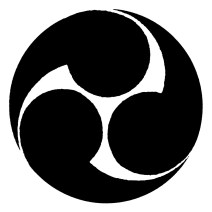
Azumaryu wins the Juryo tournament. This was done in such a way that the final was held between three wrestlers – like a three-way playoff. In Japanese you’ll heard the word “Tomoe Ketteisen”. This alludes to a mitsu-domoe:
Ryuden’s matta. And another matta.
Yoshikaze vs. Abi – continuing his genki performance.
Araiso oyakata in his role as a commentator. He is mostly asked to comment about Takayasu.