You can see Yoshikaze and Enho there, but they are still not participating in any bouts. Yokozuna and Ozeki, by the way, may sleep separately from the rest, and therefore also arrive separately:
If you recall, practice sessions on the dohyo consist mostly of moshi-ai sessions (winner decides who to call next), interspersed with higher-ranking rikishi going on the dohyo and giving all those who practiced in the most recent session some butsukari. So here are Mitakeumi and Shodai in one of those butsukari intermissions:
After the low-ranking rikishi finish their practice, it’s time for the sekitori to take the dohyo. Again, moshi-ai sessions commence – and Takagenji takes his (evil) twin.
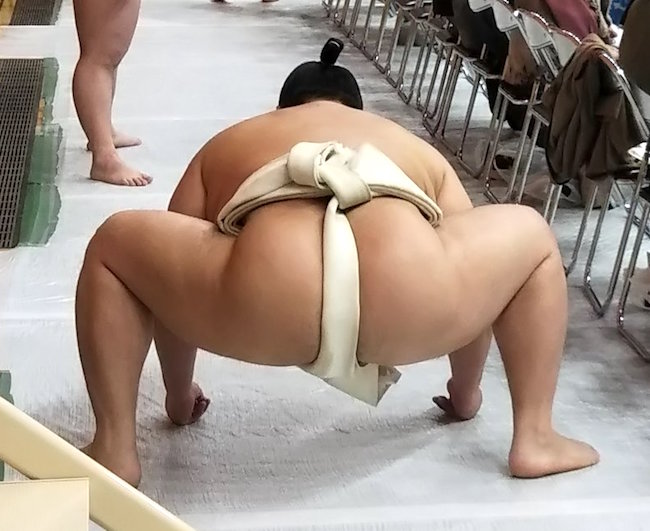
…and this is exactly why Takanofuji is going to be out of that white Mawashi come Natsu.
The sekitori moshi-ai sessions are also punctuated by butsukari sessions. Today’s star is Tokushoryu, a native of Nara prefecture. He therefore gets treated to some Yokozuna butsukari. Kakuryu does the honors:
Eventually, noon arrived, and with it the message to the Japanese nation: the new era that starts May 1st will be called “Reiwa” (令和). The whole nation is very excited about it, and head gyoji, Shikimori Inosuke, sets out to write the auspicious characters on a couple of large signs.
Gyoji serve as clerks when they are off the dohyo and out of their shiny outfits and headgear. They practice calligraphy from the moment they enter the sumo world (which, like rikishi, can be as early as age 15). Gyoji are in charge of writing all those signs with rikishi names on them, writing the banzuke, and so on. And of course, the head gyoji is also the head calligrapher.
And so, the Yokozuna were able to pay their respects to the name of the new era:
Kakuryu, “Reiwa”, Hakuho
By the way, the sharp-eyed kanji readers among you may notice that the nobori behind Kakuryu still has “Kisenosato” on it.
The sign (I think actually a second sign) ended up being hung inside the venue in time for the Makuuchi bouts.
Back to sumo activity, it was time for dohyo-iri. And Nishikigi was pestering Shodai incessantly:
So here is a summary video with some actual bouts:
That is, Ishiura getting a mighty wedgie from Toyonoshima, Tokushoryu showing Takagenji why he may not yet make it to Makuuchi this time, and Takakeisho repeating his senshuraku performance with Tochinoshin.
Finally, how about a pin-up boy? I give you… Endo!
What do you mean “how do you know this is really Endo”?
Here we are back with the Jungyo reports, where we will be trying to quench some of your thirst for sumo while we are all waiting for the next tournament.
As a reminder, the Jungyo is a regional tour the sekitori – accompanied by tsukebito and support crews – go on during four of the even-numbered months, bringing sumo to small towns and giving the locals an opportunity to see some keiko and some sumo and interact with favorites.
The Haru Jungyo traditionally begins with a dedication at Ise Grand Shrine – the holiest shrine – located in and around Ise city, Mie prefecture.
As this was a day of dedication ceremonies, it did not include the usual “shake hands with your favorite rikishi” part. The brass had to go perform ceremonies at the main shrines. The Ise Grand Shrine is actually a cluster of shrines. The two main ones are called Naiku and Geku. Ceremonies took place in both locations – about 6km apart.
The tail of the procession – current Ozeki, followed by a tiny shin-Ozeki
The rikishi and NSK brass offered prayers. The rikishi – including some additional san-yaku – were then purified by the priests
The Yokozuna performed dohyo-iri, and the top six san-yaku rikishi then performed synchronized shiko – “sanyaku-soroi-bumi”, similar to that which is performed on senshuraku.
Heading back to more secular activities, perhaps I should start with a list of kyujo. Five rikishi are absent from the Jungyo altogether: Takayasu (lower back issues), Ichinojo (herniated disk), Ikioi (general wreck), Chiyonokuni (Still recovering from operation), and Juryo’s Hakuyozan (who broke a bone during the basho if I’m not mistaken).
In addition, some rikishi are present but not participating in torikumi. Hakuho is basically doing only dohyo-iri and ceremonial functions. Enho had issues with his shoulder through most of the basho and is not on the torikumi list, and Yoshikaze is also not on it.
Enho. Present but not fighting.
Some of the above will be back in action at some point in the Jungyo, and I’ll try to keep you posted when they are.
Back at the venue – which, as you can see in the photo above, is an open facility, but very nicely set up – keiko started out early in the morning. Here is Kiribayama’s practice with Shimanoumi:
This is the only practice video the NSK Twitter account offers – probably because its subject, Shimanoumi, was the star of the day, being a native of Shima city, Mie prefecture.
Following practice, the lower rank bouts, as well as the usual performances of Shokkiri, Jinku, and drum demonstrations took place, giving the sekitori time to have lunch and wear their kesho mawashi. Some kids got their photos taken with ozeki:
Ozeki are like quarks. Here we have a down ozeki, a strange ozeki, and an up ozeki.
This photo-op is what replaces kiddie sumo these days.
Waiting for dohyo-iri back in the venue was no mean feat. The venue, as already mentioned, is an open facility. And it was cold.
Even cold-blooded Mongolians suffered, never mind the poor, suffering Brazilian.
Some fans took the opportunity to ask for autographs and the like. Sadanoumi impressed the fans as he signed an autograph with a proper calligraphy brush:
While the lower divisions’ – including Juryo – bouts took place in the usual fashion, Makuuchi was split into two sets of competitions. The bottom to middle rikishi were in normal, one bout per rikishi fashion. The top, however, participated in an elimination tournament called the “Senshiken”.
In the previous Haru Jungyo, Hakuho won the senshiken, and so he had to hand back the yusho flag:
As top yokuzuna, he also led the senshi vow (“senshi” (選士) here is a word that means “chosen”, but I suspect it’s used as a combination of “athlete” (選手, “senshu”) and “rikishi” (力士)).
I think Kotoyuki’s bout with Chiyomaru is funnier than Shokkiri. Of course, Shimanoumi stars in this summary, but there are several other torikumi for your pleasure.
So, fast forward through Juryo (Arawashi doing well this basho, Enho gets his second loss in a row), we begin with Yutakayama vs. Kotoeko. Kotoeko looking good this basho, and may just be able to get that Makunouchi kachi-koshi which has eluded him so far. He attacks Yutakayama with a harizashi, lifts his arm high, and sends him off to the arms of the time shimpan.
Due to Chiyonokuni’s injury, we have a visitor from Juryo every day, and today it was 0-4 Hakuyozan facing Ishihenka, I mean, Ishiura, who was 4-0. Ishiura tried to get under Hakuyozan’s attack, but as he pulls, his knee folds below him and he finds himself rolling. His first loss, Hakuyozan’s first win.
Toyonoshima slammed into Chiyoshoma and intended to railroad him with his bulk, as he is wont. But the nimble Mongolian freed himself, stepped sideways, and left the veteran to ponder the difficulties of age and sumo.
Kagayaki launches himself head-first into newbie Daishoho‘s chest, keeps himself low, keeps his opponent upright, and clears him from the dohyo. Basic and clean.
The Tomokaze–Terutsuyoshi bout ended almost as soon as it started, with a plain, almost dismissive, hatakikomi. I believe something is wrong with Terutsuyoshi’s legs. He keeps ending up with his center of gravity way ahead of his feet. There is an expression used for this state: “ashi ga nagaremashita” – “his feet have flowed away”. His legs don’t work as fast as he needs to support his lunge.
And the Isegahama pixie is not the only one in trouble. Yoshikaze also didn’t show up for today’s bout. He leads head-first into the tachiai, but Ryuden immediately lands a morozashi – two arms under the opponent’s arms – and Yoshikaze just goes limp. Ryuden is haveng a good basho with 4-1.
Meisei tries to take the initiative against Yago. Doesn’t quite land a grip. Short tsuppari ensues, and then the two engage in migi-yotsu. Meisei only has one layer of Yago’s mawashi, and the Oguruma man patiently maneuvers into a better grip and leads Meisei out.
An impressive Shohozan showed up today to face Sadanoumi. Starting his bout with a harizashi, he lands a grip, and then throws Sadanoumi in a beautiful uwatenage. I want more of this Shohozan.
Ikioi tries hard to keep Kotoshogiku‘s pelvis as far away from him as possible. But eventually the former Ozeki decides to use the pressure against him, moves, and shows him out. Ikioi limps back to his spot to give the bow.
Asanoyama has a good tactic against Aoiyama. Since he is a yotsu man and Aoiyama is known for his fierce tsuppari and soft knees, Asanoyama quickly drives in and gets a fistful of mawashi. But Aoiyama shows versatility, uses a kotenage to release himself from the Takasago man, complements that with a nodowa, and hands Asanoyama his second loss.
Abi starts his bout with Takarafuji, as usual, with that morotezuki and follows with tsuppari. Takarafuji is quite ready for that, patiently weathers it, moves slightly to the left and grabs Abi’s mawashi. Abi manages to release himself, tries a half-hearted hikiotoshi, and fails. Instead, the Isegahama man slaps hard, and Abi rolls all the way to the other side of the dohyo. Olé!
The next bout, Chiyotairyu vs. Okinoumi. Chiyotairyu does his locomotive tachiai. Okinoumi backs up and sidesteps. Chiyotairyu dives into the janome, hands first. And Kimura Konosuke calls it Chiyotairyu’s win! No monoii. I guess the shimpan trust Chiyotairyu’s heya-mate, Konosuke, too much. The replay clearly shows this was a mistake. Okinoumi’s feet are firmly on the tawara, so he is very much alive when Chiyotairyu hits the dirt.
Ichinojo starts off with a harite – it’s not a harizashi as there was no attempt to go for the belt – then follows with a kachiage, and finally paws Onosho down with both arms. Scary. Onosho finds himself in a heap as Ichinojo, as usual, worriedly checks if he hasn’t overdone things. I guess Ichinojo left his sleepy secret twin in Tokyo.
Endo gets a grip on Tochiozan‘s belt right off the tachiai, and rolls him like his favorite barrel of beer. Makiotoshi, Endo’s first win this basho.
Mitakeumi and Hokutofuji clash head-to-head. Mitakeumi leads at first, but Hokutofuji manages to stop the pressure, and it’s Mitakeumi who starts pulling back. Maybe it’s the knee, but whatever it is, the Mitakeumi magic is not working against his fellow komusubi, and after a short halt, again he pulls and finds himself below the dohyo.
After three losses, Tamawashi vindicates himself somewhat in this fierce battle with Takakeisho. Takakeisho leads at first and nearly bounces Tamawashi out the front side of the dohyo, but Tamawashi takes it in his stride, and returns with his own windmill. Tamawashi proves that even in oshi, Takakeisho is not invincible. With two losses in the first trimester, Takakeisho’s Ozeki run seems less certain than it looked before the basho started.
Nishikigi has run out of luck this basho. Takayasu slams into him with all his bear-power. Nishikigi tries an arm lock on the Ozeki’s left arm, but to no avail. Nishikigi is 0-5.
Kaisei and Tochinoshin lock into a “gappuri” stance – firm yotsu. Tochinoshin’s first attempt doesn’t work. There is a short impasse, and then Kaisei makes a mistake and tries to gaburi him, or at least, that’s how it looked. As a result, his center of gravity ends up just where the Ozeki wants it, and he actually lifts the heavy Brazilian – though he quickly abandons the idea. He then adds a couple of pelvis thrusts of his own, to bring his thick opponent across the tawara. 3-2, and his chances of clearing kadoban look slightly brighter.
Goeido treats Shodai like a ragdoll, and the Tokitsukaze man finds himself out of the dohyo almost straight out of the tachiai. What version of Goeido is this? Has his kernel been replaced?
Kakuryu butts heads with Daieisho (not a smart move in the long run, Yokozuna), then immediately pulls. Hatakikomi, and Kakuryu is visibly annoyed with himself. Trouble always begins when Kakuryu pulls. But the win is a win.
I’m not sure what’s going on with Hakuho. The bout itself looked fine. No dominance, but the Yokozuna leading with a kachiage, Myogiryu fending him off, and the Yokozuna coming in again and slapping his opponent to the ground. But like yesterday, he couldn’t quite stop his own movement after finishing his work. Yesterday he ended up in the crowd, and took quite a while to get up from there, and today he ended up doing the splits on top of myogiryu. Control of legs? Dizziness? We won’t know unless he goes kyujo and needs to publish yet another public proof of injury
So that’s the end of Act 1, and we have four men in the leader group – Hakuho, Goeido, Ichinojo and Kotoshogiku. Let’s see what the second trimester brings!
It’s the end of the winter Jungo. The two towns of Tsuchiura and Ushiku probably planned this event with the intention of celebrating the return of Kisenosato. Takayasu comes from Tsuchiura, while Kisenosato comes from Ushiku. However, since the event was planned, Kisenosato had the disastrous Kyushu basho, followed by a long kyujo.
And so, Takayasu had to be the star of the day, all on his own.
Hey Takayasu! Today you are going to get so… loved… by the Yokozuna! Enjoy!
But there were other rikishi in the venue as well! There was Aminishiki, showing one of those rarer and rarer smiles:
I guess being around his heya’s yobidashi, Teruya, makes Uncle Sumo happy.
Ichinojo managed to convince Mitoryu to let him play a little
Mitoryu doesn’t seem to take this too seriously, though.
Kakuryu practiced with hand weights. In the past, this exercise was mostly associated with Harumafuji.
Shohoryu watches and learns.
Hakuho, on the other hand, was working mainly on his legs. He started with plain suri-ashi:
Hehe… Yokozuna, try the Abi shiko. It will do wonders for your thighs (and your dohyo-iri)!
I wonder if the reason they called this janitor was to clean up after him…
There’s something very familiar about this janitor, though…
On the dohyo, the usual moshi-ai sessions took place, and there were several lengthy kawaigari sessions for the spectators to enjoy. Kakuryu decided to give his former tsukebito, Gokushindo, some love
Gokushindo took this as an encouragement to get himself back to sekitori status as soon as possible. He is going to drop back to Makushita tomorrow when the Banzuke is published. “Get back to the white mawashi quickly and you’ll be able to practice with me again!”, so to speak.
Goeido once again took on Chiyonoumi. I’m not sure why exactly, but hey, as long as somebody loves my man from Kochi!
Among the encouragement calls for Takayasu were also shouts of “Thank you, Hakuho!” coming from the Ozeki’s townspeople. Hearing this, the Yokozuna reacted: “The people of Ibaraki know their sumo”.
Which tells me the Yokozuna is well aware of the latest outrage campaign against his “evil kawaigari” going through the social media.
Poor Takayasu had to go through a lot of adoring fans when he got finished with that lovemaking session:
Note Abi tugging at Kagayaki to get him to respond to some fans his eye caught. Kagayaki obliges. It seems he is softening a bit! He also had a lively chat with Abi while they were both at the side of the dohyo waiting for their respective bouts. Maybe it’s the effect of Tamawashi’s kiss! 😘
I have two bout clips today. Here is Endo vs. Chiyoshoma: