Turning pro: does amateur sumo success translate?

Perhaps it’s my American sensibility showing (the NFL Draft brought over half a million people to my hometown in 2019), but the amateur-to-pro sumo prospect pipeline has been on my mind for quite some time. After several dark years where four All-Japan Amateur Yokozuna in a row (2017–2020) chose not to join Grand Sumo (one, Hidetora Hanada, is currently trying to make it in the Canadian Football League!), there has been a resurgence of amateur talent joining the pro ranks. In May this trend culminated in the debut of perhaps the most successful amateur wrestler of all time, Daiki Nakamura (now “Onosato”), and so I thought it might be fun to look through the record books and ask, “how does amateur sumo success translate to the professional level?”

In my examination I’ve gone back as far as 2008, because that’s the furthest back one can go and still find an active pro wrestler with a major amateur title (Myogiryu). I used this list from the very helpful sumoforum.net as my principal resource (it’s hard out there for us English-only sumo fans).

First, what do I mean by “amateur success?” There are many amateur tournaments and titles in Japanese sumo, but they are not all created equal. For the purposes of this article, I’m limiting my analysis to only the tournaments that can grant an amateur wrestler a higher debut ranking in Grand Sumo. For the most part, this means university-aged wrestlers and older. There are many prestigious high school titles, and many “high school Yokozuna” enter pro sumo as top prospects, but they must do so from the bottom rung, and for even the best it takes years to reach the salaried ranks from Jonokuchi.

Grand Sumo officially recognizes four in particular as major titles. They are the Kokutai Tournament, the University Championship, the Corporate Sumo Championship, and the most prestigious, the All-Japan Amateur Championship. The University Championship is for college students only, while the Corporate Championship is open only to non-students sponsored by their employer. The Kokutai and the All-Japan Amateurs are open to both, though their qualifying structures are very different (prefectures select their own representatives for the Kokutai, and notably, high school Yokozuna as well as university and corporate stand-outs are given bids to the All-Japan Amateurs). Winning any one of these tournaments (or even coming close) grants you a higher debut rank in Grand Sumo—Makushita 15 for winners, Sandanme 90 for runners up—and winning multiple titles grants you the highest debut rank you can earn: Makushita 10 Tsukedashi.

Since 2008 there have been eighteen men who have won an amateur title and then turned pro, and most have come from the university ranks, where a few powerhouse universities dominate. In particular, rivals Nihon University and Nippon Sport Science University can boast alumni of most of the wrestlers on the list below (for Americans, they are the Alabama and Ohio State of college sumo). There are some notable “corporate” stand-outs as well, however.

Shikona (Amateur titles) — Highest career pro rank as of July 2023

Myogiryu (Kokutai ’08) — Sekiwake

Jokoryu (University ’08) — Komusubi

Chiyotairyu (University ’10 + Kokutai ’10) — Komusubi

Shodai (University ’11) — Ozeki

Daikiho (Kokutai ’11) — Maegashira 16

Endo (All-Japan Amateur ’12 + Kokutai ’12) — Komusubi

Hokutofuji (University ’12 + Kokutai ’13) — Komusubi

Daishomaru (All-Japan Amateur ’13) — Maegashira 5

Ichinojo (Corporate ’13) — Sekiwake

Mitakeumi (All-Japan Amateur ’14 + University ’14) — Ozeki

Daiamami (Corporate ’15) — Maegashira 11

Mitoryu (All-Japan Amateur ’15 + University ’16) — Maegashira 15

Yago (All-Japan Amateur ’16) — Maegashira 10

Tochimusashi (University ’18) — Juryo 7

Oshoma (University ’20) — Juryo 3

Kiho / Kawazoe (University ’21) — Juryo 13

Hakuoho / Ochiai (Corporate ’22) — Maegashira 17

Onosato (All-Japan Amateur ’21, ’22 + University ’19 + Kokutai ’19, ‘22) — Makushita 3


At first glance, the answer to our question seems to be, “it depends.” But the base level seems clear. Every man on this list from 2008—2016 has achieved at least a Makuuchi promotion. Of those thirteen, eight (over half) have reached san’yaku, and two, Shodai and Mitakeumi, have attained the coveted title of Ozeki. It is also worth noting that those thirteen men have five top division yusho between them.

To me these observations are significant and suggest that our expectation for the last five men on the list, who have all been pros for 14 basho or less, should be at least a Maegashira ranking. San’yaku also seems a safe bet, though above that is anyone’s guess. Barring injury or scandal, however, they all have the potential to achieve top division success.

This is quintuply true for the aforementioned Onosato. Keen eyes will have already noted that no wrestlers on the above list have more than two amateur titles to their name—except for one. Onosato, being a 5-time amateur champ, has been heaped with high praise and higher expectations since well before his Ms10TD debut this May, and if he does not rocket up the banzuke it will be considered a colossal bust.

Let’s not worry about that yet, though. So far, our hot prospects have not disappointed. Oshoma, Tochimusashi, and Ochiai (now Hakuoho) already have lower division titles to their names, Kawazoe (now Kiho) just earned his Juryo promotion, and Onosato, with a debut 6-1 record (he won 6 straight after losing his very first bout to wily Ishizaki), is poised for salaried promotion by summer’s end. And these men are just the blue-chip prospects; there are too many young talents to count climbing their way up the banzuke right now. Sumo has been going through a strange transition since the retirement of the last era’s stars, but it seems a bright and competitive future is right around the corner with the next generation. I’m expecting at least one new Ozeki from the names above, and a lot of fun new rivalries besides. In particular, Nishonoseki stable (led by former Yokozuna Kisenosato) seems to be collecting Nippon Sports Science grads like Onosato and Takahashi, while Miyagino (former Yokozuna Hakuho) seems to favor Nihon University stars like Kiho and Otani, as well as some of the top high schoolers such as Hakuoho and Hokuseiho. Let’s hope these amateur-to-pro rivalries take all involved to the next level!

Retrospective – The Cowboy Cup Tournament

On Saturday, June 11th, the Dallas Sumo Club held the first ever “Cowboy Cup” sumo tournament. Dallas Sumo oyakata Corey Morrison came up with the idea to hold an amateur sumo tournament in conjunction with FitCon the weekend of the 11th, in Ft. Worth Texas. What he could not have predicted at the time was how blasted hot it would be that day – more on that soon.

After seeing some amateur sumo tournaments struggle to put together a solid program, Corey was dedicated to doing the absolute best he could his first time out. The results were quite impressive. He gathered athletes from across the US to the DFW area, holding competition in 4 divisions, including a women’s division. I think that every sumo club in the state was represented in some form or other, and everyone had a great time, in spite of a temperature that reached 108°F in the shade of the club’s enormous tent.

I had the honor of being part of the commentary team for the 4+ hour live stream, that seems to have gone off flawlessly. It featured a live feed of each match, the random comments of myself and Laurie from Sumo Kaboom, and some interviews with class winners and VIPs. If you want to check out the live stream, you can find it here – https://www.youtube.com/watch?v=d_xHzuoKDFQ

Jake from Grand Sumo Breakdown joined up, and produced the actual brackets, announced the matches and the winners. There were a set of shimpan who recorded matches on their phones from the corners of the dohyo, and on the occasions where a monoii was required, the crew reviewed the phone camera video to see who had won.

The Women’s Division

This is the first amateur sumo tournament I have been a part of, and it was quite excellent. Sumo seems to have taken deep root in Texas, with clubs in Dallas, Austin and San Antonio at a minimum, and with each club gaining members as they go along. My congratulations to the US sumo community, the Dallas Sumo Club, and Corey Morrison for putting on a fantastic show.

If you live in Texas, and would like to give sumo a try, the clubs are quite welcoming to new joiners, I urge you to give it a shot.

This Weekend – Cowboy Cup Sumo Tournament

Saturday June 11th, at the Panther Island Pavilion in Ft Worth, the Dallas Sumo Club will be holding the “Cowboy Cup” amateur sumo event. Scheduled to run from noon to 4:00 PM, the tournament will feature rikishi from the local sumo club, Dark Circle in Austin, Mighty Eagle sumo from San Antonio, along with competitors from across the country.

Your truly will be part of the crew putting on the event, and you may even hear my voice on the live stream that is schedule to accompany the action at the Panther Island Pavilion. If you are in the greater DFW area, and wish to come watch, you can purchase tickets here – get tickets

If you wish to compete, this is the link for you – enter to compete

There will be a fair number of US sumo media people, including Jake from Grand Sumo Breakdown, Leslie from Sumo Kaboom, and of course my own self.

This should be a fun and interesting competition, it is taking place outdoors, in Texas, in June on a day when the temperature will be above 100°F (~38°C). If you come, bring some shade and be ready for red hot sumo!

Checking in on the Waseda Sumo Club

This week there’s been a flurry of activity on the Waseda Sumo Club’s blog. Most are authored by the club’s manager, a junior named Yoshimura.

They have set up a YouTube channel with a couple of short test videos featuring some practice bouts between Hashimoto (橋本) and Igarashi (五十嵐). One looks like a yorikiri win by Hashimoto and the other a hatakikomi win by Igarashi. If UNC (my alma mater) had a keiko-ba like this, I would have jumped at the chance to join. It looks like fun!

Seeing a woman with a mawashi reminds me of Lisa, my roommate’s girlfriend, and a few of her friends — not because she wore a mawashi but she was a gymnast, and I swear she would have destroyed me. I seem to remember she won more than a few sparring sessions against Matt in the living room, come to think of it. Sorry, these were in the days before YouTube so I do not have footage of those classic bouts. I did have a digital camera back then (I’ve always been an early adopter) but it had a floppy disk inside of it and the image quality wasn’t even anywhere near what you could get with one of those disposable cameras. And it definitely would not have handled video.

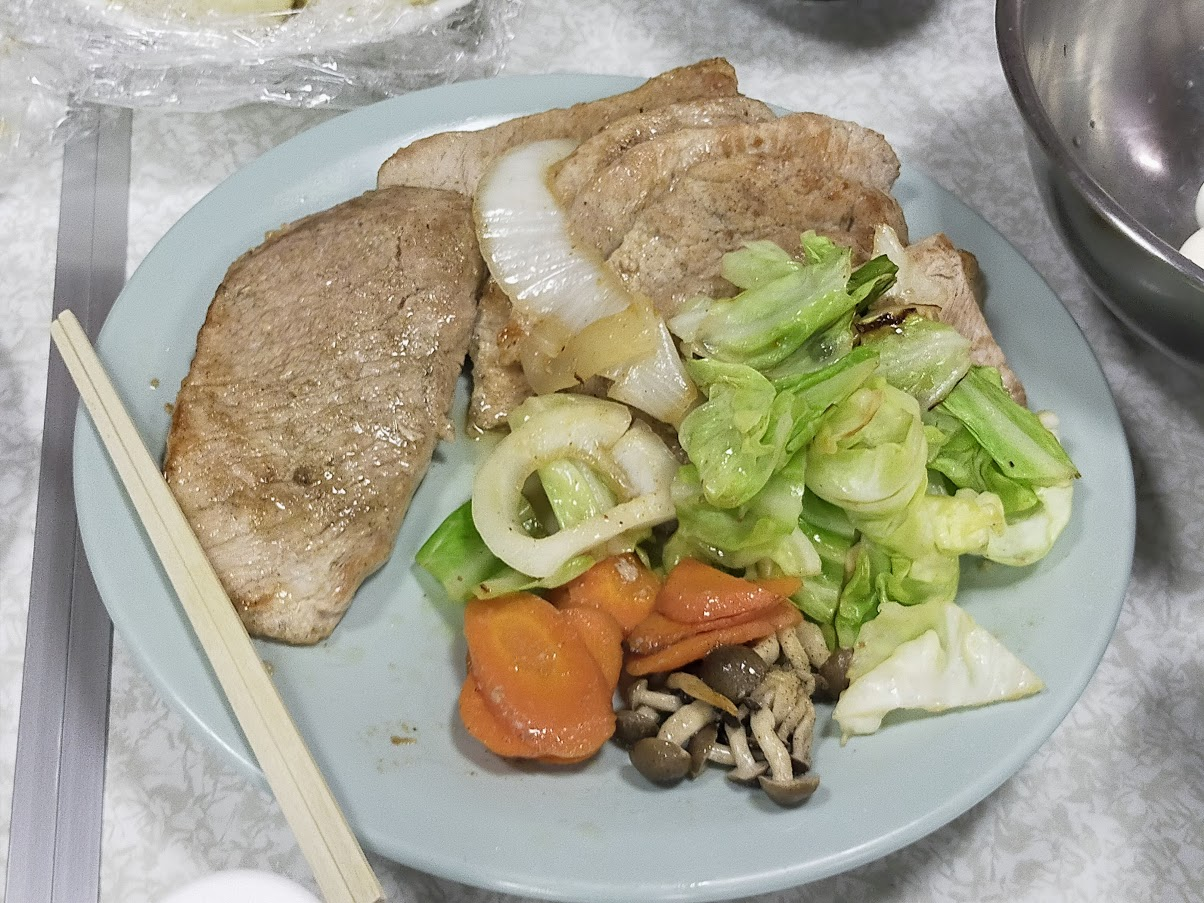
Waseda Chanko — 美味しそう!

Now that I’m in undergraduate-nostalgia-mode, I recall my diet in college was probably not optimal for competitive sumo. I think I would have had fewer pizzas, fried chicken tenders, fries, and pancakes if I had a sumo club. Instead, perhaps I would have eaten better chanko like what we see from the other posts this weekend. What we see here from Waseda’s post is a simple dish but would have been better than most cafeteria food and certainly better than what I would have been eating.

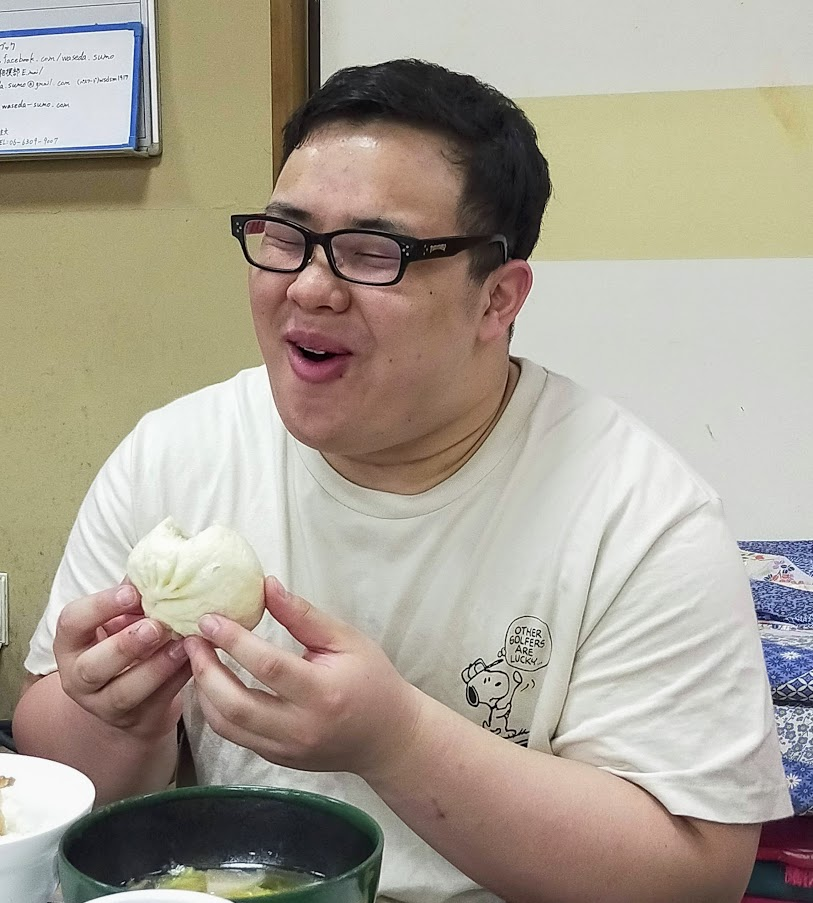
Yes, those pork buns are THAT good

The shimeji mushrooms strike me, in particular, because for like 25 years I thought I hated mushrooms — until I had one of these. I was at an izakaya called Yume (夢) in Hodogaya, close to the station. I think it’s along the highway 第一京浜 or close to the big intersection there. Or at least it was. It’s been ages. I got the mushrooms as one of those little dishes that they serve you before your meal (前菜), kinda like an appetizer. I used to go there for the buta kimchi (pork with kimchi) and to be polite I ate what was given to me, and they were fantastic. That’s actually how this “Southern Boy” had okra for the first time, too. I think the okra was served simply with sesame or something. Delicious.

Anyway, until that day I had thought all mushrooms were those terrible, bland “button” things they put on pizza and in salads here in the US. It turns out they’re not all the same. (I know, shocker, right?) I like shimeji while my wife is more of a fan of enoki. There are so many different kinds of mushrooms and some are absolutely amazing (others aren’t) but there’s so much variety. Why don’t we learn this stuff in elementary school? This is basic. Nowadays I’m actually jealous of makuuchi yusho winners getting that giant container of shiitake. Mmmmmmm….

Back on topic, the pork here was a gift from Waseda supporters, along with rice, nikuman (pork buns) and protein supplements, given by family and other supporters. This environment would foster a bit more community and more of the atmosphere I missed out on in college by choosing to double major in MarioKart and Bond.

With Ajigawa and Araiso’s new links to Waseda, in particular, it would be great to see more attention to University sumo in general. We also learn from Yoshimura’s post that the sumo club would have normally eaten with their supporters but these COVID times are weird for everyone. This is their way of showing what they did with it and showing appreciation. Another post from this past week brings us back to that Zoom Roundtable which featured Ajigawa and Demon Kakka. That would be an awesome Chanko-kai.