The following assumes that Nishikigi will stay in Makuuchi, Meisei will be demoted, and Tobizaru and Chiyoshoma will stay in Juryo. Those 3 all have a strong claim to J1, so someone will be a bit unlucky to be ranked J2. I did not worry too much about correctly guessing the East/West side, or even being off by a rank here and there, like I do with my Makuuchi banzuke projections. Still, this should give a good idea of what the second division will look like next time out.
Meisei Chiyoshoma
Tobizaru Tochiozan
AzumaryuDaiamami
Hidenoumi Kyukushuho
Kyokutaisei Ichinojo
Tsurugisho Hoshoryu
Daishomaru Hakuyozan
Daishoho Churanoumi
Wakamotoharu Chiyootori
Akiseyama Kizakiumi
Akua Midorifuji
Takagenji Asabenkei
Mitoryu Choyonoumi
FujiazumaChiyonoo
Makuuchi demotions in bold, Makushita promotions in italic. Several of the most interesting rikishi in Juryo should be up in the top division next time: Terunofuji, Wakatakakage, and Kotoshoho. If Tobizaru isn’t promoted this time, we can keep an eye on him, and with projected ranks of J5 and J6, Ichinojo and Hoshoryu are creeping up into promotion range.
Makushita Joi
Who will be ranked in the top 10 slots (Ms1-Ms5) in the third division, where a winning record can vault a rikishi to sekitori status? First in line is incumbent Ms2 Kotodaigo, who narrowly missed out on Juryo promotion despite a 4-3 record. Ms1 Sakigake should also hang around the promotion zone with his minimal 3-4 make-koshi.
Then we have the Juryo demotions: Yago and Asagyokusei. Absent Tomokaze will fall below Ms5. The remaining 6 slots should go to rikishi in upper Makushita with winning records. The likely list is Ms7 Oki (5-2), Ms8 “Prince” Naya (4-3), Ms9 Kaisho (4-3), Ms9 Chiyoarashi (4-3), Ms11 Jokoryu (5-2) and Ms13 Ryuko (5-2).
Bonus: Ones to Watch
Many of the “Ones to Watch” have hit the wall in upper Makushita (Ms8 Roga and Ms10 Oshoryu, the rikishi formerly known as Motobayashi, both 2-5) or further down the banzuke (Sd26 Hokutenhai, 3-4). Two interesting exceptions are Ms34 Kitanowaka (5-2) and Sd19 Yoshii (5-2). This was Kitanowaka’s 6th basho (not counting maezumo), and he’s gone 6-1 or 5-2 in each. He should be ranked around Ms20, so he’ll be in Makushita for a couple more tournaments at least, but he continues on a path that could see him become sekitori this year. And there’s an excellent chance that in the next tournament, Kitanowaka will meet none other than Ura, whose 7-0 yusho at Sandanme 30 should also see him ranked around Ms20!
Yoshii started at the same time as Kitanowaka, but he’s 3 years younger—only 16! He’s also never had a losing record, but his 4-3 last time left him somewhat behind. His record at Haru will see him promoted to lower Makushita, and he is an exciting prospect to keep an eye on.
2020’s Haru basho gave us a great finale, which a yusho deciding bout on the very last bout of the very last day – senshuraku’s musobi no ichiban – between both grand champions, Hakuho and Kakuryu.
What’s more normal ? Plenty of things, actually. As we know, recent times have provided us a fair amount of surprise winners, unlikely scenarios and crazy bashos.
Some venues have provided more drama than others. Let’s put a diagnosis on each yearly basho. Which ones are still mainly held by the yokozuna ? Which ones are brillantly conqueered by the rest of the field ?
Hatsu basho : complete meltdown
The first basho of the year is probably the most vandalized basho in recent times. Is it worth mentionning Tokushoryu’s improbable win, while sitting in banzuke’s unenviable place of the “makuuchi’s ass” ? Remarkably, a makuuchi spot wasn’t guaranteed to him at all, as he benefited from Tomokaze’s demotion to juryo’s first spot.
In my opinion, of of the craziest basho we could witness in recent times came in Tokyo, in January of last year. My prediction of all yokozuna plus ozeki not getting more than thirty wins combined seemed bold to the great Jason Harris, only for that prophecy to be accumplished fifteen days later. Tochinoshin went kyujo shortly after Kisenosato’s sad but inevitable retirement. Kakuryu did not finish the tournament. The yusho seemed to be given to Hakuho (who at some point had a two win lead), but the dai yokozuna couldn’t stand an injury sustained on the basho’s early days, and did not fight on senshuraku.
The eventual winner ? Sekiwake Tamawashi.
Arguably, the transitional period we’re witnessing began in that very same place. It all started with Tochinoshin’s surprise win, just a couple years ago. It eventually proved to be the first sign of the old guard paving way – before the future ozeki ending up demoted himself.
By the way, when’s the last time a yokozuna won that basho ? Neither in 2017, which saw Kisenosato’s consecration, being promoted from his long time ozeki spotright after the basho. Nor in 2016, where a Japanese won a yusho for the first time in ten years, namely Kotoshogiku.
Always better with Jason’s reactions: ozeki Kotoshogiku (10-0) v yokozuna Hakuho (10-0), Day 11 of Hatsu basho 2016
Hakuho is the last yokozuna to have triumphed there, in 2015. That will make six years, come 2021 !
Natsu basho : contested
Let’s skip Haru basho for now and turn to the May tournament, in Tokyo. It could be named “the contender basho”.
Remember last year’s basho ? It started with Tochinoshin’s apparent revival as an ozekiwake. The Georgian piled up wins before seemingly reinjured himself in the process, and struggling to get his desired ten wins. The story ended with an infamous henka on Kakuryu, which sealed the yusho for Asanoyama, then ranked maegashira 8. Maegashira 8 !
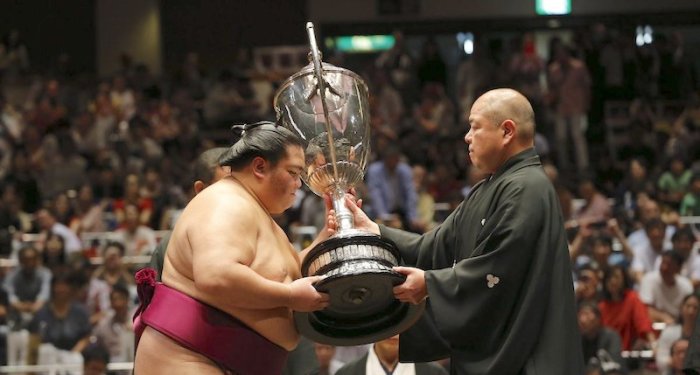
Several awards were presented to Asanoyama – who received instructions on how to collect them, shortly before the ceremony – by no one else than Donald Trump. Has the US president handed several rewards to our next yokozuna ? We will see.
Newly promoted ozeki Asanoyama Hideki
Anyway, another rikishi became an ozeki shortly after winning a yusho in may – namely Terunofuji. Back in 2015, the then man in form benefitted from heya mate Harumafuji’s help to leapfrog Hakuho on quest of the Emperor’s Cup. He was promoted to sport’s second highest rank before July.
Finally, how not to mention Kyokutenho’s unlikely yusho, back in 2012 ? After a slow start – he was 2-3, the Mongolian benefitted from an incredible drop of form of the upper ranks, most notably Kisenosato, who blew up a two win lead after day 11. It all ended with a nervous playoff against Tochiozan.
Nagoya basho : holding its own
Yokozuna record in Nagoya is pretty good. From 2008 to 2017 included, only Hakuho and Harumafuji (twice as an ozeki) have won it.
I wouldn’t call Nagoya a fortress, though, as the 2018 basho was the first one in a while to be a “nokozuna” : Kisenosato did not compete, while Hakuho, Kakuryu (and ozeki Tochinoshin) had pulled out by day 6. Sadly, that feat would repeat several times since then – so eventual winner, Mitakeumi, definitely opened Pandora’s box.
Triumphant in Nagoya: Mitakeumi Hisashi
Last year’s winner was yokozuna Kakuryu, who got his sixth – and currently last – yusho.
Aki basho : melting down
Why is Aki basho melting down ? Since 2005, it has notably been won by Asashoryu (thrice), Harumafuji (twice), Kakuryu (once), and, of course, Hakuho (seven times).
However, last editions have had a fair share of drama.
Back in 2015, Kakuryu – the sole yokozuna competing – benefitted from Terunofuji’s first grave knee injury to pip him on the yusho race, although he got dragged into a playoff by the ozeki.
The 2016 edition came as an enormous surprise as Goeido, then a kadoban ozeki, not only won the yusho, but with a zensho yusho ! The runner up, in the process, was crowd favorite Endo.
With a famous stare down : yokozuna Harumafuji (10-2) v ozeki Goeido (12-0), Day 13 of Aki basho 2016
In 2017, right before the infamous scandal that prompted his retirement, Harumafuji recovered from a three (!) loss deficit to Goeido, who himself melted down, before defeating him twice on senshuraku – once in regulation, and once in the ensuing playoff.
If 2018 occurred with a fine share of normality – Hakuho the winner -, how not mentionning the 2019 edition ? Another nokozuna, with endless contenders : Meisei, Tsurugisho, Okinoumi (who could have clinched the whole thing with a different scenario on senshuraku) all got in the process.
Eventually, the basho gave way to an original playoff between both sekiwake : Takakeisho and Mitakeumi, the winner.
Kyushu basho : not quite, but almost a fortress
Calendar year’s last basho could have been called “yokozuna’s second fortress”, had two of the last three editions not be so dramatic.
As already mentioned, the 2017 edition saw Harumafuji’s regrettable scanda land subsequent retirement. Hakuho emerged from chaos, not without providing his share of controversy, as he openly contested the shimpan’s decision of not calling a matta on Yoshikaze’s bout.
Should have stayed longer : yokozuna Harumafuji
Next year’s tournament provided a very rare occurrence of a komosubi win. I twas Takakeisho’s landmark ozeki run, thanks to a fine 13-2 record, with a bit of help of Mitakeumi, who defeated Takayasu on senshuraku. The ozeki could have sealed a place in a playoff, had he not succumbed to pressure.
Haru basho : yokozuna’s last fortress
Chiyotaikai won this basho in 2003, as an ozeki. Hakuho won it in 2007, but as an ozeki (that was the tricky part of this basho’s statistics !). From 2008 (with the 2011 edition having been cancelled), this basho has only been won by yokozuna.
One small exception to that: Kakuryu won it as an ozeki in 2014. To be more exact, following a 14-1 playoff loss in January, Kakuryu’s 14-1 win in Osaka cemented his yokozuna promotion.
One could say that the 2014 edition saw a half yokozuna winning it ! We can’t close our discussion without mentionning the 2017 edition, which saw Kisenosato’s yokozuna debut and only yusho at the top rank, despite sustaining a career ending injury.
It all started so well… Kisenosato began his yokozuna career with a yusho
In a sense, the Ibaraki born contributed to establish Osaka as the last yokozuna’s fortress.
Much to the delight of the sumo world, the Haru Basho was able to go all 15 days without being canceled due to a rikishi contracting COVID-19. Before the start of the tournament, I went on record saying that I thought they would not make it past day 9, but I was thankfully wrong. The stables broke camp in Osaka, and retreated to Tokyo. With the spring jungyo tour canceled, the rikishi have 6 weeks to train, and where needed, heal up. Given the way that Japan in general and the heya specifically work, it is possible to sequester an entire sumo stable, as we saw in Osaka. While this limits the risk of contracting the virus, we can assume the risk is not zero.
But fans are wondering (Team Tachiai including) what the plan is for the remaining 4 tournaments in the 2020 calendar year. We have already witnessed the unprecedented 1 year delay in the summer Olympic Games, scheduled for Tokyo 2020. One indication was the sumo association departing from tradition (Hey, it can happen!) by not putting the Natsu tickets on sale immediately following the conclusion of Haru in Osaka. It would seem that the Japan Sumo Association, along with the rest of the world, do not expect things to be quite back to normal yet in mid May. We think there are a few options that make some degree of sense.
Cancel the remaining tournaments of 2020 – The most drastic action would be to cease public competition. This would allow the NSK to focus on rikishi health and safety, and preserving the talent in place today. New recruits would have a long period of time to train and prepare for their first basho. This would absolutely devastate the association and the stables financially, as it would continue to isolate the supporter groups and fan clubs from interacting (a source of revenue) with the stables. I think this option would be the most unlikely.
Only conduct the 2 remaining Tokyo tournaments – This would allow the stables and the association to eliminate any infection risk from travel to venues in Nagoya and Kumamoto, while still providing sumo to the public. The logistics of picking up the stables and re-homing them in distant cities would eliminated, but the number of tournaments remaining in 2020 would be cut in half. The time between them would pace out to 3½ months each, giving the rikishi a lot of time to train and heal. The net effect would be something that many readers here have expressed a strong desire to see – more time between competition for rest, recovery and improvement. Subsequent tournaments would be conducted under the same rules as Osaka – no public, but ample TV coverage. This would still be a financial blow the the association and the stables, as the sequestration of the rikishi would necessarily continue.
Conduct the remaining 4 tournaments in Tokyo – This would allow the NSK to keep their schedule and their TV commitments, but would remove the logistical need (with its associated risk) of moving the stables to Nagoya and Kumamoto. There would be some impact to those host cities, but it is possible that could be dealt with over subsequent years. This would allow competition to happen every 2 months, and provide a welcome sporting event for the public, who still faces a long summer with no baseball, no soccer and limited activities in nature. The remaining 4 basho would be conducted under the same rules as Osaka – no public, but ample TV coverage. This would still be a financial blow to the association and the stables, as the sequestration of the rikishi would necessarily continue, and there would be no interactions with the supporting groups and fan clubs that are a source of much needed money for the stables.
What are your thoughts? Please feel free to chime in in the comments.
Together with Asanoyama’s Ozeki promotion, the new sekitori have been announced. As expected, there are 3 promotions from Makushita to Juryo: Ms3e Asabenkei (6-1), Ms3w Fujiazuma (5-2), and Ms4e Chiyonoo (5-2). None are young rising stars—they are between 28 and 32 years old, all have been in the paid ranks before, and the last two have been in Makuuchi.
The corresponding demotions are not announced, but it’s easy to guess that going down to Makushita are J10 Yago (4-11), J12 Asagyokusei (5-10), and J13 Tomokaze (0-0-15). Missing out on promotion due to lack of available slots is Ms2w Kotodaigo (4-3).