Are we really in the dark ages of sumo?

Last week I looked at the 2024 yusho year and tried to situate it historically through focusing on the wins and rank of the yusho winner. I concluded by observing 2024 continued a trend beginning in 2019 of below-average win totals and a below-average rank of the champion. Some responded that I was being negative about the quality of sumo. Similarly, some said the metric is only useful for making assertions about dominance, not quality.

What I commented under that post, I repeat here: I was not attempting to be negative about the current state of sumo. Anything I write about Makuuchi division sumo is written with the understanding I am writing about the 40 or so best athletes in their sport. Every other month we are treated to the 40 best men in the world competing against one another. What other sport can say that? We are spoiled.

As for the critique of dominance versus quality: it is accurate…to a point. I don’t think it is unreasonable to assert a Yokozuna is a qualitatively better rikishi than a komusubi. I feel pretty confident that 14 wins is qualitatively better than 12 wins. If I had the choice between watching a year 6 komusubi yusho with 12 wins or 6 yokozuna yusho with 14 wins; I’d take the latter. In 2024, we basically saw the former.

So is the current state of sumo so bleak? No.

A shortcoming of the championship quality metric is the built-in dominance factor: it does not consider anyone else but the champion. Is there a way to evaluate the competitiveness of a basho, or an entire year of basho?

A simple way would be to compare the difference between the amount of wins between the yusho winner and the runner up. We could call this yusho differential: yusho wins minus jun-yusho wins=yusho differential. A small yusho differential (YD) would seem to indicate a more competitive yusho since it would mean the winner and runner-up had a similar number of wins. I am arguing that a 13-3 (Y)-12-3(JY) is more competitive than a 15-0(Y)-12-3(JY).

In a yusho year we would expect a YD close to 6 since the champion usually has at least one more win than the runner up. In fact, plotting the YD since 1958 this is what we see:

Most years, the YD ends up at 8 (12 times), closely followed by 9 (10 times) and 7 (9 times). So, a YD of 7 to 9 is average and indicates the champion winning 1 or 2 more matches than the runner up. Anything below this 7-9 range would indicate a more competitive basho and a higher total would indicate a less competitive basho.

Evaluating basho years this way, 1997 was clearly the most competitive ever with a YD of 2. Playoffs decided 4 of the basho that year: highlighted by March when there was a 4-way playoff! At the other end of the spectrum, 1984 and 2013 saw the champion outpace the runner up by 15 wins. 2013 may have been exciting for fans of Hakuho and Harumafuji, but probably not so much for others.

How did 2024 stack up in this measure of competitiveness? With the help of 2 playoffs, the YD for 2024 was 5. And believe it or not, this year was the third consecutive year with a YD of 5. We have had 3 consecutive years of basho with multiple playoffs (two in ’22 and ‘24; and three in ‘23). The YD metric indicates we are in a very competitive- some might even say, exciting- era of sumo! The past three years have been very competitive with yusho frequently coming down to the final matches of day 15. The only span of 3+ years that can equal this level of competitiveness was 1997-2001:

Year YD
1997 2
1998 8
1999 4
2000 6
2001 4

Numbers don’t tell the whole story. Numbers will never tell us which Shodai is going to show up any given Tuesday. But numbers can help us tell a better story. Considering yusho-differential helps us appreciate the competitiveness of the past several years- one of the most competitive time periods in recent history. The lack of dominant yokozuna/ozeki performances have made way for closer yusho races.  What excitement will 2025 bring?
2024: The Yusho Year in Review

Ozeki Kotozakura made good on his potential and wrapped up 2024 with a 14-1 record and his first yusho. In doing so, he became the fourth man to capture a title in 2024: joining Yokozuna Terunofuji in January (13-2) and July (12-3); M17 Takerufuji in March (13-2); and K/S Onosato in May (12-3) and September (13-2). In all those ranks and records we find a way to historically situate a yusho-year.

A basic way to evaluate a year of yusho victories is tallying the number of wins by the champion. Since 1958 (excluding 2011 and 2020 when there were only 5 basho) the average number of wins for the six yusho is 81.5. By that metric, any total greater than 82 wins is above average and anything below 81 is below average.

In 2024 the win total was 77: well below average. Since 1958, only five years saw a lower win total (’61, ‘75, ’99,’22, ’23) while 2 years saw an equal number of wins (’72, ’03).

Another way to gage the strength of each championship is to consider the rank of the champion. We could call this rank-quality (RQ). For RQ I awarded 5 points for every yokozuna championship; 3 for every ozeki; 2 for every sekiwake; and one for every komosubi. For every maegashira championship I subtracted the rank value of the rikishi. In this system, the highest RQ value for one year would be 30: representing a yokozuna (5 points) winning each of the 6 basho.

The RQ for 2024 was -1. Terunofuji’s two wins for 10 points; plus 3 for Onosato’s wins as a komosubi (1 point) and sekiwake (2 points); plus 3 for Kotozakura’s win as an ozeki; minus 17 points for Takerufuji’s win at M17. The average RQ for a basho-year is just under 21.5. Once again, in 2024 the average rank of yusho winners was well below average.

It is now a rather simple exercise to add the annual total of championship wins and the rank quality. The highest possible score in such a system would be 120: this represents a yokozuna winning each basho with a 15-0 record. We might call this a championship quality (CQ) score. The average CQ score since 1958 is 103. The CQ score for 2024 was 76: 77 wins + -1 RQ. A 76 RQ score basically translates to an M1 winning each basho of the year with 12 or 13 wins. Not exactly compelling sumo.

In short, 2024 continued an era of mediocre yusho years.

2024 was below average for the number of wins and the rank of winners. This has been the case every year since 2019. The average number of wins in a year is 81.5. The average rank quality is 21.5. The average sum of these numbers- the championship quality- is 103. Since 2019 numbers look like this:

Year Wins (81.5) Rank quality (21.5)

Championship quality (103)

2019

80 11

91

2020

66

-24

42

2021

80

19

99

2022

74

-3

71

2023

74

18

92

2024

77

-1

76


Again, in 2020 there were only 5 basho, so that year’s totals are not considered in the averages. Even so, every year since 2019 has been below average in every metric.  This is not only a six year lull; it is an historical 6 year lull. The 74 wins in 2022 and again in 2023 represent the lowest total for any year since 1958. The rank quality of -3 in 2022 is the worst for any year of the six-basho era. The -1 RQ of 2024 is only “bettered” (ehhh…worsened?) by the -2 RQ of 1991. The 71 CQ of 2022 and 76 CQ of 2024 are the worst 2 scores of any year.

There has never been a span of yusho as weak as 2019-2024. 1972-1976 and 1998-2003 had similar lulls. But in both periods, there were at least some categories that were average to above average.

Year

Wins (81.5) Rank quality (21.5)

Championship quality (103)

1972

77 3

80

1973

84

26

110

1974

78

21

99

1975

76

17

93

1976

81 21

102

1998

79 7

86

1999

76

20

96

2001

81 4

85

2001

79

19

98

2002

80 24

104

2003

77

22

99


The championship quality from 2019-2024 has been consistently, completely, and historically below average. When you consider just the rank and record of the yusho winner, 2019-2024 is the worst span of yusho quality in the six basho era.

Will 2025 bring more of the same? There is reason to look forward with hope. If Takerufuji duplicates his success, it will certainly be at a better rank than M17. Onosato is now an ozeki. Kotozakura is fishing for tuna in January. Any basho won by these men in 2025 will improve the RQ and CQ score for the year. Hopefully they (and others!) can push each other to greater heights. Even if those “greater heights” only represent a return to normalcy.

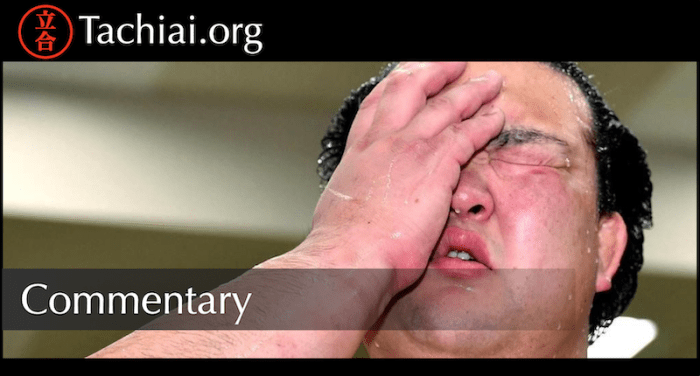
Commentary: Sumo Video Take Down, again

This morning we got a gut shot for English-speaking sumo fans as news comes from Jason that he received a copyright strike from Abema. He and other YouTube channels and streams face increasingly aggressive action from Abema now, as well as the NHK. It may not be a coincidence that this is occurring during “the rise of AI.” As I’ve said a few times on the blog and on Twitter, AI is not about intelligence and decision-making, it’s about automation. Just as the music companies employed bots to find their content on YouTube, I would not be surprised at all if AI bots are being used to find things like Abema’s logo and such on videos throughout the service.

My son’s a soccer fan and while a lot of Liga MX content is available on Univision, much more content required a $50/mo Fubo service for TuDN. So when searching for Mexican soccer streams, it was funny to see how many streams on YouTube and Twitch were tilted at a 45 degree angle, cropped slightly, or had images/stickers overlaying the video to avoid detection. I am not sure if that’s the direction sumo streams will go – I’m sure similar gimmicks to avoid detection would work for a while. But like with Mexican soccer, it will only be a matter of time before they caught up, and that was before AI. More creative methods will require more work and more effort from the streamer.

Why am I bringing up Mexican soccer? It’s because people think sumo fans are under attack but my point is that this is a much wider crackdown on copyrighted content and now it’s aided by the best AI tools. It’s not just sumo, folks. My son and I would be watching these Chivas games streamed at a 45-degree angle but they were still getting shut down over, and over. As a fan of Pachuca, it became untenable to watch anything. And that’s something as obscure as Liga MX. Premier League, Bundesliga, La Liga, NFL, NHL, etc…many sports have been going through this. Sumo is not alone.

Face it, many of the big name streaming services are so far losing money hand-over-fist. Paramount, for example, is under discussions to sell. Netflix has far fewer movies than it used to and it’s impossible to find a platform with Bond movies. But anyway, back to sports. In the end, the Mexican soccer fans finally got an alright, affordable streaming service in Vix. Sumo fans are getting a pretty good streaming service from the NHK.

As I’ve said before, if the sumo fan community is going to insist on leading the pirate life and getting everything for free, we’re going to get ignored as far as content goes. I seriously cannot put up with Taylor Swift and the NFL and all of this other mainstream crap that people are apparently throwing money at. Why do you think TV is full of pharma and political ads? It’s because people are spending money on medicine and throwing money at Biden and Trump like it’s the end of the world. There were serious ads about “restless leg syndrome,” for Christ’s sake.

Services go to where markets demonstrate their strength. Konishiki’s tour is an awesome opportunity, as are sumo tournaments, like those in Texas. We have to keep it up!

Anyway, I’m all for people keeping their money in their pockets. But where people spend money, businesses are willing to spring up and take it. The Kyokai is no different as we see whenever Shibatayama oyakata is on TV…usually with some curry or something in hand. When we financially support these services, we will get more attention and more content. Spend money on fun stuff and stuff you enjoy.

I hope the streamers can work something out with the channels like Abema and NHK. There is a massive “value add” in providing content for a new audience in another language. Maybe they would be open to an MOU or something? I just hope there’s a path toward cooperation that benefits everyone. The sumo world relies on the support it receives from its fans. And more and more of those fans are from foreign countries so I am confident that the Kyokai, NHK and Abema will be open to providing more content. Until then, I guess we’ll need to see how things play out.

The Destruction of Sumo Fan Media

With the Haru basho hurtling toward us, its time for me to speak up about the actions of the Japan Sumo Association to dismantle sumo fan media following the Hatsu basho. If you had not heard, all of the sumo bigs: Kintamayama, Jason and Natto, were removed from YouTube, and their content erased. In the case of Jason and Kintamayama, that catalog of old videos went back over a decade, and represented a remarkable time capsule. All of it cast away and removed.

I am well aware that in legal terms, the NSK and NHK were well within their rights to do this. They owned the content that these creators were using to create their own content. Their take down and removal was completely legitimate and technically correct, and being technically correct can count for a lot in Japan.

But gone forever are “font day”, Jason hollering “He got him!”, and a swarm of other elements that drew many of us to the sport to begin with. For quite a lot of us, it was Jason or Kintamayama that made it possible for us to become sumo fans at all. For the longest time it was nearly impossible to enjoy sumo in the rest of the world, until these modern day scions of Prometheus took their own time and initiative to re-broadcast matches via video sharing.

Personally speaking, I made daily use of all three sources for creating write ups of highlights and previews. I can’t tell you how valuable it is to have Kintamayama’s digest, Natto’s graphics, or Jason’s commentary when I assembled content for this blog. Gone – all gone. I would at times, while writing previews, seek out videos of earlier matches, Jason’s was always the first choice, and if not his channel, Kintamayama’s. That whole “Mock Basho” during COVID was built around my ability to look at prior match ups between the rikishi and take a guess how the play by play could be modified to match the results created by the GSB team.

But yes, the NSK and NHK had the rights to take it down. But should they have done it?

For myself, I have multiple ways to watch sumo in real time and time shifted. I should be able to continue coverage much like I have in the past, but it will be more difficult and time consuming. But then again, I am a bit of a sumo “Super fan” with the resources to spend to make it possible. For the casual fan, they may find themselves starved of content, and foreign enthusiasm for Japan’s national sport may fade. As I have always said, sumo is a Japanese sport produced for Japanese speaking Japanese people living in Japan. Maybe this move was to shore up that reality, or maybe it was just short sighted attempt to maintain control over their rightful ownership of content. Either way, the sumo fan base lost valuable assets, and we are all a bit worse off for their actions.